
AI in Education Examples: What’s Actually Happening in Indian Schools Right Now
Your students are already competing against AI. The question isn’t whether AI will change education in India. It’s whether you’ll help shape that change or get left behind.
Let’s be honest: most Indian educators haven’t seen real AI in education examples yet. They’ve heard the buzz. They’ve read the headlines. But they haven’t watched it work in a classroom down the street. That changes today. Here are the actual, happening-right-now ways Indian schools are using AI in 2026.
Key Takeaways
- AI in education examples India now includes adaptive learning platforms that adjust question difficulty to each student’s performance.
- Automated grading tools can scan answers and return feedback quickly, freeing teachers for actual instruction.
- Some tools explain concepts in Hindi and regional languages, which helps students outside English-medium settings.
- AI works best as a teaching assistant; teachers still decide what and how students learn.
- A reliable computer makes it much easier to try these tools than a shared phone.
Real AI in Education Examples From Indian Classrooms
Delhi-based schools are using AI-powered adaptive learning platforms that adjust difficulty based on student performance. A student struggles with quadratic equations? The system doesn’t just flag it. It generates new problems at the right difficulty level, explains concepts in Hindi or regional languages, and tracks exactly where the learning gap is. This isn’t theoretical. This is running in classrooms today.
Bangalore tuition centers are deploying AI classroom tools India teachers use to automate grading. Teachers upload answer sheets. The system scans, evaluates, and provides feedback in minutes instead of hours. One teacher told us she recovered 8 hours per week. That’s time she now spends on actual instruction, not paperwork.
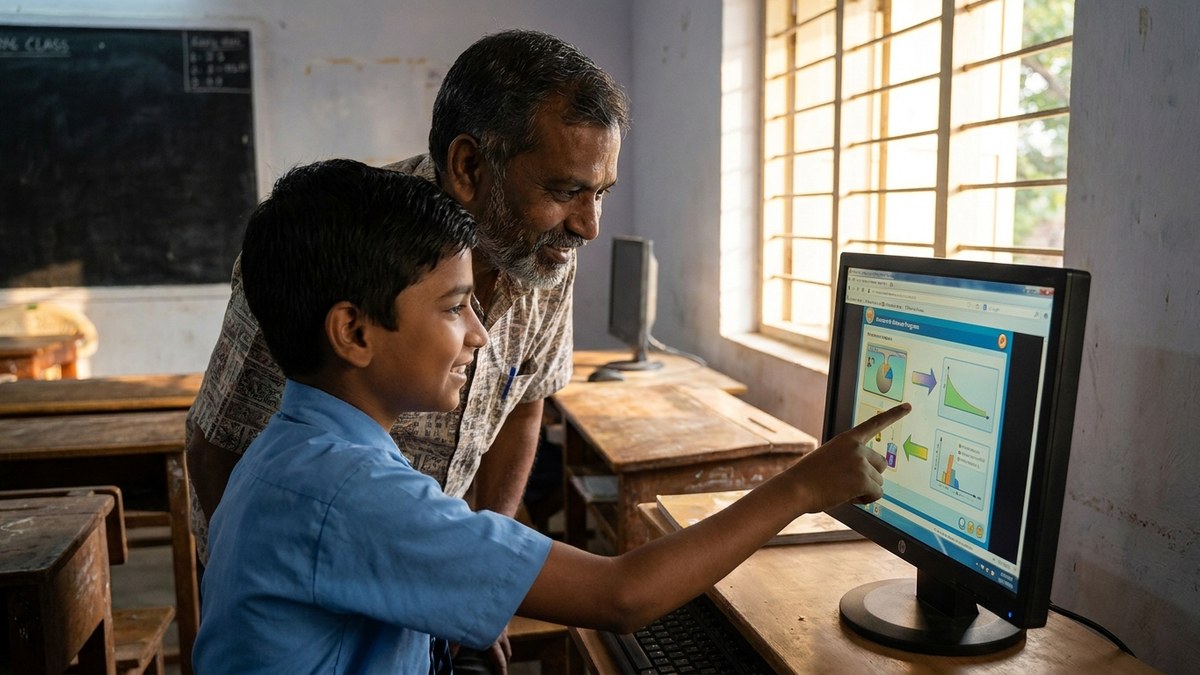
Mumbai’s private schools are experimenting with AI tutoring bots that answer student questions 24/7. A student at 9 PM needs help with chemistry. Instead of waiting for their tuition teacher, they chat with an AI that explains concepts, works through problems, and knows when to escalate to a human. The bot learns from each interaction. It gets better at explaining what this specific student needs.
Here’s the truth: AI in education examples aren’t just in fancy private institutions. PODs (Points of Digital Learning) in smaller towns are using affordable AI tools to compete with big coaching centers. A trained educator running a community learning centre can now offer personalized learning paths that would have cost 10x more five years ago.
AI Classroom Tools India Teachers Are Actually Using
Let’s move past the hype and talk specifics. What AI classroom tools India teachers are deploying right now:
- Personalized learning platforms that adapt content difficulty in real-time. These aren’t new. But they’re getting smarter and cheaper.
- Automated assessment systems that grade essays, MCQs, and subjective answers. Some use image recognition to evaluate handwritten work.
- Student performance analytics that predict who will struggle before they actually do. Teachers get alerts. They intervene early.
- Multilingual AI tutors that teach in English, Hindi, Tamil, Telugu, and other Indian languages.
- Attendance and engagement tracking that uses computer vision to monitor classroom participation.
Most people don’t realise that many of these tools are now government-backed. The DIKSHA platform, supported by the Ministry of Education website, is integrating AI features for personalized learning paths. Teachers can access these for free or at minimal cost.
Why Indian Schools Are Adopting AI So Fast in 2026
Three reasons are driving adoption:
First, the teacher shortage is real. India needs millions more educators. AI doesn’t replace teachers. It multiplies their impact. One teacher with AI support can personalize learning for 100 students instead of 30.
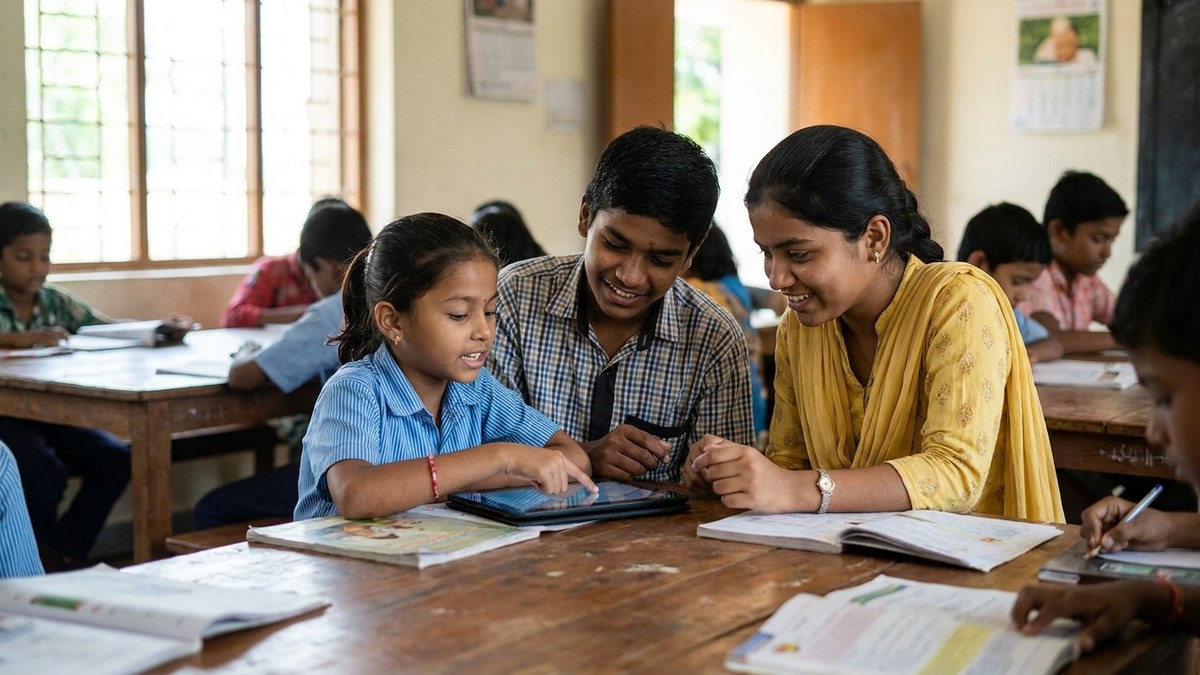
Second, equity demands it. A student in a village shouldn’t get worse education than one in Delhi. AI tutoring is the same quality whether you’re in Gurgaon or Guwahati. Check out resources on AI for inclusive education to understand how this works for students with learning differences too.
Third, parents expect it now. They’ve seen what AI can do. They’re asking schools why their kids aren’t getting personalized learning. Schools that don’t adapt will lose enrollment.
The Real Barriers (And How to Overcome Them)
Here’s what’s actually stopping adoption of AI in Indian schools:
Infrastructure. Many schools don’t have reliable internet or devices. This is solvable. A basic setup like APNA PC (Mini PC i3 7th Gen, 8GB RAM, 128GB SSD, monitor, keyboard, mouse, webcam, headset with 3-year warranty and installation) costs Rs.30,000 and runs most AI education software smoothly.
Teacher resistance. Teachers fear AI will replace them. Wrong. AI handles repetitive work. Teachers focus on mentoring, motivation, and critical thinking. The best teachers in 2026 will be the ones who master AI tools.
Data privacy concerns. Valid. But the government is setting standards. UNESCO education programme guidelines are shaping how student data is protected in AI systems.
What This Means for You as a Teacher or Edupreneur
If you run a tuition center or POD, you need to understand AI in education examples because your competitors already do. The question isn’t whether to adopt AI. It’s when and how.
Start small. Pick one AI tool. Use it for one subject or class. Learn it deeply. Then expand. Visit the Apni Pathshala blog for practical guides on implementation.
The teachers and edupreneurs who win in the next three years will be those who see AI not as a threat but as a force multiplier. They’ll use it to give every student the attention they deserve. They’ll recover hours spent on admin work and redirect that energy to actual teaching.
AI in education examples are no longer theoretical. They’re happening in classrooms across India right now. The question is: will you be part of that movement, or will you watch from the sidelines?
Frequently Asked Questions About Ai in education examples india
What are examples of AI in education in India?
Common examples include adaptive practice platforms, automated answer-sheet grading, AI doubt-solving chatbots and tools that explain topics in regional languages. Schools and tuition centres use them to personalise practice and reduce paperwork.
How can teachers use AI in the classroom?
Teachers can use AI to draft lesson plans, create practice questions, mark objective answers and spot topics where students struggle. The teacher should always review the output before using it with students.
Will AI replace teachers in India?
No, AI handles repetitive tasks like marking and practice generation, but it cannot build trust, motivate students or understand a child’s context. Teachers who learn these tools will likely be more effective, not redundant.
Do I need expensive equipment to use AI in teaching?
No, many AI tools run in a web browser on an ordinary computer with internet access. A shared home or centre computer is more comfortable than a phone for planning and reviewing. Start with free tools before paying for anything.
Is AI-generated content in education always accurate?
No, AI can make mistakes or give outdated answers, so always check against NCERT or your syllabus. Treat it as a first draft. Verify facts, formulas and examples before sharing them with students.
NEP 2020 recognises the role of technology, including artificial intelligence, in improving learning, assessment and teacher support.