Your child sits alone at a desk, staring at a math problem for 20 minutes. Stuck. Frustrated. Meanwhile, three streets away, another student cracks the same problem in five minutes by explaining it to a friend.
Here’s the truth: peer learning groups for students aren’t just nice-to-have. They’re the difference between struggling silently and actually understanding concepts. In 2026, as Indian education becomes increasingly digital, the students who collaborate will outpace those who don’t.
Let’s be honest. Most people don’t realise that student study groups India are reshaping how learning happens. Not just in metro cities, but in tier-2 and tier-3 towns too. The collaborative learning benefits are backed by solid learning research. When students teach each other, retention jumps. Confidence builds. Questions get answered without waiting for a teacher’s availability.
Why Peer Learning Groups Actually Work
When your child explains a concept to a classmate, something magical happens. They cement their own understanding. They discover gaps in their knowledge. They learn patience and communication. These aren’t soft skills that sound nice on paper. They’re survival skills for competitive exams and real-world problem-solving.
Think about how you learned to cook. Did you read a recipe alone, or did someone show you while you watched and asked questions? Peer learning groups for students work the same way. Active participation beats passive consumption every single time.
- Faster concept clarity: When a friend explains something, they use language you actually understand. Not textbook jargon.
- Reduced exam anxiety: Studying with peers normalises doubt. Everyone struggles sometimes. That’s okay.
- Better retention: Teaching reinforces learning. Students who explain concepts remember them longer.
- Accountability: You can’t skip a group session without letting your friends down. Self-discipline builds naturally.
- Diverse problem-solving approaches: Each student brings different thinking styles. More approaches mean better solutions.
Making Peer Learning Groups Work in Your Community
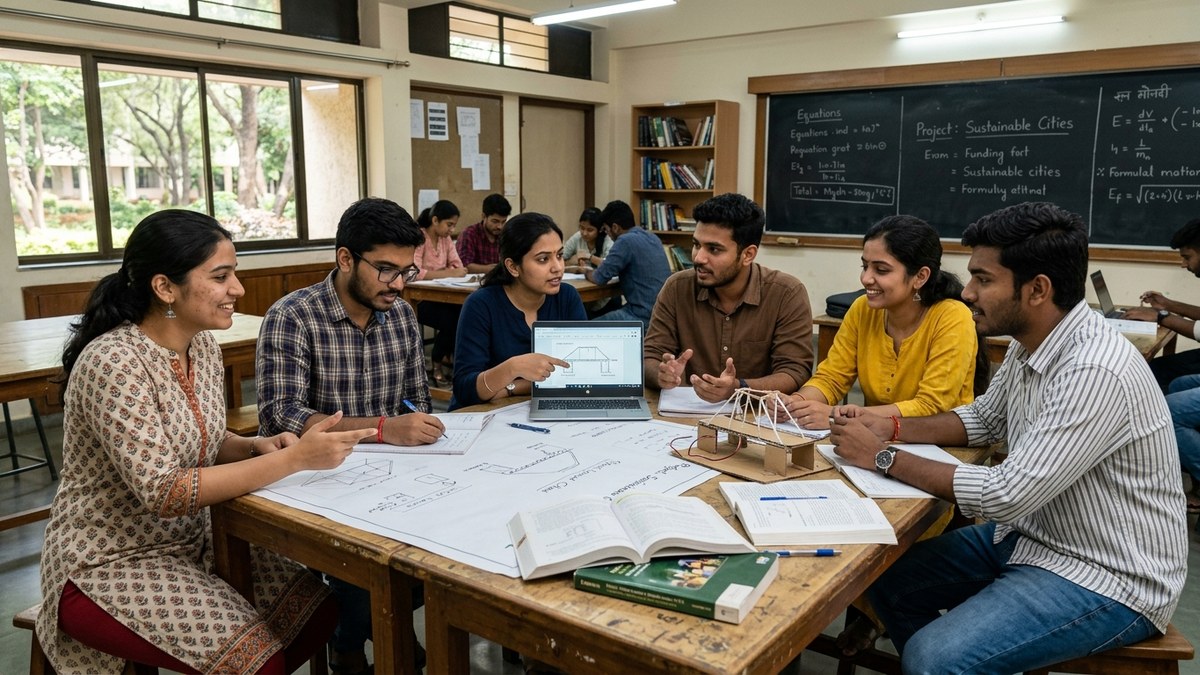
Not every study group succeeds. Some dissolve into gossip sessions. Others become dominated by one or two students. Here’s what separates effective student study groups India from the chaotic ones:
Set clear goals. “We’re meeting to understand chapter 5 of physics” beats “let’s study together sometime.”
Limit group size. Four to five students is ideal. Larger groups fragment into side conversations.
Rotate leadership. Different students lead different sessions. Everyone gets responsibility.
Have a facilitator. This could be a tuition teacher, an experienced parent, or a trained community educator running a Point of Digital Learning (POD). A POD is a home or community learning centre run by a trained educator where students gather for structured collaborative sessions.
The collaborative learning benefits multiply when you add digital tools. Imagine students in a POD using APNA PC to access DIKSHA digital learning platform together. They watch a concept video, pause, discuss in their peer group, then solve problems collaboratively. That’s 2026 learning.

Most people don’t realise that APNA PC makes this possible. Rs.30,000 complete bundle. Mini PC i3 7th Gen, 8GB RAM, 128GB SSD, monitor, keyboard, mouse, webcam, headset. Three-year warranty. Installation included. That’s one device that can serve an entire peer learning group. Connect it to a projector. Five students watch together. Discuss together. Learn together.
Running a POD with peer learning groups means you can help weak students catch up without singling them out. They learn alongside peers at similar levels. Confidence returns. Progress accelerates.
If you’re a tuition teacher thinking about scaling your impact, peer learning groups are your answer. Check out our tuition teacher website guide to market your group sessions effectively.
The bottom line: Solo studying is dying. Peer learning groups for students are the future. In 2026, the question won’t be “Does your child study?” It’ll be “Does your child study with others?”
Ready to build something real in your community? Start a Teach to Earn learning POD today. Combine peer learning groups with digital tools. Watch your students (and your impact) grow.