
Most families are no longer debating whether children should use AI. That part is already decided by school reality, peer pressure, and daily homework deadlines. The real question inside homes is different: how do we use AI in a way that saves time without weakening understanding? Many parents tell me the same thing. Their child now completes assignments faster, but when asked a basic follow-up question, confidence drops. The child is not lazy, and the parent is not old-fashioned. Both are reacting to a study process that has become output-first instead of learning-first. If this sounds familiar, you are not alone. The good news is that families can fix this without banning technology, without shouting, and without creating new tension every evening. What works is a simple routine, clear roles, and short checkpoints that protect thinking.
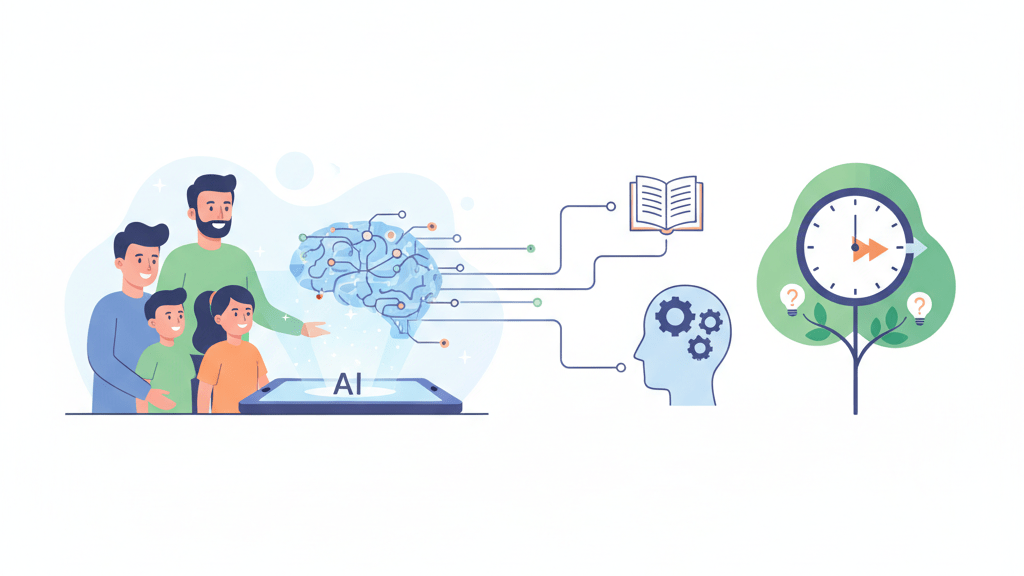
Parent (Anita): I need help. My son is using AI for everything now. Homework gets done quickly, but I’m not sure he actually understands what he submits.
Mentor (Raghav): You’re noticing something important. AI can improve speed, but speed alone can hide weak recall. Let’s build a structure where AI helps, but your son still thinks, explains, and writes on his own.
Anita: Should I just stop AI on weekdays?
Raghav: A strict ban usually creates resistance. Instead, use sequence. When children know the order of steps, conflict goes down and learning quality goes up.
Anita: What sequence?
Raghav: Three steps. First attempt, AI assist, own expression. Step one is 12 minutes without AI. Step two is targeted AI support for confusion only. Step three is final answer in the child’s own language.
Anita: He says step one wastes time because AI can explain everything in seconds.
Raghav: That first attempt is not wasted. It activates prior knowledge. Without it, the brain becomes passive. With it, AI becomes a comparison tool, not a crutch.
Anita: Can this work in science? He gets stuck in definitions and diagrams.
Raghav: Yes. Before opening AI, ask him to write three quick lines: what the topic is, one thing he remembers, and one doubt he has. Then ask AI only for that doubt. This keeps him mentally present.
Anita: What should I ask after he uses AI?
Raghav: Ask one oral check question: ‘Explain this as if you are teaching your cousin in class 6.’ If he can explain simply, understanding is forming. If he can’t, go back one step.
Anita: We fight most during homework time. I don’t want daily arguments.
Raghav: Replace arguments with visible rules. Put a small note near the study table: 12-minute first attempt, 8-minute AI assist, 10-minute own writing. When rules are visible, parents become coaches, not police.
Anita: What about language subjects? AI gives polished answers and he copies them.
Raghav: For language, use the ‘rewrite challenge.’ Let AI give one version. Then your child must rewrite in simpler words with one personal example. Teachers immediately notice original voice.
Anita: He also uses AI right before tests. Is that okay?
Raghav: Right before tests, reduce generation and increase retrieval. Ask AI for quiz questions, not full answers. Practice recall first, then check mistakes.
Anita: How many subjects should follow this routine?
Raghav: Start with two subjects for one week. Too much change at once fails. Once habit forms, expand gradually.
Anita: What signs show the routine is working?
Raghav: Four signs: less resistance at study time, better oral explanation, fewer blank moments in class tests, and more confidence when asked ‘why’ questions.
Anita: If he gets one poor score, should I remove AI completely?
Raghav: No. One score is feedback, not final judgment. Review the process first: Did he attempt before AI? Did he rewrite in his own words? Did he practice recall? Usually the problem is skipped steps, not the tool.
Anita: He says classmates use AI more aggressively and still get good marks.
Raghav: Short-term marks can be misleading. In board exams and interviews, explanation strength matters. Build durable understanding now; it pays later.
Anita: How should I guide without sounding controlling?
Raghav: Use neutral language. Instead of ‘Don’t copy,’ say ‘Show me your thinking in three lines.’ Instead of ‘You’re dependent,’ say ‘Let’s do first attempt and compare.’ Tone protects trust.
Anita: He gets distracted by endless AI chat threads.
Raghav: Set a prompt budget: maximum three prompts per question. Constraint improves clarity. If prompt three fails, switch to textbook and teacher notes, then return.
Anita: Can we track progress simply?
Raghav: Keep a weekly scorecard with five rows: first attempt done, AI used for doubts, own rewrite completed, oral explanation passed, revision quiz score. Tick marks are enough.
Anita: What should weekends look like?
Raghav: Weekend should be consolidation. Pick one chapter. Do 20-minute recall from memory, 15-minute AI correction, and 15-minute teaching-back session. Teaching-back is powerful.
Anita: He asks AI to generate project files directly. Should that be allowed?
Raghav: Allow AI for structure, not final submission. Let AI suggest outline, references, and checklist. But final script, slides, and speaking points must be his.
Anita: What if school instructions are unclear about AI?
Raghav: Follow a simple home policy: AI can assist understanding, summarization, and practice questions; AI cannot replace final personal expression. This policy works even when school guidelines vary.
Anita: We have limited time in evenings. Is this routine realistic?
Raghav: Yes, because it prevents rework. When children copy without understanding, parents spend extra time before tests fixing basics. A 30-minute structured session today saves many hours later.
Anita: Should I sit with him for every session?
Raghav: Not necessary. Sit for the first 10 minutes only to start correctly. Then check once at the end with one explanation question. This keeps involvement high and stress low.
Anita: He gets anxious when I question him.
Raghav: Then convert checks into collaboration. Say, ‘Teach me this quickly, I forgot this chapter.’ Children respond better when they feel respected, not tested.
Anita: Can AI improve writing quality without making it artificial?
Raghav: Absolutely. Use AI as editor after draft one. Ask for clearer transitions, grammar correction, and simpler wording. But preserve your child’s examples and sentence rhythm.
Anita: What’s one non-negotiable rule I should keep?
Raghav: Non-negotiable: no submission before explanation. If your child cannot explain the answer in plain words, the answer is not ready.
Anita: This already feels calmer than banning and arguing.
Raghav: Exactly. Families don’t need fear-based rules. They need rhythm. When rhythm is clear, AI becomes a study partner, not a replacement brain.
Anita: So the goal is not less AI, but better AI use?
Raghav: Correct. Better sequence, better prompts, better follow-up, better recall. That is how homes protect learning while embracing modern tools.
Anita: Thank you. I can start this tonight.
Raghav: Start small, stay consistent for seven days, and review honestly. You’ll see less stress, clearer thinking, and stronger confidence.
Anita: Sometimes he asks, “Why should I think first when AI can do it faster?”
Raghav: Tell him this: AI can give an answer quickly, but only your own thinking builds exam confidence. In exam halls, children need memory, structure, and calm—not just familiarity with generated text.
Anita: That makes sense. I can explain that without sounding negative about technology.
Raghav: Exactly. We are not anti-AI. We are pro-understanding.
If your home has been stuck between ‘use AI for everything’ and ‘ban AI completely,’ choose the middle path of guided use. Children do better when expectations are specific, short, and repeatable. Parents also feel calmer when they are coaching a process instead of managing daily conflict. f you want a practical setup at home with the right machine, accessories, and support for real study use, visit the APNA PC section here: https://www.teachtoearn.in/apna-pc/. Start with one chapter, one week, and one simple routine. Consistency matters more than perfection. Once children experience that AI can save time and still improve understanding, resistance drops naturally. That is when modern learning actually works: fast where it should be fast, and thoughtful where thinking cannot be outsourced.