
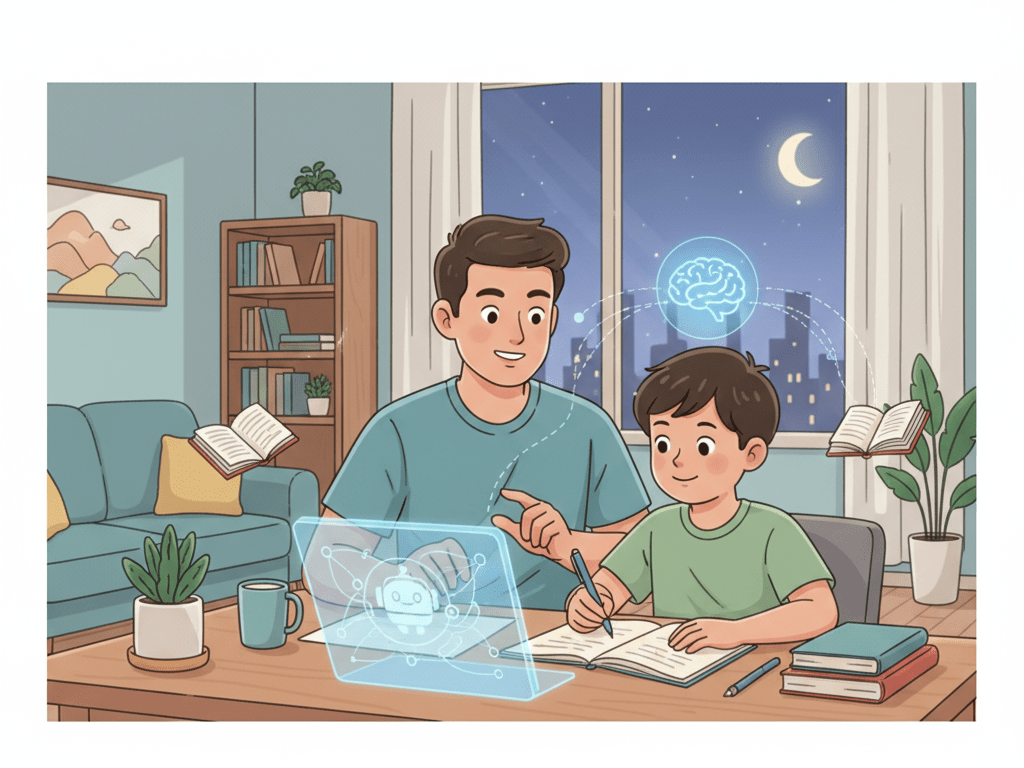
Parents are not against technology anymore. Most have accepted that AI is now part of homework, projects, and everyday learning. The real tension starts when speed goes up but understanding goes down. Children submit faster, yet hesitate when asked to explain basics without a screen. That pattern creates stress at home: parents feel children are taking shortcuts, children feel parents do not understand modern study methods, and both sides get stuck in daily arguments. The good news is that this is not a discipline problem, and it does not need strict bans. It is usually a process problem. When families use a clear routine, AI becomes a support tool rather than a replacement for thinking. The conversation below is designed for regular Indian homes where time is limited, exams still matter, and parents want practical methods that reduce conflict while improving real learning.
Parent (Meera): My daughter finishes homework quickly with AI, but when I ask one follow-up question, she gets blank. I am worried she is memorizing output, not learning.
Mentor (Raghav): Your concern is valid. AI can improve speed, but speed without recall is fragile. The goal is to keep AI in the workflow while protecting thinking, writing, and explanation.
Meera: Should I stop AI on weekdays and allow it only on weekends?
Raghav: That usually backfires. Instead of banning tools, set sequence rules. Sequence creates discipline without daily arguments.
Meera: What sequence should we follow?
Raghav: Use a three-step rule. Step one: first attempt without AI for 12 minutes. Step two: AI support for specific doubts. Step three: own output in your child’s words.
Meera: She says first attempt wastes time because AI can explain everything in seconds.
Raghav: First attempt activates the brain. Without it, children consume answers passively. With it, they compare, correct, and remember.
Meera: How do I make first attempt practical for subjects like science?
Raghav: Ask her to write three lines before opening AI: what the chapter is about, what she thinks the key idea is, and one doubt she cannot solve.
Meera: And if she writes nonsense just to complete the rule?
Raghav: That still helps. Imperfect thinking is better than no thinking. Over days, quality improves if the routine stays consistent.
Meera: Biggest issue at home is copy-paste answers in notebook work.
Raghav: Set a visible family rule: AI text is draft material, not final submission. Final answer must include one personal example and one line of “why this matters.”
Meera: I cannot sit beside her for every assignment.
Raghav: You do not need to. Use a one-minute teach-back after each study block. Ask her to explain one concept aloud as if teaching a younger student.
Meera: I am not confident in many subjects. What do I even evaluate?
Raghav: Evaluate structure, not content depth. Good explanation has definition, logic, example, and one mistake to avoid.
Meera: Math performance has dropped. She understands solved examples but cannot solve fresh questions.
Raghav: Common pattern. Add one blind solve after AI help. She should close solution, then solve a similar question from scratch.
Meera: She gets impatient when she cannot solve quickly.
Raghav: Timebox frustration. Give 6 minutes to struggle, then allow one precise AI query, not a full solution request.
Meera: What is a precise query for math?
Raghav: Something like: “I got stuck at step 3 while simplifying this expression. Show only the next step and explain why.”
Meera: She asks AI broad prompts like “teach me chapter 4” and then says output is too long.
Raghav: Teach prompt discipline. Better prompts are narrow and level-specific: “Explain photosynthesis at Class 8 level in 5 points, then ask me 3 check questions.”
Meera: We also struggle with distractions: notifications, reels, random tab switching.
Raghav: Build a low-friction study environment. Phone away from desk, only required tabs open, one visible task card, and a timer running.
Meera: She says timers increase pressure.
Raghav: Then use gentle timing. Try 25 minutes focus, 5 minutes break. No judgement language, only completion language.
Meera: What is completion language?
Raghav: Instead of “you are behind,” say “one block completed, next small target.” It protects motivation.
Meera: She avoids written practice because typing is faster.
Raghav: Keep a hybrid rule. Digital for discovery, written for consolidation. Every AI-supported topic must end with a handwritten summary or solved set.
Meera: Does writing really matter this much now?
Raghav: Yes. Most exams still reward written recall under time pressure. Typing fluency cannot replace handwritten retrieval stamina.
Meera: How often should she revise with AI quizzes?
Raghav: AI quizzes are useful, but always follow with no-screen recall. Ask her to write key points without looking at notes.
Meera: We start routines, then everything breaks during exam weeks.
Raghav: During exams, simplify routine. Two focused blocks, one mixed revision sheet, one error-log review, and sleep protection.
Meera: Sleep becomes chaotic before exams.
Raghav: Protecting sleep is not luxury; it is memory infrastructure. A tired child reads more pages but retains less.
Meera: Can siblings study together with AI, or does that become noisy?
Raghav: It can work with structure. Shared timer, separate questions, then each child teaches one concept to the other.
Meera: How do I track progress without creating daily pressure?
Raghav: Track five weekly indicators: start-on-time rate, focus blocks completed, teach-back clarity, repeated mistakes, and confidence score.
Meera: Confidence score feels subjective.
Raghav: Subjective is fine when tracked over time. Trend tells you when to adjust before marks drop.
Meera: What do I do when she makes careless errors repeatedly?
Raghav: Use process correction, not character labels. Say: “Let’s find the pattern and fix the method,” not “you are always careless.”
Meera: She compares herself to classmates who use shortcuts and still score.
Raghav: Shortcuts can work briefly. Process wins over a full academic year. Disciplined learners compound quietly.
Meera: If we had to keep just one non-negotiable daily habit, what should it be?
Raghav: One focus block, one teach-back, one written retrieval. This trio improves attention, understanding, and recall together.
Meera: What should parents avoid most?
Raghav: Unpredictable rules. If AI is banned one day and ignored the next, children stop taking boundaries seriously.
Meera: Some days motivation is very low. Should we skip completely?
Raghav: Use recovery mode, not zero mode. Reduce targets, keep the routine alive, and restart momentum in 20 minutes.
Meera: How can we improve prompt quality over time?
Raghav: Keep a small prompt notebook. Save prompts that worked for explanation, practice questions, and revision checks.
Meera: Should parents read every AI response the child gets?
Raghav: No. Audit output quality instead. Ask for one explanation, one application, and one self-correction.
Meera: Self-correction?
Raghav: Ask: “What part of your answer might be weak?” This builds judgment and reduces blind trust in AI text.
Meera: Sometimes she gives up when the first attempt is wrong.
Raghav: Normalize wrong first attempts. Learning quality rises when children see mistakes as data, not proof of inability.
Meera: Any weekend routine you recommend?
Raghav: Weekend is diagnosis day. Clean error log, identify two weak topics, and plan first task for Monday.
Meera: What does a practical error log look like?
Raghav: Keep it tiny: question type, why error happened, corrected method in one line. Small systems survive.
Meera: How do I know AI is helping and not harming?
Raghav: Test transfer. Give a new question from the same concept. If she applies independently, AI helped.
Meera: Final advice for families like ours?
Raghav: Build a routine your child can run on low-energy days without your constant supervision. Independence is the real outcome.
When families shift from control battles to process clarity, study time becomes calmer and outcomes become stronger. You do not need complicated trackers, expensive tools, or all-day supervision. You need a repeatable rhythm: first attempt, focused AI support, own output, and short review. Over a few weeks, this usually reduces arguments, improves homework quality, and builds confidence in difficult subjects. If you want to go deeper, read these practical TeachToEarn guides on building deep work habits at home and building self-study without daily fights. And if you are planning a distraction-aware setup for learning at home, explore the APNA PC section here: https://www.teachtoearn.in/apna-pc/. Keep the system simple, keep the language supportive, and let consistency do the heavy lifting that pressure never can.