
Most families are not failing because children are lazy or parents are careless. They struggle because home learning has no steady rhythm. On some days, everyone is motivated and work gets done. On other days, screens, mood swings, and school pressure derail everything. Then exam week comes and the whole house feels tense. In the AI era, content is no longer the problem. Children can access unlimited explanations in seconds. The real challenge is converting information into disciplined learning habits that actually improve marks, confidence, and independent thinking. Parents don’t need to become strict supervisors or subject experts for this. They need a simple daily system that is clear, realistic, and repeatable. The conversation below breaks this down in practical language for Indian homes where time is limited, expectations are high, and emotional balance matters as much as academic outcomes.
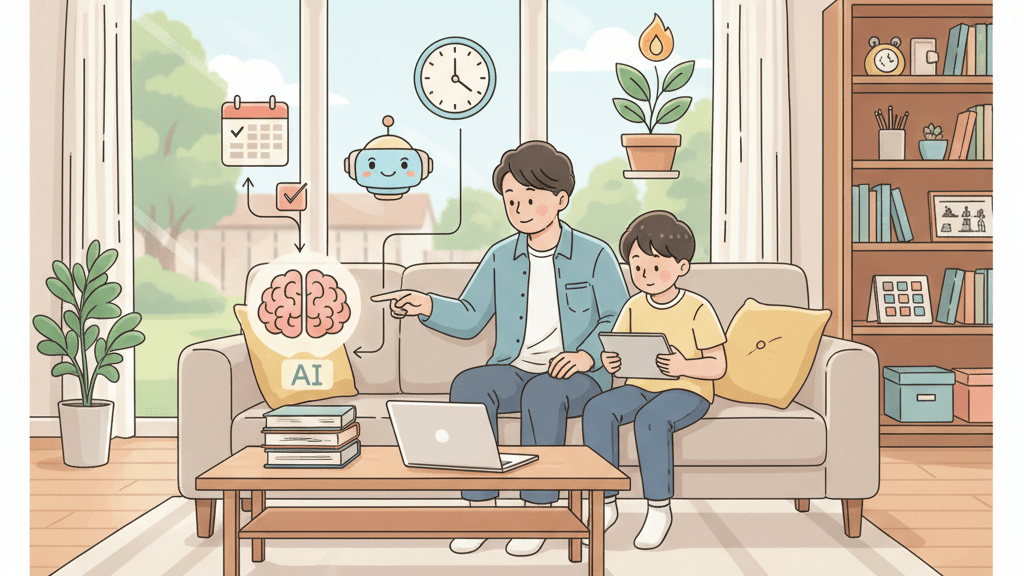
Parent (Meera): We keep telling our son to study, but he only starts when one of us sits next to him. The moment we leave, focus drops. How do we change this?
Mentor (Arjun): That means the learning system is dependency-based. He is studying because of your presence, not because he owns the process. We need to move from supervision to structure.
Meera: What does that look like practically?
Arjun: Start with two daily non-negotiables. First, one concept goal. Second, one practice goal. Make both measurable. For example: “Understand photosynthesis steps” and “solve 10 related questions.” Vague goals create delay; clear goals create action.
Meera: We tried targets before. He agrees, then gets distracted by notifications and random videos.
Arjun: Distraction is rarely solved by motivation alone. It is solved by environment design. During study block, use airplane mode or app lock, one-tab rule on laptop, and keep only required material visible. Attention follows design.
Meera: We force long sessions because we feel short sessions are not serious enough.
Arjun: Long sessions often create fake productivity. Begin with 30 minutes focus + 5 minutes break, repeat twice. For older students, go to 40 + 10. Short focused cycles improve completion, and completion builds confidence.
Meera: He reads chapters and says “I understood,” but tests show basic mistakes.
Arjun: Because recognition is not recall. Reading feels like understanding, but exam performance requires retrieval under pressure. Add a 90-second teach-back after every concept.
Meera: Teach-back as in explaining to us?
Arjun: Yes. Ask him to explain as if teaching a younger child. Then ask two questions: “Where can this be applied?” and “What’s the most common mistake?” If he can answer both, understanding is stronger.
Meera: I am not strong in science. I worry I’ll ask wrong questions.
Arjun: Parents don’t need perfect subject knowledge. Your role is process coaching. You track routine, ask clarity questions, and keep the emotional climate stable. That matters more than solving every question yourself.
Meera: What about AI tools? He uses them, but often just copy-pastes answers.
Arjun: Set AI boundaries at home. Allowed: simplify difficult concepts, generate extra practice, review mistakes. Not allowed: writing full homework, solving mock tests end-to-end, or replacing revision.
Meera: How do we enforce this without daily conflict?
Arjun: Add one family rule: “AI support must be followed by your own output.” That output can be a handwritten summary, a solved example, or a spoken explanation. No output, no credit.
Meera: We also struggle with consistency. Two good days, then the routine collapses.
Arjun: Don’t chase perfect weeks. Build a minimum viable routine. Even on busy days, keep one concept block and one practice block alive. Momentum matters more than intensity.
Meera: Exam pressure changes everything. We become anxious, and then he becomes defensive.
Arjun: That’s common. Parents’ anxiety gets transferred through tone. Replace fear language like “You’ll fail” with process language like “Let’s fix one weak area now.” Calm tone improves effort quality.
Meera: Should we track progress daily?
Arjun: Daily interrogation creates fatigue. Do a short evening check-in: What did you learn? Where did you get stuck? What is tomorrow’s first task? Keep it under seven minutes.
Meera: What metrics should we track weekly?
Arjun: Five simple indicators: study attendance, concept clarity, practice completion, error correction speed, and confidence level. These reveal progress before marks do.
Meera: He keeps avoiding difficult chapters and repeats easy topics.
Arjun: Use challenge sandwich. Start with one easy task for momentum, then one hard concept while energy is high, and end with moderate practice. This reduces avoidance behavior.
Meera: Can peer learning help? He studies better with friends sometimes.
Arjun: Yes, if structure is clear. Small study pods work when each session has a target, timer, and output. Without structure, group study becomes social time.
Meera: What output should each pod session produce?
Arjun: One solved worksheet, one teach-back round, and one mistake log. If those three are done, the session was meaningful.
Meera: How do we improve writing quality? He knows answers but writes poorly in exams.
Arjun: Add daily 10-minute expression drills. One definition, one explanation, one application example, and one common error. This gradually improves structured answers.
Meera: Is oral explanation also useful?
Arjun: Very. Oral recall strengthens understanding and confidence. Ask for a one-minute spoken summary after the written drill.
Meera: What about sleep? He sleeps late before tests.
Arjun: That’s a hidden performance killer. Sleep is memory consolidation time. A tired brain takes longer and retains less. Protect sleep as strictly as study time.
Meera: Sometimes we keep comparing him with toppers to push performance.
Arjun: Comparison may create temporary pressure, but it damages long-term motivation. Replace “Who is ahead?” with “What improved since last week?” Growth feedback builds agency.
Meera: We begin every year with enthusiasm but lose rhythm by mid-term.
Arjun: Use monthly reset meetings at home. One hour only. Discuss what worked, what failed, and what should be simplified. Sustainable systems are updated regularly.
Meera: Should rewards be linked to marks?
Arjun: Prefer effort-based rewards: consistency, honest correction, and on-time completion. Marks are lag indicators; habits are lead indicators.
Meera: How do we handle days when child resists everything?
Arjun: Reduce volume, not structure. Keep the smallest possible win: one 20-minute concept block and one short practice set. A small completed day is better than a skipped day.
Meera: Is technology always a distraction, then?
Arjun: Not when the setup is intentional. A distraction-aware digital learning environment can reduce friction and help families maintain discipline with less conflict.
Meera: What is the one principle we should remember every day?
Arjun: Don’t try to control every minute. Build a simple system your child can repeat independently. Repetition builds confidence, and confidence builds long-term academic strength.
If families want lasting academic improvement, they must stop treating study as a daily emergency and start treating it as a repeatable process. The biggest win is not just better marks next month; it is raising children who can plan their work, stay focused, recover from mistakes, and use AI responsibly without becoming dependent on it. That shift happens through small daily actions: clear goals, short focused blocks, teach-back, writing practice, and emotionally calm parent support. Over time, these habits compound and become self-driven discipline. For families looking for a distraction-aware setup that supports structured routines and guided AI learning at home, explore APNA PC here: https://www.teachtoearn.in/apna-pc/. Keep the system simple, keep expectations clear, and keep the routine steady. In an AI-first world, consistency is the real advantage.
—