
Most parents today are not short of intention; they are short of a practical system. They care deeply, spend money on tuition, arrange resources, and still end each day feeling that learning is not really improving. In many homes, effort has become noisy: repeated reminders, emotional pressure before tests, rushed homework completion, and scattered digital usage that looks like study but behaves like distraction. Children are not always resisting learning—they are often reacting to unclear structure. When expectations are vague, routine breaks. When routine breaks, confidence drops. The good news is that deep learning can be built at home without becoming strict, fearful, or exhausting. What helps is a calm rhythm: clear daily outcomes, short focus cycles, teach-back conversations, and responsible AI support. The dialogue below is for families who want strong academic growth and emotional balance together.
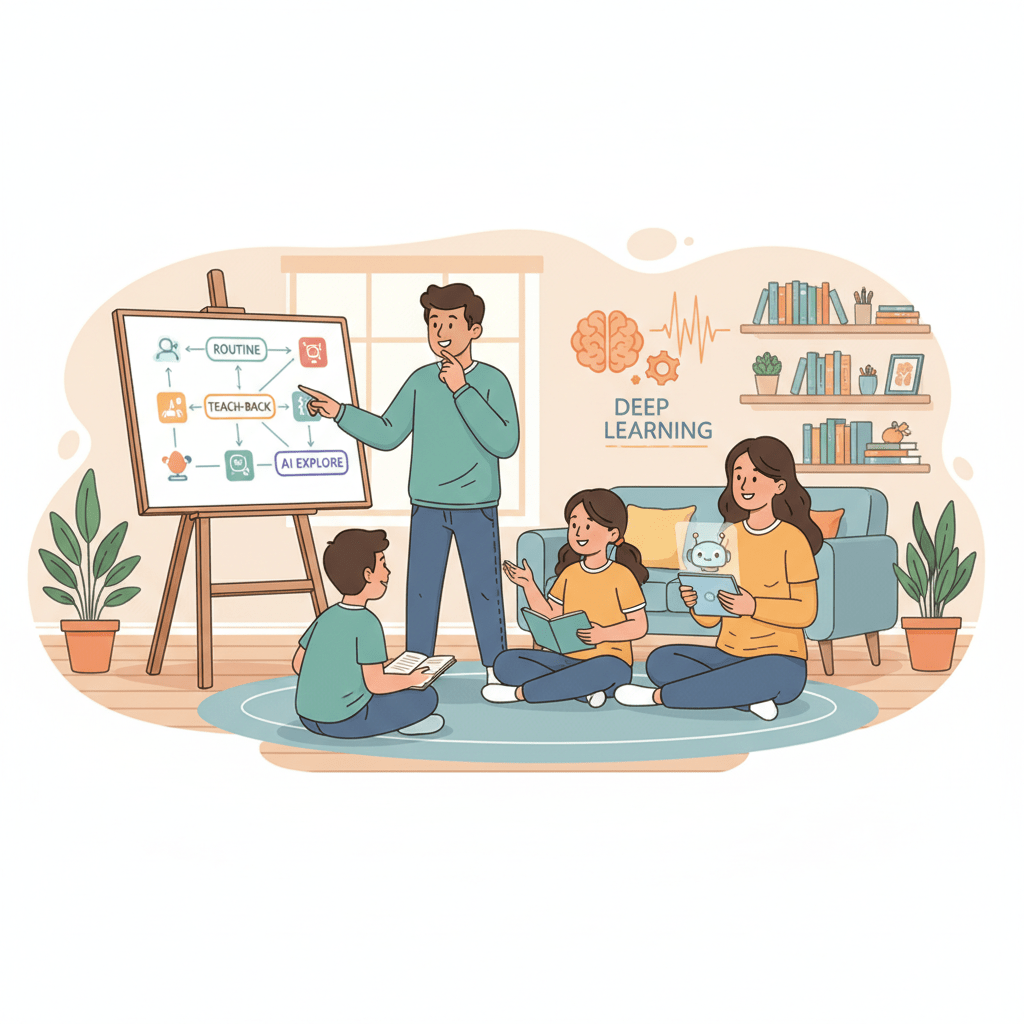
Parent (Riya): We are putting in effort every day, but my daughter still studies only when we stand next to her. The moment we step away, focus drops. How do we fix this?
Mentor (Arjun): That usually means motivation is external, not internal. When learning depends on supervision, consistency breaks quickly. Start by shifting from ‘finish this now’ to ‘own this target today.’ Give one clear daily outcome in each subject: for example, one concept mastered and one practice set completed. Children cooperate better with clarity than with repeated reminders.
Riya: We tried targets. She says yes, then gets distracted by phone notifications, chats, and random videos.
Arjun: Distraction is not just a discipline issue; it is an environment design issue. If study and entertainment share the same digital space, attention keeps switching. Create a dedicated study mode: notifications off, one-tab rule, app blockers during focus blocks, and fixed break windows. Also, begin each block with a micro-goal written in one line: ‘Today I will solve 8 fraction problems without hints.’ A written target keeps the brain anchored.
Riya: How long should one study block be? We force one hour and it becomes a fight.
Arjun: Use shorter cycles. Start with 25 minutes focus + 5 minutes break. Repeat twice, then take a longer break. This format reduces resistance and improves completion. Long forced sessions create mental fatigue and fake productivity. Small wins build momentum, and momentum builds confidence.
Riya: She reads chapters, underlines everything, but cannot explain in tests. Where is the gap?
Arjun: The gap is between recognition and recall. Reading can feel like understanding, but test performance needs retrieval. Add a teach-back ritual after every concept: ask her to explain the topic in 60–90 seconds as if teaching a younger student. Then ask two follow-ups: ‘Where does this apply?’ and ‘What mistake happens most often?’ If she can answer those, understanding is real.
Riya: Do parents need subject knowledge for this? I’m not confident in math and science.
Arjun: You don’t need to be a subject expert. You need to be a process coach. Your role is to ask clarity questions, track routines, and keep emotional stability at home. Let teachers, books, and tools deliver content. Parents should protect consistency.
Riya: What is the best way to use AI tools? She either copies from AI or keeps asking it for every small answer.
Arjun: Use AI as a learning assistant, not a replacement brain. Set three allowed uses: simplify concepts, generate practice questions, and review mistakes. Set three not-allowed uses: writing full homework answers, solving entire tests, and replacing revision. After every AI explanation, ask for handwritten summary and one self-created example. Without this output, AI becomes passive consumption.
Riya: That sounds good, but we still get emotional meltdowns before exams.
Arjun: Because exam week exposes weak routines from previous weeks. Build weekly structure now: Monday to Friday for concept + practice, Saturday for correction of weak areas, Sunday for light revision and planning. During exam month, reduce new topics and increase retrieval practice. Calm preparation prevents panic.
Riya: How do we track progress without making home feel like a coaching center?
Arjun: Keep a tiny family dashboard with five indicators: attendance to study blocks, concept clarity score (self-rated), practice completion, error correction speed, and confidence level. Review once a week in 10 minutes. Avoid daily interrogation. Progress conversations should feel supportive, not investigative.
Riya: Sometimes she compares herself with toppers and loses confidence.
Arjun: Comparison is one of the fastest motivation killers. Replace ‘Who is ahead?’ with ‘What improved from last week?’ Improvement-based feedback builds agency. Tell her: ‘We are measuring growth, not competition noise.’ This keeps identity stable even when marks fluctuate.
Riya: What about sleep and physical activity? We are sacrificing both for more study time.
Arjun: That backfires. Memory consolidation depends heavily on sleep. A child sleeping late and waking tired may spend double time for half output. Protect sleep, hydration, and short physical movement daily. A sharper brain studies faster, so health is actually an academic strategy.
Riya: Can digital tools really help long-term, or do they always become distractions eventually?
Arjun: Digital tools help when the system is intentional. Use a dedicated learning setup, not random mixed-device usage. For many families, a structured environment like APNA PC helps because it reduces noise, supports focused learning flow, and makes guidance easier for parents without micromanagement. Technology should reduce friction, not add it.
Riya: We also struggle with writing quality. She knows answers but writes poorly in exams.
Arjun: Add expression drills. After concept study, do 10-minute written responses: one definition, one explanation, one applied example. Then self-check for structure: opening line, key logic, and conclusion sentence. Repeated short writing drills improve exam output dramatically over time.
Riya: How often should we meet teachers or mentors?
Arjun: Don’t wait for report cards. Schedule a short check-in every 3–4 weeks focused on one question: ‘What is the biggest learning bottleneck right now?’ Then align home routine with that input. Consistent low-intensity correction is better than last-minute heavy intervention.
Riya: At times she studies, but avoids difficult chapters and keeps doing easy ones. What should we do?
Arjun: Use a ‘challenge sandwich’ strategy: begin with one easy task for momentum, then one difficult concept while energy is high, then return to moderate practice. This reduces avoidance and helps children build tolerance for cognitive discomfort, which is essential for real growth.
Riya: How can we make revision less boring?
Arjun: Rotate methods: quick oral recap, flashcards, mixed problem sets, and one mini-test under timer. Variety improves engagement while preserving rigor. The key is not entertainment; the key is active recall in different formats.
Riya: What is your advice for parents who become anxious and transfer that anxiety to children?
Arjun: Use language discipline at home. Replace panic lines like ‘You will fail’ with process lines like ‘Let’s fix one weak area today.’ Children borrow emotional tone from parents. Calm coaching improves performance faster than fear-based pressure.
Riya: This gives me hope. What is the one line I should remember daily?
Arjun: Learning improves when home changes from pressure zone to process zone. If your system is clear, calm, and consistent, marks become a lagging indicator of better habits—not a daily source of fear.
Deep learning at home is not created by longer hours; it is created by better structure. When children know what to do, when to do it, how to check understanding, and how to recover from mistakes, confidence begins to rise naturally. Parents do not need to become strict supervisors or subject experts. They need to become calm system-builders: protect routine, ask clear questions, encourage reflection, and celebrate improvement. If you want practical references, read these TeachToEarn posts: How Families Can Build Strong Study Discipline Without Burnout and How Parents Can Help Kids Learn Better in the AI Era. For families looking for a focused digital setup that supports distraction-aware study routines, guided AI usage, and measurable learning progress, visit APNA PC: https://www.teachtoearn.in/apna-pc/. The long-term goal is not just better marks in the next test; it is helping children become independent, thoughtful learners who can adapt in an AI-shaped world with confidence and clarity.
Parent (Riya): If we follow this for three months, what should we realistically expect?
Mentor (Arjun): Expect three visible outcomes: better attention span during study blocks, better quality answers in written tests, and fewer emotional breakdowns before exams. Marks may not jump overnight, but conceptual strength and self-confidence rise first, and marks follow. Think of this as compounding—small daily discipline creates large long-term outcomes. Keep the family culture steady, and your child will not only score better but also learn how to learn, which is the most valuable skill for school, career, and life.