
Most families don’t struggle because children are unwilling to learn; they struggle because revision at home feels random, emotional, and tiring. One day the child studies for two hours, the next day nothing moves, and by exam week everyone is frustrated. In the AI era, quick answers are easy to get, but long-term memory and exam confidence still come from a repeatable revision system. Parents often feel trapped between two extremes: either strict pressure that creates resistance, or loose freedom that creates inconsistency. The middle path is practical. You can build calm, disciplined revision habits without becoming a full-time supervisor. It starts with clear daily targets, short focus cycles, retrieval-based checks, and family language that supports effort instead of fear. The conversation below is built for real homes, real schedules, and real student behavior.
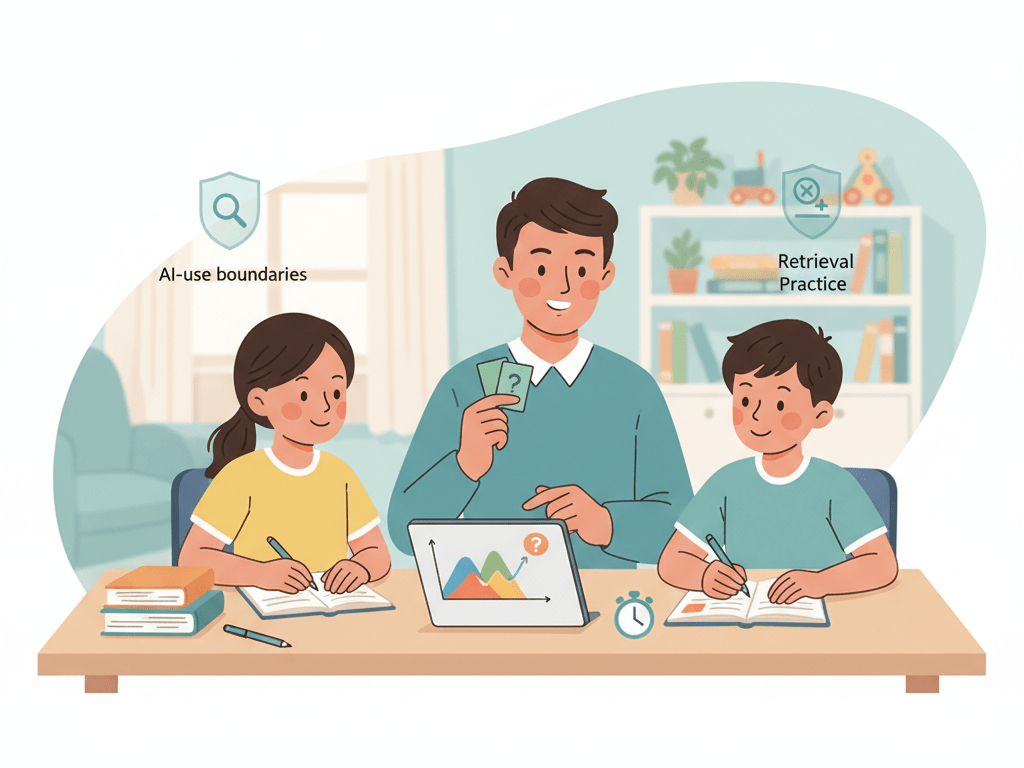
Parent (Neha): We keep saying revision is important, but my daughter only revises when tests are very close. How do we fix this?
Mentor (Arjun): Don’t begin with motivation talks. Begin with a revision structure that repeats every day. Motivation comes and goes; structure stays.
Neha: What should that structure look like?
Arjun: Keep it simple: one concept recall block, one question-solving block, and one correction block. Three blocks, clear outputs, no confusion.
Neha: We usually just ask her to “revise chapter 4.” Is that too vague?
Arjun: Exactly. “Revise chapter 4” feels big and undefined. Instead, write specific tasks: “Recall 5 key ideas from chapter 4,” “Solve 10 mixed questions,” and “Correct 3 old mistakes.”
Neha: She says rereading is revision. But scores don’t improve much.
Arjun: Rereading creates familiarity, not durable memory. Revision should be retrieval-heavy. Close the book and recall first; open the book only to verify and fill gaps.
Neha: How much time should one block be?
Arjun: For middle school, use 25 minutes focus + 5 minutes break. For older students, 35 + 7 works well. Keep the cycle stable; don’t chase marathon sessions daily.
Neha: We lose time because she keeps switching topics whenever one feels hard.
Arjun: Use a one-block-one-topic rule. Topic switching feels productive but weakens depth. Finish a block before switching.
Neha: She gets distracted by phone notifications and random tabs.
Arjun: Then design environment first: phone outside study zone, one-tab rule, and only needed books on desk. Attention follows environment design more than willpower.
Neha: Should I sit with her the entire time?
Arjun: No, that creates supervision dependency. Do short checkpoints: start check, mid-cycle check, and end review. Let her own the work in between.
Neha: We also argue about what to revise first every evening.
Arjun: Remove evening decisions. Plan sequence the night before: easy warm-up task, difficult retrieval task, then moderate practice. Decision fatigue kills consistency.
Neha: She says hard topics make her anxious, so she avoids them.
Arjun: Use challenge sandwich: start with one easy win, then do the hard topic while energy is high, finish with moderate work. This reduces avoidance.
Neha: How do I know if revision quality is actually improving?
Arjun: Track five weekly indicators: start-on-time rate, retrieval accuracy, question completion, error-repeat rate, and confidence score (1–5).
Neha: What is retrieval accuracy?
Arjun: If she recalls 10 points without notes and 7 are correct, that’s 70%. Watch this trend weekly; it predicts exam improvement better than total hours.
Neha: We made an error notebook before, but it became huge and she stopped using it.
Arjun: Keep a tiny error log with only three lines per mistake: error type, cause, corrected method. Small logs get used; giant logs get abandoned.
Neha: She uses AI tools for explanations. Sometimes useful, sometimes copy-paste.
Arjun: Set a family rule: AI support only after own attempt. Own attempt can be a rough answer, a diagram, or a 60-second verbal explanation.
Neha: She says own attempt wastes time if AI can give perfect answers.
Arjun: Perfect answers don’t build exam stamina. The brain needs struggle, correction, and retrieval to retain. AI should accelerate learning, not replace thinking.
Neha: During exam month, tension rises and our language gets harsh.
Arjun: Shift from fear language to process language. Instead of “You’re behind,” say “Let’s fix one weak area in this block.” Calm wording protects performance.
Neha: What should a typical weekday revision session look like?
Arjun: Example: Block 1 retrieval from yesterday, Block 2 problem-solving from current chapter, Block 3 error correction + tomorrow’s first task note. Total around 90 minutes with breaks.
Neha: And weekends?
Arjun: Weekends are for consolidation. Do one mixed-topic test, one deep correction review, and one weekly planning reset.
Neha: She forgets formulas quickly. Any practical method?
Arjun: Use spaced micro-revision: 5-minute formula recall daily, then every third day application questions. Memory improves when recall and application are paired.
Neha: In language subjects, she knows content but writes weak answers.
Arjun: Add a daily 10-minute expression drill: one definition, one explanation, one example, one common error. Writing quality improves through repeated concise expression.
Neha: Should speaking practice be included?
Arjun: Definitely. One-minute oral summary before writing helps organize thoughts and boosts confidence.
Neha: Sometimes she has low-energy days and refuses long sessions.
Arjun: Keep a minimum day protocol: one 20-minute retrieval block and one short practice set. Reduce volume, never remove structure.
Neha: We compare her with cousins, and it always backfires.
Arjun: Replace social comparison with self-comparison: this week vs last week. Growth feedback builds ownership and lowers resistance.
Neha: Can grandparents help positively?
Arjun: Yes, if roles are clear. Ask them to listen to one short teach-back daily. That creates support without extra pressure.
Neha: How quickly can we expect visible change?
Arjun: Usually 10–14 days for smoother starts, 4–6 weeks for stable revision habit, and 6–8 weeks for noticeable test confidence gains.
Neha: What if we miss two or three days due to travel or events?
Arjun: Use recovery protocol, not guilt. Restart with two focused blocks, one correction review, and next-day plan. Recovery speed matters more than perfect streaks.
Neha: One final rule I should remember as a parent?
Arjun: Don’t try to control every minute. Build a repeatable revision rhythm your child can run independently even when motivation is low.
When parents ask for better marks, what they usually need first is better revision design. The goal is not to make children sit longer; it is to help them remember better, apply faster, and panic less in exams. Small systems make a big difference: clear block-wise targets, retrieval before rereading, short error logs, and calm review conversations at night. If your home routine feels inconsistent right now, don’t restart with a complicated plan. Start with one repeatable cycle and improve it weekly. You can also read these recent posts for practical family study frameworks: How Parents Can Build Deep Work Habits for Students at Home ? and How Parents Can Build Self-Study Without Daily Fights?. If you want students to build stronger digital learning habits alongside revision, guide them to explore the APNA PC section here: https://www.teachtoearn.in/apna-pc/. Consistency beats intensity, and calm systems beat daily conflict.