
Most parents are not worried that their children are using AI. They are worried about *how* they are using it. In many homes today, homework gets completed faster, but understanding feels thinner. A child can get answers in seconds, yet still struggle to explain the concept in class or solve a similar question in a test. That gap is becoming common. The solution is not banning AI or creating daily fights around screens. The solution is building a simple home process where AI becomes a support tool, not a shortcut machine. When parents shift from monitoring everything to guiding a repeatable study rhythm, children become calmer, more independent, and more confident. The conversation below is designed for exactly this practical reality in Indian homes.
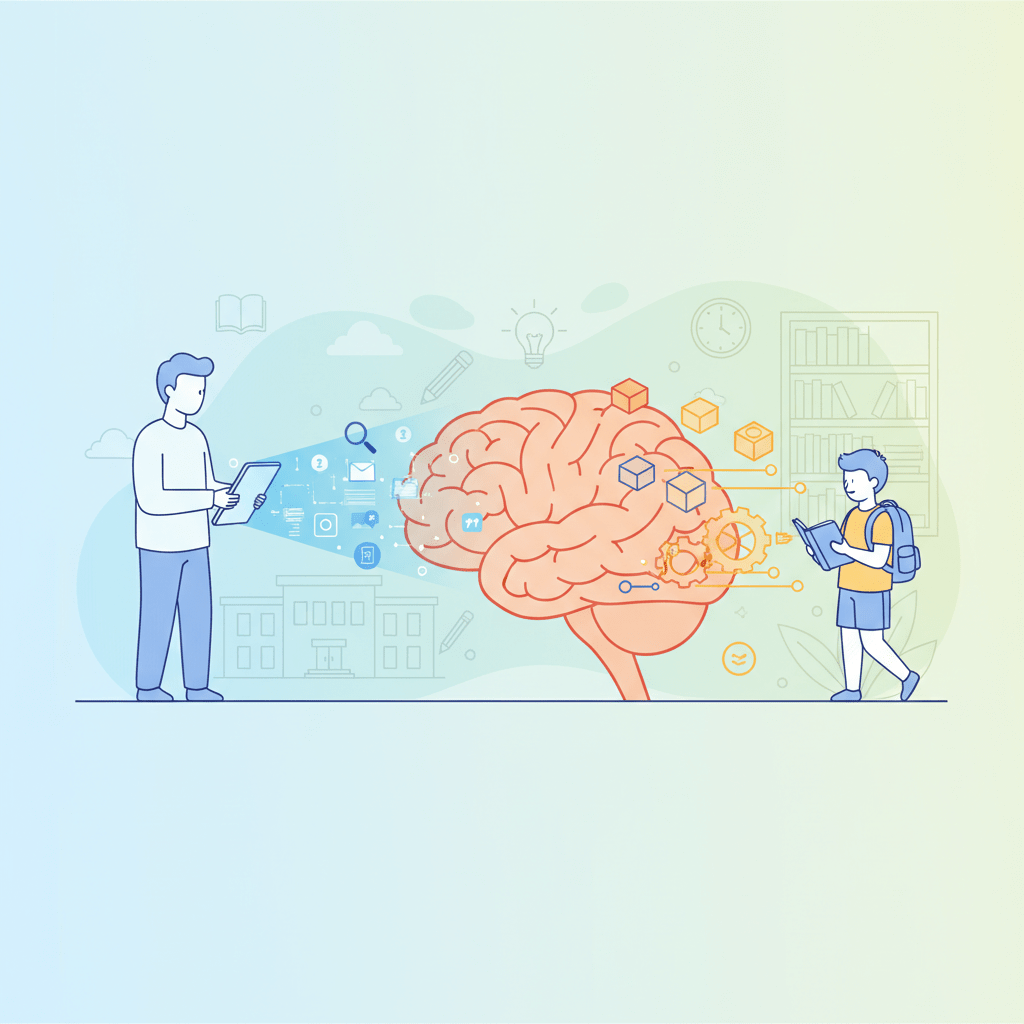
Parent (Nisha): My son says AI helps him finish homework quickly. Marks are okay, but I feel he is not really learning. Am I overthinking?
Mentor (Arjun): You are not overthinking. Fast completion and deep learning are different. AI can improve speed, but unless the child explains, applies, and recalls, the learning remains shallow.
Nisha: So should I stop him from using AI during study time?
Arjun: No. A full ban usually fails and creates resistance. Instead, set clear usage rules. AI should be used in phases: first attempt, then AI support, then own output.
Nisha: What does first attempt mean in practical terms?
Arjun: Before opening AI, he spends 10 to 15 minutes trying the topic himself. He writes what he understood, what confused him, and one specific doubt. Then AI becomes targeted, not random.
Nisha: He says this wastes time when AI can answer immediately.
Arjun: It saves time long-term. Without first attempt, the brain stays passive. With first attempt, the brain compares and corrects, which builds memory and reasoning.
Nisha: Sometimes he copy-pastes AI answers into notebooks.
Arjun: Create a no-copy final rule. AI output is draft material. Final submission must include his own wording, examples, and one personal explanation.
Nisha: How do I check that without sitting beside him all evening?
Arjun: Use the 60-second teach-back. After homework, ask him to explain one concept aloud in one minute. If he can explain clearly, he learned. If not, revisit quickly.
Nisha: What if I don’t understand the subject myself?
Arjun: You do not need subject mastery. Listen for structure: definition, logic, example, and common mistake. If these are present, understanding is usually real.
Nisha: Math is hardest. He gets AI solutions but cannot solve similar problems alone.
Arjun: That happens when students read solved steps passively. For math, require one ‘blind solve’ after AI help: close the solution and solve a parallel question from scratch.
Nisha: He becomes impatient during difficult chapters.
Arjun: Use focus blocks. 30 minutes work, 7 minutes break, then restart. Inside each block, only one subject and one target question set. AI queries only during the last 7-minute window.
Nisha: Why last 7 minutes?
Arjun: It prevents constant context switching. Frequent switching is the biggest hidden reason children feel busy but make slow progress.
Nisha: How can I reduce distraction from reels and notifications?
Arjun: Create a study-mode environment: phone off table, notifications muted, only required tabs open, and one visible task note. Environment design beats repeated scolding.
Nisha: He asks AI broad questions like ‘teach me entire chapter’ and then gets overwhelmed.
Arjun: Teach prompt discipline. Better prompt: ‘Explain photosynthesis in Class 8 level, 5 key points, then quiz me with 3 questions.’ Specific prompts produce useful output.
Nisha: Can AI quizzes replace revision?
Arjun: AI quizzes are good, but revision needs written retrieval. After quiz, he should write key answers without seeing notes. Writing strengthens exam recall.
Nisha: I notice he avoids writing because typing is easier.
Arjun: Use a hybrid rule: learning can begin digitally, but consolidation must include pen-and-paper summary or solved set. Exams are written, so training must include writing.
Nisha: How do I track progress without creating pressure every day?
Arjun: Track five weekly indicators: start-on-time rate, completed focus blocks, teach-back clarity, repeated error count, and confidence score from 1 to 5.
Nisha: Confidence score sounds subjective.
Arjun: Subjective is okay when tracked over time. Trend matters. If confidence drops for two weeks, adjust method before marks fall.
Nisha: What should I say when he makes careless mistakes?
Arjun: Use correction language, not blame language. Say: ‘Let’s identify pattern and fix process,’ instead of ‘You always do this.’ Process language keeps the child engaged.
Nisha: Can siblings study together using AI, or does that become distracting?
Arjun: Group study can work if structured. Set one shared goal, one timer, and one output. At the end, each child teaches one point to the other.
Nisha: During exams, anxiety increases and all routines collapse.
Arjun: Use minimum viable routine in exam weeks: two focused blocks daily, one mixed revision set, one error-log review, and sleep protection. Consistency beats late-night panic.
Nisha: Sleep is a daily battle before exams.
Arjun: Treat sleep as learning infrastructure. A tired brain reads more and remembers less. Protecting sleep often improves marks faster than adding another hour of weak study.
Nisha: How should we use weekends better?
Arjun: Weekdays are execution. Weekends are diagnosis and planning. Review weak topics, clean the error log, and define next week’s first tasks.
Nisha: What is an error log that children actually maintain?
Arjun: Keep it tiny: Question type, why error happened, corrected method in one line. Three lines per mistake max. Small logs survive, giant templates die.
Nisha: How do I know AI is helping and not hurting?
Arjun: Check transfer. After AI-supported study, ask a fresh question from the same concept. If he applies correctly, AI helped. If he freezes, it was only answer exposure.
Nisha: Sometimes he argues that everyone in class uses AI shortcuts.
Arjun: That is exactly why process-focused students will stand out. In a shortcut culture, disciplined learners gain a compounding advantage.
Nisha: What one rule gives maximum improvement in one month?
Arjun: Daily non-negotiable: one focus block + one teach-back + one written retrieval. This trio upgrades attention, understanding, and recall together.
Nisha: And what should I avoid doing as a parent?
Arjun: Avoid unpredictable rules. Do not ban one day and ignore the next. Children cooperate better with stable systems than emotional enforcement.
Nisha: If one week goes badly, should we reset everything?
Arjun: No full reset. Use recovery mode for three days: smaller targets, quick wins, and on-time starts. Recovery speed is more important than perfect streaks.
Nisha: This sounds manageable. Final principle?
Arjun: Do not build dependence on parent supervision. Build a routine the child can run alone even on low-motivation days. That is real academic maturity in the AI era.
Families do not need complicated systems to make AI useful for children. They need consistent daily structure: first attempt, focused support, own output, and gentle review. When children learn to think before they ask, verify before they submit, and explain before they move on, AI becomes a multiplier for learning instead of a substitute for effort. Over a few weeks, parents usually notice lower conflict, faster homework starts, and stronger confidence in difficult subjects. If you want more practical home-study systems, read this recent TeachToEarn guide and this one as well. For families looking to create a distraction-aware study setup with responsible technology use, explore the APNA PC section here: https://www.teachtoearn.in/apna-pc/. Keep the process simple, repeat it daily, and let consistency do the heavy lifting that pressure never can.