
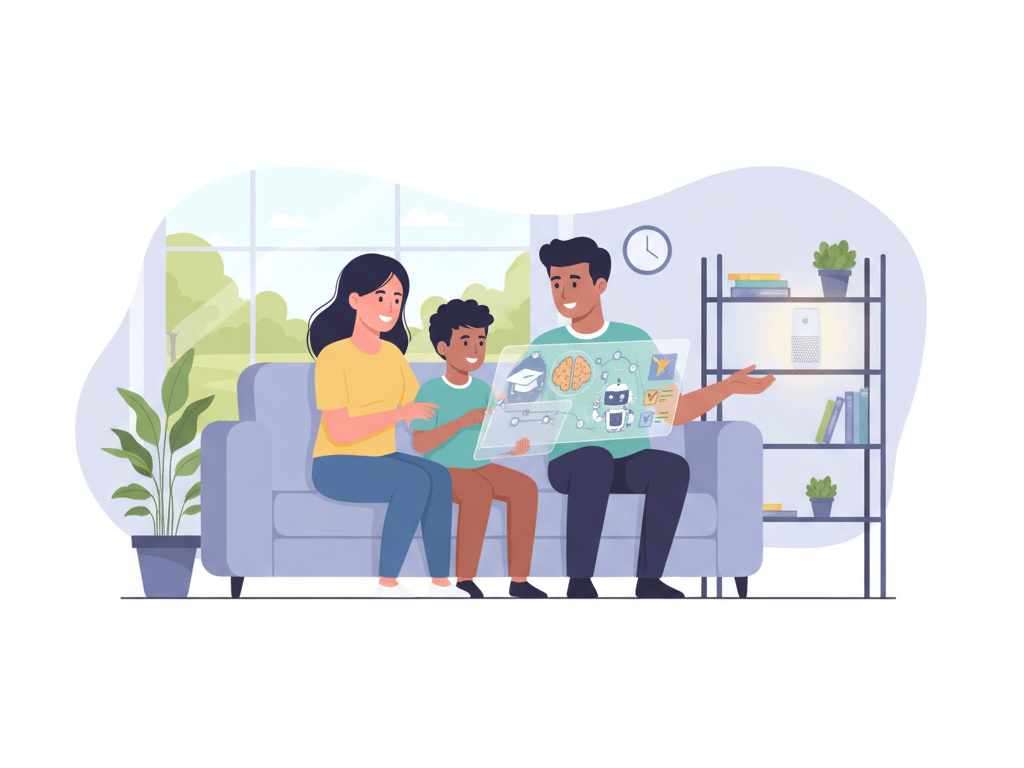
If your home feels like this right now, you are not alone: your child opens AI, homework gets completed in half the time, but exam confidence is still shaky. Parents see quick output, teachers see incomplete understanding, and children feel they are “working hard” but still not improving where it matters most — independent thinking and recall.
The good news is you do not need to ban AI. You need to redesign how it is used. In most homes, the problem is not AI itself. The problem is sequence. AI is being used too early, too broadly, and without a final “prove you learned it” step.
Let’s fix that with a practical routine you can start this week, even if you are busy and not an expert in every subject.
Why AI Homework Feels Productive but Doesn’t Always Build Exam Readiness
Here is what usually happens:
- Child asks AI for full answers immediately
- Copies a polished response into notebook or assignment
- Submission looks complete, but thinking effort stays low
- During tests, child cannot reconstruct the answer under pressure
That gap creates stress for everyone. Parents start monitoring more, children hide usage more, and daily study turns into conflict. If this sounds familiar, do not panic. This is reversible when you make AI a coach after effort, not a shortcut before effort.
The 30-Minute “First Think, Then AI, Then Recall” Routine
Use this simple 3-phase structure for one subject block each day:
Phase 1 (10 minutes): First Attempt Without AI
Ask your child to solve or write from what they currently know. Even if the attempt is incomplete, this activates memory pathways. Wrong attempts are useful data, not failure.
Phase 2 (10 minutes): AI for Targeted Help
Now allow AI, but only for specific doubts. Replace vague prompts like “Explain full chapter” with focused prompts such as:
- “I’m confused between mitosis and meiosis. Explain in a 5-row comparison table for Class 9.”
- “Show only the next step in this algebra problem and tell me why that step is needed.”
- “Give me 3 likely mistakes students make in this topic.”
Phase 3 (10 minutes): No-Screen Recall
Close AI and ask for output in the child’s own words:
- Write a 5-point summary from memory
- Solve one similar question from scratch
- Teach back the concept in 60 seconds
This third phase is where exam confidence is built. Without recall, AI support does not convert into retention.
What Parents Should Check (Without Becoming Full-Time Supervisors)
You do not need deep subject knowledge to track quality. Use this weekly scorecard with just five indicators:
- Start-on-time rate: How often study begins as planned
- Focused blocks completed: Number of uninterrupted 25-minute sessions
- Teach-back clarity: Can your child explain topic structure clearly?
- Repeated error count: Are the same mistakes reducing week to week?
- Confidence score (1–5): Child’s self-rating after each subject block
These indicators show trends before marks do. If confidence drops for two weeks, adjust method early instead of waiting for poor test results.
A Real Example: Turning AI from Copy Tool into Learning Tool
Suppose your daughter has to write a history answer: “Causes of the Revolt of 1857.”
Old pattern: She asks AI for a full 8-mark answer, copies it, and moves on.
New pattern:
- She writes 4 causes from memory first (even if incomplete).
- She asks AI: “What is missing from my 4 causes? Add only points I missed in simple language.”
- She rewrites final answer in her own structure: political, economic, military, social/religious.
- She closes screen and does a 1-minute oral recap to you.
Result: assignment quality stays high, but more importantly, retrieval improves. Over time, this reduces panic in tests because the child has practiced recall, not just reading polished text.
Common Mistakes to Avoid
- “No AI ever” rules: usually create secrecy, not discipline.
- Unlimited AI use: creates dependency and weak recall.
- Parent-only monitoring: is exhausting and unsustainable.
- No writing practice: hurts exam performance in handwritten contexts.
- Long lectures after mistakes: lowers motivation; short process feedback works better.
Use process language at home: “Let’s improve your method,” instead of “You are careless.” This single shift reduces defensiveness and improves learning behavior.
What to Do Now (Do This Today)
What to do now: Run the 30-minute routine tonight for just one subject: 10 min first attempt, 10 min targeted AI help, 10 min no-screen recall.
Where to go/click: Open this practical parent resource and set up your home system: https://www.teachtoearn.in/apna-pc/. Then read one related guide and apply one rule immediately.
Why now: Exam confidence is built daily, not one week before tests. If you implement this routine now, your child gets weeks of compounding practice in focus, understanding, and recall.
Start small, stay consistent, and let the system do the heavy lifting. AI can absolutely help your child learn better — but only when your home routine puts thinking first.