Most classrooms still run on a 19th-century factory model: teacher talks, students copy, exam tests memory, everyone forgets. We call it “Education.” It’s mostly information transfer. But what if students were treated like intelligent adults instead of passive recipients? What if classrooms were built on curiosity, discussion, reasoning, and ownership?
That’s where POGIL — Process Oriented Guided Inquiry Learning — changes the game.
Instead of memorizing answers, students construct understanding.
Instead of being told what to think, they figure it out.
Instead of competing silently, they collaborate actively.
This isn’t a trendy teaching hack. It’s a structural redesign of how learning works — and it aligns perfectly with what the real world actually demands. If you care about raising self-directed, confident, thinking adults (not exam machines), you should care about POGIL.
Q: What is POGIL and why should I care?
POGIL stands for Process Oriented Guided Inquiry Learning. Started in 1994 by chemistry professors who were sick of students memorizing formulas without understanding them, it’s now used in over 1,000 American schools and colleges.
Here’s why it matters: In a POGIL classroom, you’re not a passive recipient of information. You work in small teams, explore data and models, figure out patterns yourself, and build your own understanding. The teacher doesn’t lecture – they facilitate. They ask questions, observe, and guide. You do the intellectual heavy lifting.
Q: How is this different from regular classroom teaching?
In traditional classrooms, the teacher stands at the front, defines terms, explains concepts, and you frantically take notes hoping to remember everything for the exam.
In POGIL, you get a carefully designed activity – maybe data tables, maybe a scenario, maybe a model to interpret. Your team tackles it together. You spot patterns. You argue about what they mean. You form conclusions. The teacher circulates, asks probing questions, but never just hands you the answer.
The learning cycle goes: Explore → Understand → Apply. You’re essentially rediscovering concepts yourself, which means you actually retain them.
Q: What’s this “process skills” thing people keep mentioning?
This is where POGIL gets interesting. It’s not just about learning chemistry or physics or biology. You’re simultaneously developing the skills that actually matter in the real world:
- Critical thinking
- Teamwork and collaboration
- Communication (written and oral)
- Problem-solving
- Information processing
- Metacognition (thinking about how you think)
These aren’t accidental byproducts. They’re built into every POGIL activity through the structure itself and explicit questions like “Explain your reasoning” or “Compare your answer with your team’s and discuss differences.”
Q: Do I have to work in groups? I prefer studying alone.
Yes, you work in teams of 3-4 students. Each person has a specific role that rotates – task manager, recorder, spokesperson, reflector. This isn’t busywork. It’s intentional.
The truth most people won’t tell you: Learning happens through social interaction. When you explain your reasoning to teammates, when you defend your interpretation, when you realize your classmate saw something you missed – that’s when deep understanding forms. You’re negotiating meaning, not just absorbing facts.
Research backs this up. Students in POGIL classrooms show better content mastery AND develop skills that traditional lectures can’t teach.
Q: What does the teacher actually do if they’re not teaching?
They facilitate. They observe. They ask questions at exactly the right moment to nudge your thinking. They identify when your team is stuck and give just enough guidance to get you unstuck without solving the problem for you.
Good POGIL teachers know when to step in and when to let you struggle productively. They create the conditions for learning instead of delivering information.
Q: This sounds like it takes longer than just being told the answer.
It does take more time initially. But here’s what nobody tells you about “efficient” lectures: you forget 90% within a week. You can regurgitate formulas for the exam but can’t apply concepts to new situations.
POGIL students retain what they learn because they constructed that knowledge themselves. One student put it perfectly: “I learned the material better because it was more for me to figure out than the teacher to tell me.”
You’re not optimizing for short-term test performance. You’re building genuine understanding that lasts.
Q: Can POGIL work outside of science classes?
Started in chemistry, but now it’s used across disciplines – computer science, marketing, foreign languages, music theory, even humanities subjects. The learning cycle (explore, understand, apply) works for any content where students need to develop both knowledge and thinking skills.
Q: How does this prepare me for the real world?
No employer cares if you memorized the Krebs cycle. They care if you can:
- Analyze unfamiliar data
- Work effectively in teams
- Communicate your reasoning
- Solve problems you haven’t seen before
- Learn new things independently
POGIL develops exactly these capabilities. You’re practicing being a self-directed learner in a supported environment.
Q: What’s the catch? Why isn’t everyone doing this?
POGIL requires teachers to completely rethink their role. Instead of being the sage on the stage, they become facilitators. That’s uncomfortable for many educators who’ve spent years perfecting lectures.
It also requires carefully designed activities – you can’t just wing it. There’s a whole support structure (The POGIL Project) providing training, materials, and workshops, but it still demands more upfront work from teachers.
The real barrier isn’t pedagogical – it’s institutional inertia and the outdated belief that teaching means telling.
Q: How can I experience POGIL if my school doesn’t use it?
Advocate for it. Show your teachers the research. Point them to pogil.org where they can find training and materials.
Better yet: Apply POGIL principles to your own learning. When studying, don’t just read and memorize. Find models and data to explore. Form study groups where you explain concepts to each other. Ask yourself process questions: “Why does this pattern exist?” “How would this apply to a new situation?” “What’s my reasoning here?”
Become the self-directed learner the education system should have trained you to be from the start.
POGIL treats you like the intelligent, capable person you are. It gives you agency over your learning instead of making you a passive consumer of lectures. That’s what real education looks like.
If You Want Students to Think, Not Just Score
POGIL proves something powerful: When students are trusted with responsibility, they rise to it.
- They become thinkers.
- Communicators.
- Problem-solvers.
- Independent learners.
And here’s the uncomfortable truth:
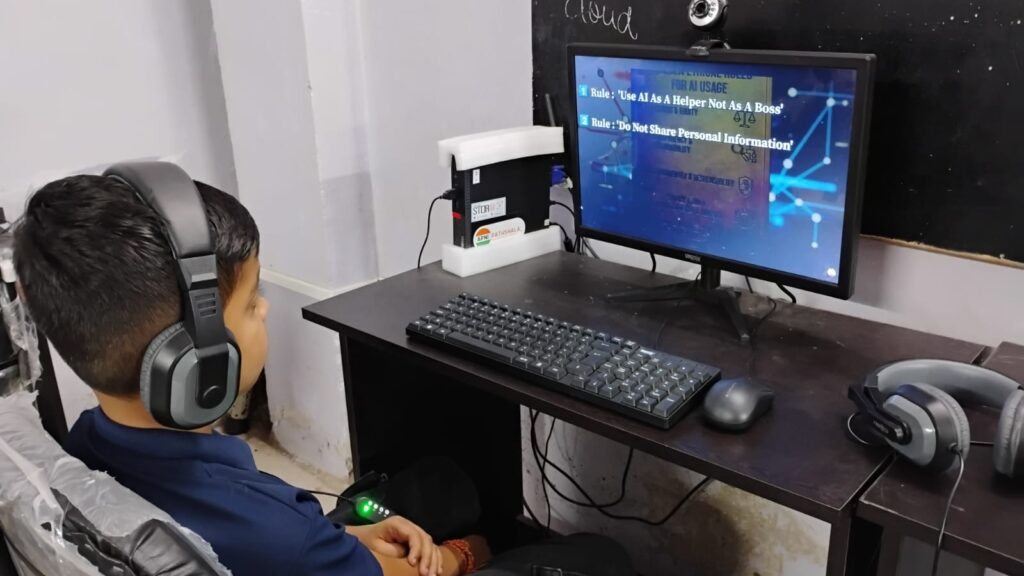
AI tutors are now making content delivery cheap and abundant. The future of education is not better lectures. It’s better thinking. Visit the https://app.jee.eklavya.io/ to indulge the ai learning experience.
If schools want to stay relevant, they must move from “sage on the stage” to “guide on the side.”
From information delivery to intellectual development.
From control to agency.
If you’re a:
- Student — demand classrooms that challenge your brain, not just your memory.
- Teacher — experiment with facilitation over lecturing.
- Parent — choose environments that build capability, not just report-card scores.
- School leader — rethink your model before the world moves on without you.
Real education isn’t about finishing the syllabus. It’s about building minds. And once you see that clearly — you can’t unsee it.
You can start from your home at https://www.teachtoearn.in/start-a-teach-to-earn-learning-pod/