
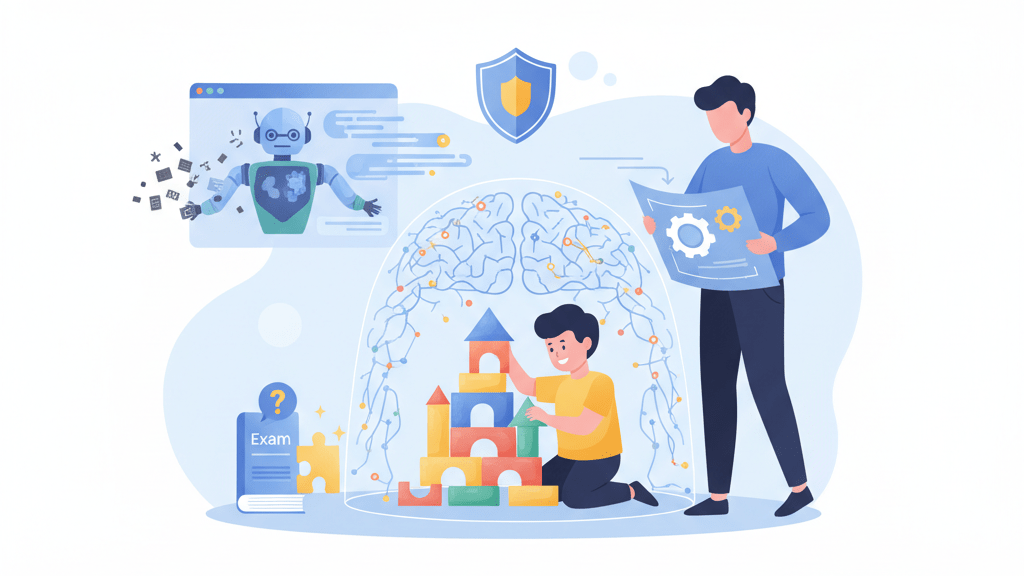
Many parents are noticing a new homework habit at home.
A child gets a question.
They open an AI tool.
They copy the answer.
They paste it into the notebook.
The homework looks perfect. The handwriting is neat. The teacher may even praise it.
But when exam time comes, the child freezes.
Why?
Because copy-paste learning builds beautiful notebooks but weak understanding.
The real goal of homework is not submission.
The real goal is confidence during exams and real understanding of the topic.
The good news is that parents don’t need to ban AI or start daily arguments.
What children need is structure, not scolding.
Here is a simple framework any family can run at home every day.
Rule 1: No Submission Before Explanation
Before a child submits any homework answer, ask them one simple thing:
“Explain it to me.”
If they cannot explain the answer in their own words, the answer is not ready yet.
This rule is powerful because explanation forces the brain to organise knowledge.
You can ask children to explain in any of these simple ways:
- Explain it verbally
- Write 3 lines explaining the logic
- Draw a small diagram
- Teach the concept to you like a teacher
When children know they must explain the answer, copy-paste stops automatically.
Rule 2: AI Is a Draft Tool, Not the Final Answer
AI is not the enemy.
In fact, AI can be a fantastic tutor when used correctly.
But the rule must be clear:
AI can help create the draft.
The final answer must be written in the child’s own voice.
Encourage your child to:
- Read the AI explanation
- Understand the idea
- Rewrite the answer in their own words
This simple habit builds two critical skills:
- comprehension
- expression
In other words, AI becomes a teacher, not a shortcut.
Rule 3: Maximum Three Prompts Per Question
AI can also become a distraction if children keep asking endless questions.
To prevent this, introduce a simple limit:
Maximum 3 prompts per homework question.
If the child still doesn’t understand after three prompts, they must switch to:
- textbook explanation
- class notes
- teacher examples
This rule ensures that AI remains a support tool, not a dependency.
Better AI Prompts Children Should Use
Most children ask AI lazy questions like:
“Give me the answer.”
This leads to passive learning.
Teach children to ask thinking prompts instead.
Here are examples that dramatically improve learning.
Prompt 1 : “I am stuck at this step. Show only the next step and explain why.”
This keeps the child involved in solving the problem.
Prompt 2 : “Explain this concept in 5 points for a class 8 student.”
This simplifies complex explanations.
Prompt 3 : “Ask me 3 quiz questions to test my understanding.”
Now AI becomes a practice partner rather than an answer generator.
Parent Language That Reduces Homework Fights
Most homework conflicts happen because of the words parents use.
Commands trigger resistance.
Better language triggers thinking.
Here are simple examples.
Instead of saying :
“Don’t copy from AI.”
Say
“Show me your thinking in three lines.”
Instead of saying
“You are becoming dependent on AI.”
Say
“Let’s compare your answer with the AI draft.”
Instead of saying
“Did you finish your homework?”
Ask
“What did you understand today?”
This small shift changes homework from compliance to curiosity.
The Real Goal of Homework
Homework is not about filling notebooks.
Homework is about building three skills:
- Understanding concepts
- Explaining ideas clearly
- Solving problems independently
If AI is used correctly, it can actually accelerate learning.
But if it becomes a copy-paste machine, it silently destroys confidence.
The Big Shift Families Must Make
The biggest mistake parents make is policing tools.
But tools will keep changing.
Instead of banning technology, families should focus on learning processes.
When parents move from:
“Stop using AI”
to
“Show me your thinking”
something magical happens.
Homework fights disappear.
Children become more confident.
And learning becomes deeper.
The rule is simple:
Use AI to think better.
Not to avoid thinking.
And when families focus on the process instead of punishment, both stress and dependency drop dramatically — while real learning finally begins.