
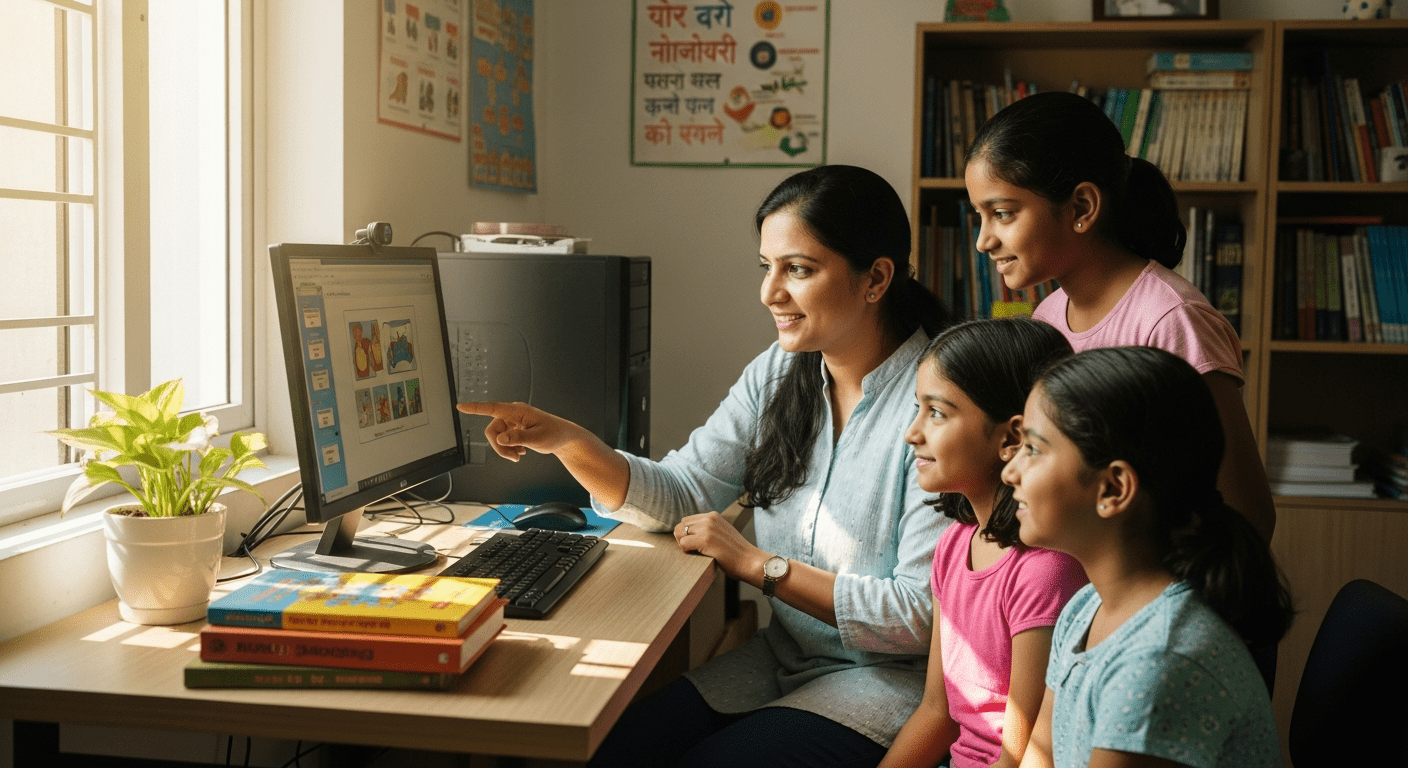
Pratibha has a postgraduate degree in commerce and a quiet house by ten in the morning. Her children are at school. Her husband is at work. For years she told herself the degree was wasted. It wasn’t. The idea of teach to earn from home changed how she saw that empty room and those free hours. Today she guides twelve neighborhood children at a small computer desk, and she earns from it every single month.
She is not an exception. She is what happens when a capable woman gets a clear path and the right tools.
Why So Many Capable Women Stay on the Sidelines
India is full of women who could teach tomorrow morning if someone simply showed them how. Graduates. Former teachers who stopped after marriage. Mothers who help their own kids with homework every night without ever calling it a skill. The talent is sitting in living rooms across the country, unused.
Here’s the truth: the barrier is rarely ability. It’s structure. A woman knows she can teach, but she doesn’t know what to charge, how to find students, or what to actually do for two hours a day. So the idea stays an idea. Building real income for homemakers has never been about talent. It’s about giving that talent a shape it can stand on.
The demand is waiting too. Parents in your own lane are paying for tuition that is overcrowded, inconsistent, or simply too far away. They want someone close, someone they trust, someone who treats their child as more than a fee. That someone could be you.
What Teach to Earn From Home Actually Means
Teach to earn from home is not babysitting with worksheets. It is running a small, structured learning space called a POD. A POD stands for Point of Delivery. Think of it as a micro-school that fits inside one tidy room of your house.
A home learning POD has fixed hours, a simple curriculum, and computers loaded with educational tools. You are not standing at a blackboard pretending to know every subject. You set up the space, keep the schedule steady, and guide children as they work through digital lessons. The software carries the teaching load. You carry the consistency and the care, which is the part no app can replace.
A typical home POD looks like this:
- Eight to fifteen children from your own neighbourhood
- Two short batches a day, one after school and one in the early evening
- A computer or two with learning software already installed
- One reliable adult, you, keeping it all running on time
Global research backs this model. UNESCO global education research shows that consistent, supported learning environments matter more for outcomes than expensive infrastructure. A calm room and a steady routine beat a fancy building with no one paying attention.
The Setup Is Smaller Than You Think
Most women assume this needs lakhs of rupees and a separate shop. It doesn’t. The computer is the heart of the setup, and it has already been built for exactly this purpose.
APNA PC is a complete bundle. You get a mini PC (Intel Core i3 7th Gen, 8GB RAM, 128GB SSD), a monitor, keyboard, mouse, webcam, and headset, all pre-loaded with learning software like Scratch, LibreOffice, Blender, VS Code, and Apni Prerna. The price is ₹30,000 for the full bundle, inclusive of education software, a 3-year warranty, and installation. Start with one unit. Add a second when your batch grows.
If you want to understand what the device includes and why it suits home teaching, the APNA PC affordable computer for learners page lays it out plainly. The Student Safety Software is the detail parents love most, because it means their child is learning, not wandering the internet.
Teach to Earn From Home: Your First 30 Days
You do not need months of preparation. You need a clear first month. Here is a path that works.
- Week 1, ready the room. Clear one corner. A clean table, a chair or two, and the computer. Children and parents both respond to a space that looks cared for.
- Week 2, talk to five parents. Not flyers. Real conversations on your own street. Invite them to see the setup. Proof beats pitches every time.
- Week 3, run a free trial batch. Take four or five children for a week at no charge. Let parents watch their kids actually enjoy learning.
- Week 4, Set your fee and your timings. Lock the schedule. Collect the first month. You are now running a POD.
The first batch is always the hardest. After that, parents talk to other parents, and the work finds you. India’s own Ministry of Education keeps pushing for wider learning access, and small home-based educators are quietly part of that shift, one street at a time.
What the Numbers Actually Look Like
Let’s be honest about money, because that is why this matters. Twelve children at ₹600 a month is ₹7,200 from a single batch. Add a second batch in the evening, and you are close to ₹14,000 a month from the same room and the same computer. That is real income earned teaching, built from hours that used to disappear into an empty afternoon.
This is not a guess. The TeachToEarn POD Economics breakdown walks through cost, revenue, and the point where your setup pays for itself. For most home PODs, the APNA PC unit is recovered within the first few months, and everything after that is income you keep.
The growth is in your hands. Stay small if you like the calm. Or add a co-teacher, take in thirty children, and turn one room into a proper neighborhood learning hub. The model bends to fit your life, not the other way around.
Dr. Aniruddha Malpani, founder of TeachToEarn, put it simply: “A child without a computer today is a citizen without opportunities tomorrow.” When you teach to earn from home, you solve two problems at once. The children near you get steady, screen-safe learning. And you get an income and a purpose built around your own day, on your own terms.
Ready to turn your spare room into a real income? Start a TeachToEarn Learning POD here and take the first step toward teaching the children near you while you earn from home.