Every month, Priya’s family spent ₹5,000 on coaching classes for her son. The money was not the issue. The progress was made. After two years, his marks were average, his confidence was shaky, and he still could not type a single sentence without looking at the keyboard. A neighbor told her about a home learning POD in India two streets away. She visited on a Saturday. Her son joined the very next week. Eight months later, he designed his first digital presentation completely on his own.
Why Coaching Classes Miss the Most Important Skill
Here is what most coaching centers get right: they cover the syllabus. Here is what most of them miss entirely: everything that comes after the syllabus.
India has thousands of coaching centers. Most are designed to help students pass exams. Few are designed to help students use a computer, build a project, or think digitally. That gap is growing wider every year, and most parents do not realize it until it is too late.
The result is predictable. Students finish years of coaching able to answer questions on paper. They still cannot navigate a spreadsheet, write a properly formatted email, or submit an assignment online. These are not advanced skills. They are basic ones. And they remain untaught because no coaching center has made them a priority.
According to the DIKSHA national digital learning platform, India has built a massive repository of curriculum-aligned digital content. But accessing that content requires a device and the habit of using one. Coaching centers rarely provide either.
The real gap between a coaching class and an edupreneur-run learning centre is not just the size of the room. It is the philosophy behind the teaching. One fills syllabus gaps. The other builds a learner who can navigate the real world after exams end.
What a Home Learning POD in India Actually Delivers
A home learning POD in India is a small, community-based learning space run by a trained educator. The group is small, typically eight to twelve children. The educator knows every student by name. When a student falls behind, it shows in the second session, not the second year.
What makes a POD different from a coaching class is not just size. It is the combination of personal attention and digital access in the same room, every session.
A well-run POD delivers the following:
- Personal attention from someone who knows your child’s specific stumbling blocks, not just their roll number
- Hands-on computer time every session, building real digital habits rather than theoretical knowledge
- Curriculum-aligned digital content through platforms connected to national learning goals, including material aligned with the Digital India initiative
- Affordable fees because the overhead is a home or community space, not a rented commercial building with air conditioning and a reception desk
- Real trust between educator and family, built over weeks of visible, consistent progress that parents can actually see
For a parent who has spent years watching their child attend classes without growing, a home learning POD in India feels like the thing they wish they had found three years earlier. The shift in their child is not subtle. It is immediate and visible.
How APNA PC Powers the Home Learning POD in India
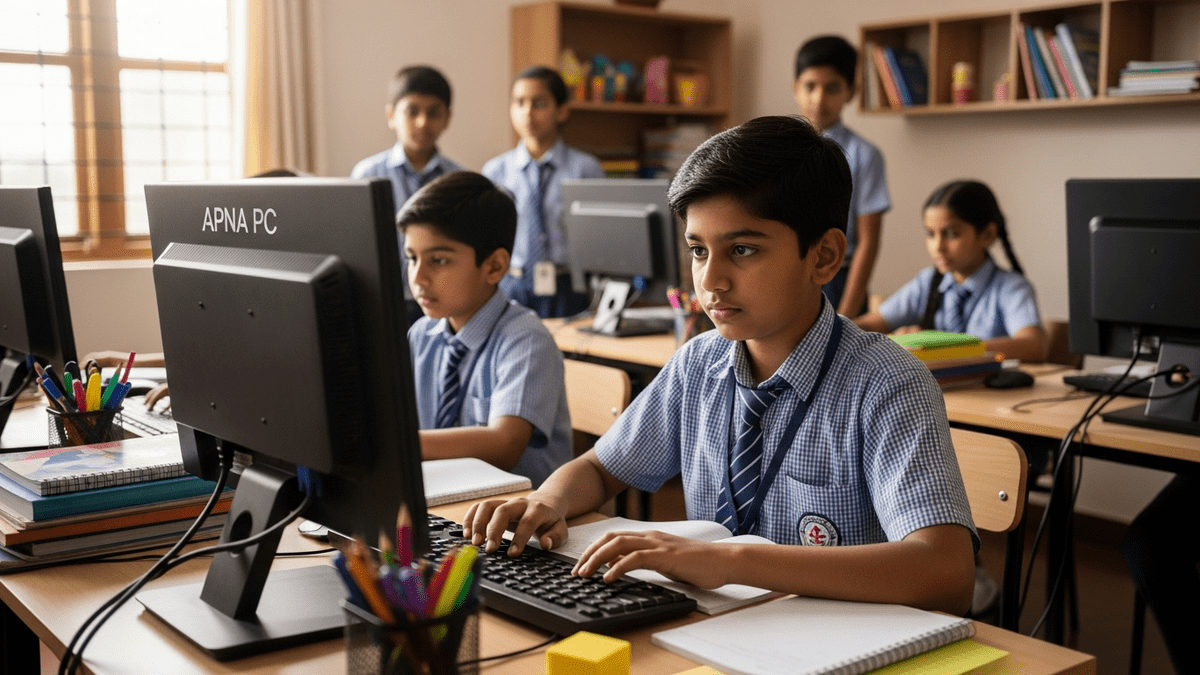
Most home learning PODs run on APNA PC. There is a practical reason for that.
APNA PC is a complete computer bundle at ₹30,000, inclusive of education software, a 3-year warranty, and installation. The bundle includes a mini PC with an Intel Core i3 7th Gen processor, 8GB RAM, a 128GB SSD, a monitor, a keyboard, a mouse, a webcam, and a headset. It comes pre-loaded with Zorin OS or Windows, LibreOffice, Scratch, Blender, VS Code, the Arduino IDE, and Apni Prerna, a student safety and monitoring application built for Indian classrooms.
In a POD setting, APNA PC is not just a device. It is the entire classroom.
Explore APNA PC, the affordable computer built for learners, to see what a complete community learning center setup looks like.
Children in a POD equipped with APNA PC get hands-on time every single session. They learn to type. They use spreadsheets. They explore coding tools. They build the kind of digital habits that carry through secondary school, college entrance exams, and their first job. By the time these children reach Class 10, they are not learning how to use a computer for the first time. They already know.
Here is the truth: digital literacy cannot be taught theoretically. You learn it by doing it. A home learning POD in India, powered by APNA PC, puts doing at the center of every session. That is the real difference between a POD and a coaching class.
Five Things to Check Before Choosing a POD for Your Child
Not every POD is set up well. When parents look for an affordable education option, here is what separates strong PODs from average ones:
1. The educator is trained and certified. TeachToEarn-trained POD operators complete a structured program before they open their center. Ask if the educator has formal certification and when they received it.
2. There is a working computer in the space. A POD without a functioning computer is a small coaching class with a new name. The device must be present. Children must use it every single session, not just on special days.
3. The group stays small. Eight to twelve students is the effective range for personal attention to work. Above fifteen, the advantage of a POD starts to dissolve into the same problems coaching classes have.
4. The educator has a clear digital learning plan. Ask what tools and platforms the children use each week. A prepared educator has an immediate, specific answer. Hesitation is a red flag worth noting.
5. Children produce real work. Typed assignments, digital projects, short presentations. Outputs prove learning far better than attendance records or exam scores alone. Ask to see examples from current students before enrolling your child.
A well-run home learning POD in India should answer all five of these clearly and confidently. If it cannot, keep looking. The right educator exists in most neighborhoods. You just have to ask the right questions to find them.
The Indian education system is evolving. Home learning PODs are becoming a real alternative, not just for families who cannot afford coaching but for parents who want more than coaching can offer. The access, the personal attention, and the digital skills all come together in one small room with the right educator and the right tools.
Ready to find or start a home learning POD in India? Explore the TeachToEarn POD program here and take the first step toward a learning experience that actually sticks.