
In Mumbai, a Class 8 student has access to coding bootcamps, STEM labs, digital libraries, and AI workshops. In a village 400 kilometres away, a Class 8 student has a school, a chalkboard, and a textbook. Both students are equally intelligent. Both are equally curious. But one has a ten-year head start in digital skills.
This is the urban-rural education gap in India. It is not about teacher quality. It is not about school infrastructure. It is about access to technology. And until recently, there was no affordable way to close it.
Learning PODs are changing that. A learning POD with a few computers and a local educator can bring the same digital learning experience to a village that Mumbai students take for granted. Rural education in India is no longer limited by geography.
The Real Gap Between Urban and Rural Students
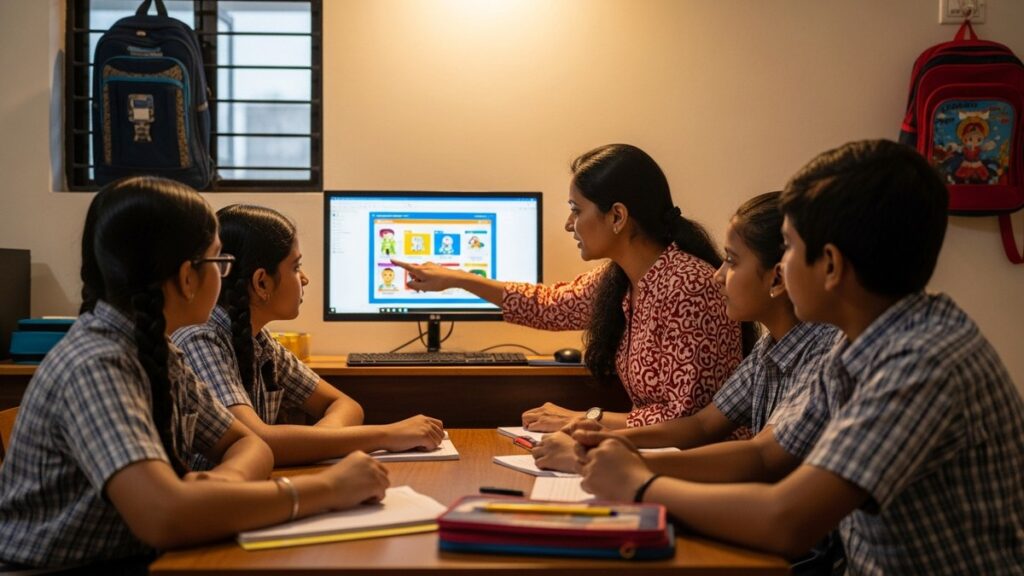
The gap is not intelligence. Rural students consistently score well on board exams. The gap is exposure. An urban student grows up seeing computers everywhere. They use them at home, at school, at cafes, and at friends’ houses. By the time they reach college, they are digitally fluent without ever taking a formal course.
A rural student may never touch a computer until college. They arrive at university and discover that every assignment requires digital skills they do not have. They spend their first year learning what their urban classmates learned at age 10. The gap is not about ability. It is about access.
This gap shows up in career outcomes. Urban students with digital skills get better internships, better jobs, and better opportunities. Rural students with equal intelligence but no digital access fall behind, not because they are less capable, but because they started later.
The gap is also about awareness. A student in Mumbai knows that coding, data analysis, and digital design are career options. A student in a rural area may never have heard of these fields. You cannot pursue a career you do not know exists.
How Learning PODs Close the Gap
A learning POD does not need a big city. It needs a room, a few computers, and a person willing to run it. In a rural setting, the room is often easier to find than in a metro. Rent is cheaper. Community ties are stronger. Word of mouth spreads faster.
A learning POD with 4-5 APNA PC setups can serve an entire village. Children rotate through in batches. The local educator guides them through structured curriculum. The computer does the heavy lifting. Within months, rural children are building Scratch projects, typing documents, and exploring the internet with the same confidence as their urban peers.
Start a TeachToEarn Learning POD in your village or small town. The model is designed to work anywhere, not just in cities.
Why Technology Is the Great Equaliser
A textbook in a village teaches the same content as a textbook in a city. But a computer in a village opens the same doors as a computer in a city. The child in a rural area who learns coding on APNA PC has access to the same tools, the same tutorials, and the same opportunities as a child in Bangalore.
Technology does not care about geography. A Scratch project built in a village looks the same as one built in a metro. A coding skill learned in a small town is worth the same as one learned in a tech hub. The computer is the great equaliser.
APNA PC costs ₹30,000. For a rural family, that is significant. But for a community-funded POD, it is ₹6,000 per family if five families share the cost. That is less than two months of coaching fees in a city.
The children in India’s smallest towns deserve the same opportunities as children in the biggest cities. A computer makes that possible. A learning POD makes it practical.
Start a TeachToEarn Learning POD. APNA PC — affordable computer for rural students.
DIKSHA — India’s national digital learning platform. Digital India initiative.
Ready to bring digital learning to your community? Explore the TeachToEarn POD program and start a learning centre that bridges the gap.