
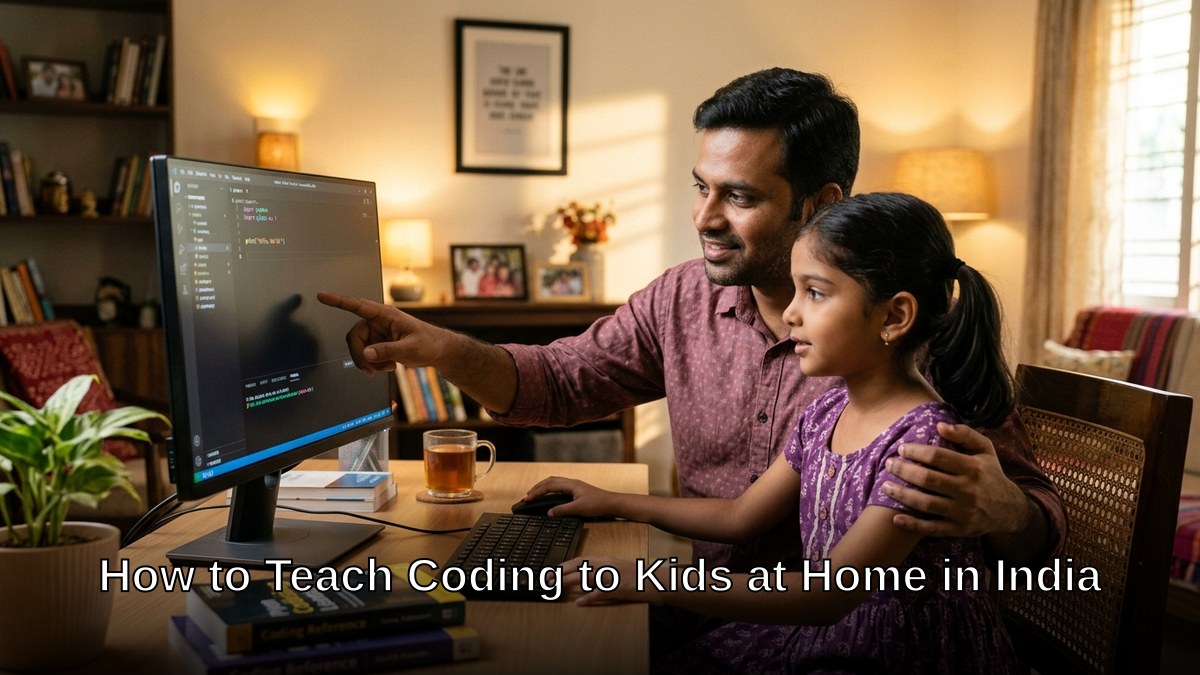
Your child can code. Not in five years. Not after engineering college. Right now. At home. In India.
Most parents think coding is for the gifted few or something that happens in fancy schools with air conditioning. Let’s be honest: that belief is costing your child real opportunities. Coding teaches logic, problem-solving, and creativity in ways that no traditional subject does. And you don’t need to be a tech expert to teach coding to kids at home in India. You need the right approach, the right tools, and the right mindset.
Here is the truth: coding for kids isn’t about creating the next Sundar Pichai. It’s about giving your child a language to think differently. To build things. To fail, fix, and try again. That’s a life skill.
Why Home-Based Coding Learning Works Better
Classroom coding classes for children often move too fast or too slow. Your child sits in a room with 30 others, shares one computer between two kids, and the teacher moves on whether they understood or not. At home, there’s no rush. Your child learns at their own pace. They can ask questions without embarrassment. They can spend 20 minutes on one concept if they need to.
Programming for kids at home also means real-world application. Your child builds something and shows it to you immediately. That feedback loop is powerful. They see the connection between what they learned and what they created.
- One-on-one attention and personalized pacing
- No commute time or fixed class schedules
- Safe, comfortable learning environment
- Immediate family involvement and encouragement
- Lower long-term costs compared to coaching centres
The barrier isn’t motivation or intelligence. It’s access to proper equipment and structured guidance.
The Three Essential Ingredients You Need
First: a reliable computer. Not a laptop that overheats. Not a phone screen. A proper desktop or mini PC with enough power to run coding software without lag. Your child needs instant feedback when they write code, not a 30-second delay that kills their focus.
Second: beginner-friendly software. Scratch, Python, or visual programming platforms that don’t require kids to memorize syntax before they understand logic. The software should feel like play, not punishment.
Third: someone to guide them. This doesn’t mean you need to know computer programming yourself. You need to know how to ask questions. How to encourage. How to let them struggle productively before stepping in.
This is where APNA PC changes the equation. It’s a complete bundle designed specifically for this purpose. You get a mini PC (i3 7th Gen, 8GB RAM, 128GB SSD) plus monitor, keyboard, mouse, webcam, and headset. But that’s not the game-changer. The education software is pre-installed. The 3-year warranty means you’re not panicking if something breaks. Installation and setup are handled. For Rs.30,000, you have everything a child needs to start learning coding at home.
Most people don’t realise that the biggest cost of home learning isn’t the software. It’s the wasted time setting things up, troubleshooting problems, and figuring out what to teach. APNA PC eliminates that friction.
Building a Point of Digital Learning in Your Home or Community
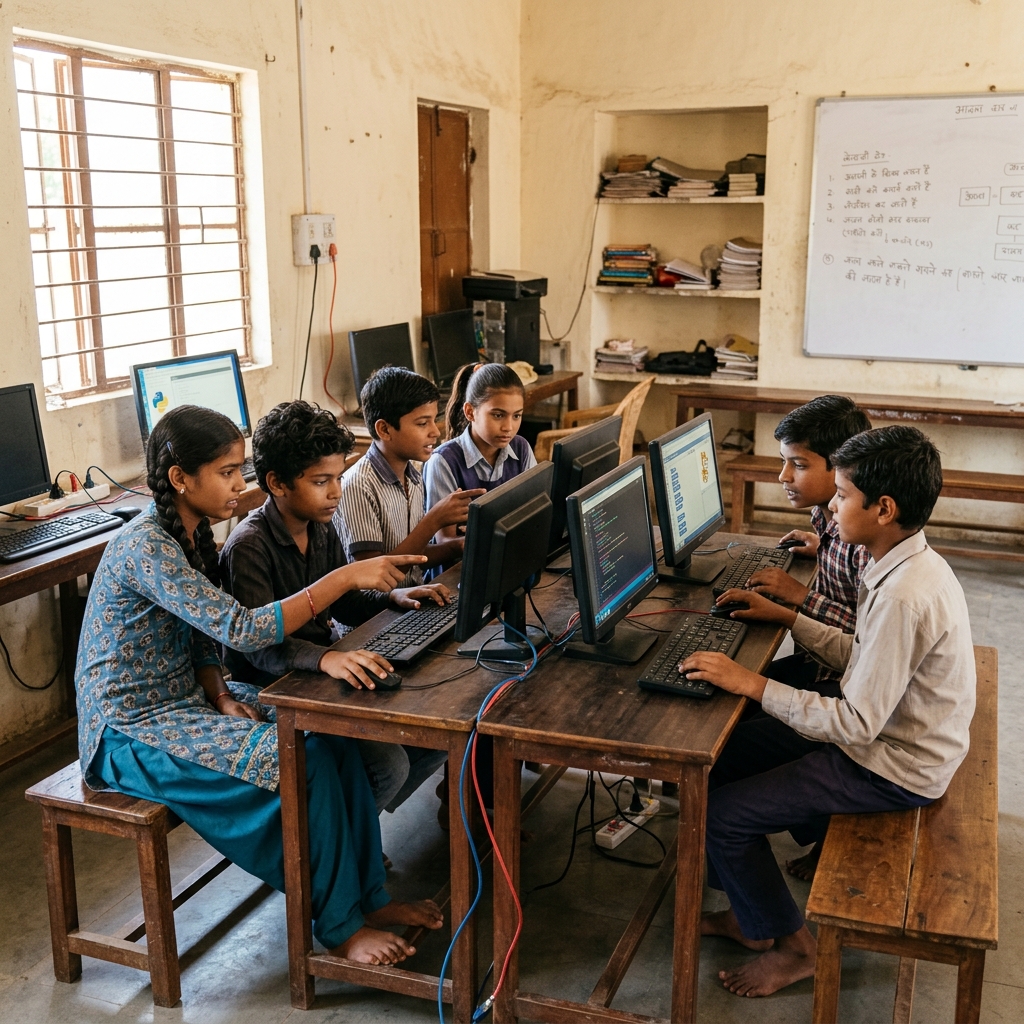
Here’s an idea that’s working across India right now: turn your home or a small community space into a POD (Point of Digital Learning). Not a formal coaching centre. Not a franchise. Just a trained educator, a few computers, and children learning together.
If you’re a homemaker, a retired teacher, or someone with space and patience, you can run a POD. You don’t need to be a coder. You need to be organized and willing to learn alongside your students. You set your own hours. You charge what makes sense for your community. You become the person who gives neighbourhood kids access to skills that will shape their future.
A POD with 4-5 APNA PC setups costs around Rs.1.5 lakhs for hardware. Add basic furniture and internet. Your investment is recovered in 3-4 months if you charge Rs.2,000-3,000 per child per month for coding classes. And unlike tutoring, which is reactive (fixing marks), coding education is proactive (building skills).
You also get support from TeachToEarn. Training. Community. Resources. You’re not doing this alone.
Check out our smart classroom setup guide for more on creating spaces like this. And if you’re interested in leveraging technology, explore AI tools for teachers to enhance your teaching.
Starting Small: Your First Steps
You don’t need to commit to a full POD immediately. Start at home with your own child. Get the APNA PC bundle. Choose one beginner platform (Scratch is free and excellent). Spend 30 minutes a week learning together.
In three months, you’ll see the shift. Your child will be creating small games or animations. They’ll be debugging their own mistakes. They’ll be thinking in sequences and conditions. That’s coding. That’s also thinking.
Once you see what’s possible, you can scale. Invite neighbourhood kids. Formalize it. Build a POD. Or stay small and focused. Either way, you’ve given your child something real.
According to UNICEF India education reports, digital literacy is no longer optional. It’s foundational. Teaching coding to kids at home in India isn’t a luxury. It’s preparation for the world they’ll actually live in.
The question isn’t whether your child should learn to code. It’s when. And whether you’ll be the one who opens that door.
Ready to start? Launch your own Point of Digital Learning today. Or begin with APNA PC at home. Either way, begin.