
Smart Classrooms Are Already Here. Your School Is Just Behind.
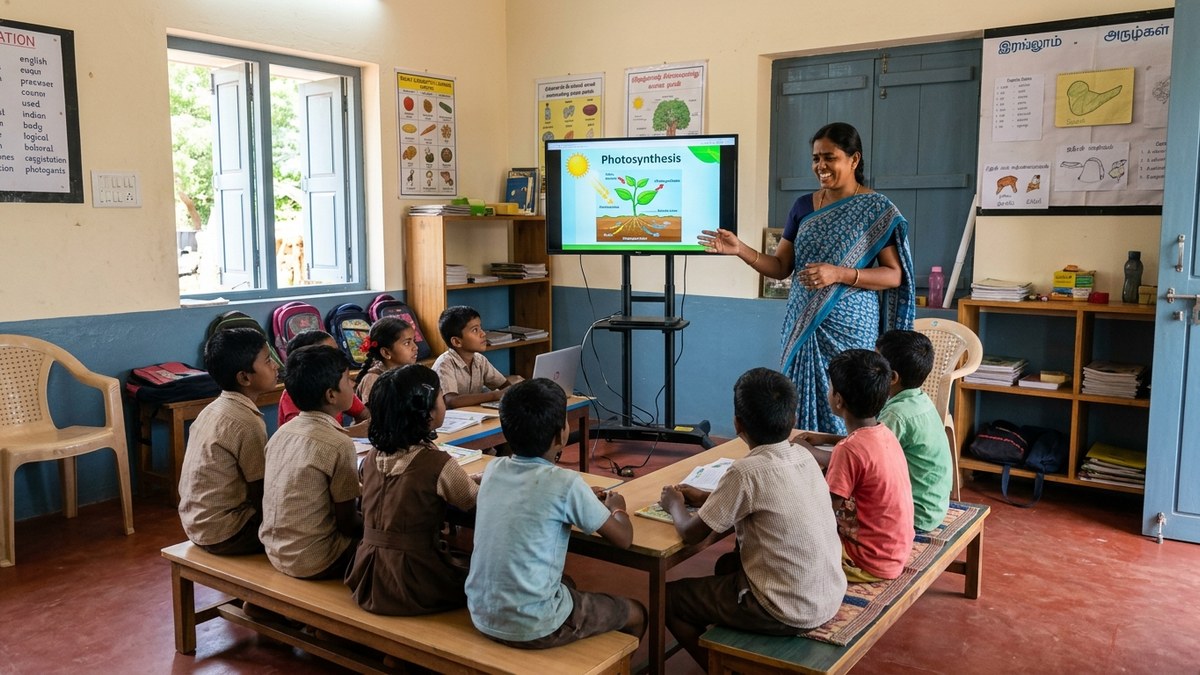
Here’s the truth: the classroom revolution isn’t coming. It’s already happened in pockets across India, and schools that haven’t caught up are losing students to those that have. Parents see the difference. Teachers feel it. And kids? They learn faster when a smart classroom India setup replaces chalk dust with interactive screens and engagement.
We’re not talking about futuristic fantasy. Right now, in Bangalore, Delhi, Mumbai, and smaller towns, schools are installing digital classroom technology that’s changing how children learn. The question isn’t whether smart classrooms work. It’s whether your school will be the one leading this shift or trailing behind it.
Let’s be honest: traditional teaching methods still work. But they work at 60% efficiency when they could work at 90%. A student staring at a blackboard for 45 minutes retains less than a student interacting with a smart board where concepts come alive visually. The data backs this up. The results speak for themselves.
What Makes a Smart Classroom Actually Smart
Most people don’t realise that a smart classroom isn’t just a projector and a laptop. It’s an ecosystem. Digital classroom technology combines hardware, software, and pedagogy into one coherent experience.
A real smart board teaching setup includes:
- Interactive display panels that respond to touch and stylus input
- Learning management software that tracks student progress in real time
- Connectivity that doesn’t fail when you need it most
- Teacher training so educators actually use these tools, not just stare at them
- Student engagement features that make learning feel like participation, not punishment
When these elements work together, something shifts. A shy student who never raises her hand in a traditional classroom becomes vocal in a smart classroom where she can submit answers anonymously first. A struggling learner gets instant feedback instead of waiting a week for marked papers. A teacher spends less time on administrative tasks and more time on actual teaching.
The Google Classroom guide shows one approach, but schools need complete solutions. That’s where APNA PC comes in. For Rs.30,000, you get a complete bundle: education software, 3-year warranty, professional installation, plus a Mini PC with i3 7th Gen processor, 8GB RAM, 128GB SSD, monitor, keyboard, mouse, webcam, and headset. Everything a school needs to start. Everything a Point of Digital Learning needs to operate.
Why Indian Schools Are Adopting Smart Classrooms Now
The pandemic forced a reckoning. Schools that had ignored digital classroom technology suddenly had no choice. They adapted or collapsed. Now, even as offline classes have returned, schools realize they can’t go back. Parents expect it. Teachers have tasted the benefits. Students demand it.
But there’s another reason driving adoption: competition. Private schools that installed smart board teaching systems saw enrollment jump. Government schools that got funding for digital infrastructure noticed attendance improve and learning outcomes rise. Tuition centers using smart classrooms attracted more students than those using traditional methods.
The Digital India initiative has pumped resources into educational technology. Schools that leverage these grants are moving faster than those waiting for perfect conditions.
Here’s what’s happening on the ground: a homemaker in Pune starts a Point of Digital Learning (POD) in her community center using APNA PC and education software. Within six months, 30 kids are learning from her. A retired teacher in a small town does the same. A tuition center owner in Hyderabad replaces her whiteboard with a smart setup and doubles her fees because results are undeniable. These aren’t exceptions anymore. They’re becoming the norm.
The Real Cost of Not Upgrading
School owners worry about investment. Fair concern. But consider the hidden cost of delay.
Every semester a school stays analog, it loses competitive advantage. Parents compare. They see that School A has smart classrooms and School B still uses chalk. They choose School A. Teachers get frustrated with outdated tools and leave for better-equipped institutions. Students fall behind peers in schools with digital classroom technology.
The investment in APNA PC isn’t an expense. It’s insurance against irrelevance. Rs.30,000 for a complete setup that lasts three years with warranty support. That’s Rs.833 per month. Compare that to the cost of losing even one student per term.
Check out the best online teaching tools available, but understand this: tools alone don’t work. They need to be bundled with support, training, and realistic implementation. APNA PC includes all three.

From Theory to Action: Starting Your Smart Classroom
You don’t need permission from anyone to start. A school owner can upgrade one classroom this month. A tuition teacher can set up a POD in a rented space. A homemaker can launch a community learning center in her neighborhood. A retired educator can create a digital hub for local students.
The barrier isn’t technology anymore. It’s decision. Will you move forward or stay put?
The infrastructure exists. The software works. The hardware is affordable. What’s missing is action. Schools, teachers, and edupreneurs who delay another six months will regret it when competitors have already captured market share.
Start small if you need to. One APNA PC. One classroom. One batch of students. Prove the concept works in your context. Then scale. This is how smart classroom India is actually growing, not through grand announcements but through quiet, practical adoption by people who decided to move.
Start your own smart classroom POD today and stop watching from the sidelines.
The future of Indian education isn’t being written in ministry offices. It’s being written by school owners, teachers, and entrepreneurs who are choosing to upgrade. Where will you be in this story?