
Your Tuition Fees in India Are Probably Too Low
Most people don’t realise that tuition fees in India have stagnated while everything else has gotten expensive. You’re teaching the same way your predecessors did five years ago, but your costs have doubled. Electricity bills up. Internet charges up. Your time is worth more now.
Here’s the truth: if you’re charging what you charged in 2023, you’re taking a pay cut every single month. The question isn’t whether you should raise tuition fees in India. The question is how much you’re leaving on the table by not doing it already.
Key Takeaways
- How much to charge for tuition in India depends mainly on three things: your qualifications, your city, and whether you teach generalist homework help or a specialized subject.
- One-on-one home tuition commonly runs Rs.300 to Rs.1,500 per hour depending on grade and city, while a POD group class runs Rs.150 to Rs.500 per student monthly.
- Specialists in board exams, competitive exams, coding or spoken English can charge two to three times more than a generalist tutor doing random homework help.
- Raising rates typically loses a small share of price-sensitive students but increases total income because you keep fewer, more committed families.
- Proper education software and a reliable computer let you charge more by showing parents organized attendance, progress reports and structured delivery.
What Are Parents Actually Paying Right Now?
Let’s be honest about the current landscape. Tuition fee structure across Indian cities varies wildly. Here’s what tuition fees in India actually look like in 2026:
- One-on-one home tuition for primary students (Classes 1-5): Rs.300-600 per hour in tier-2 cities, Rs.600-1,200 in metros
- Secondary students (Classes 6-10): Rs.400-800 per hour in smaller towns, Rs.800-1,500 in major cities
- Board exam preparation (Classes 11-12): Rs.600-1,200 per hour, sometimes reaching Rs.2,000+ for specialized coaching
- Competitive exam coaching: Rs.1,000-3,000 per hour depending on expertise
- Group tuition at a Point of Digital Learning (POD): Rs.150-400 per student per month
These numbers aren’t random. They reflect what parents can actually afford and what trained educators deserve to earn. But here’s what most teachers miss: these are baseline rates. Your rates should be higher if you offer specialized expertise, use technology effectively, or run a structured learning centre.
How much to charge for tuition depends on three factors: your qualifications, your location, and your delivery model. A teacher with a master’s degree running a POD in a Tier-1 city should charge significantly more than someone offering casual coaching in a village. That’s not arrogance. That’s market reality.
The Technology Advantage Nobody’s Using
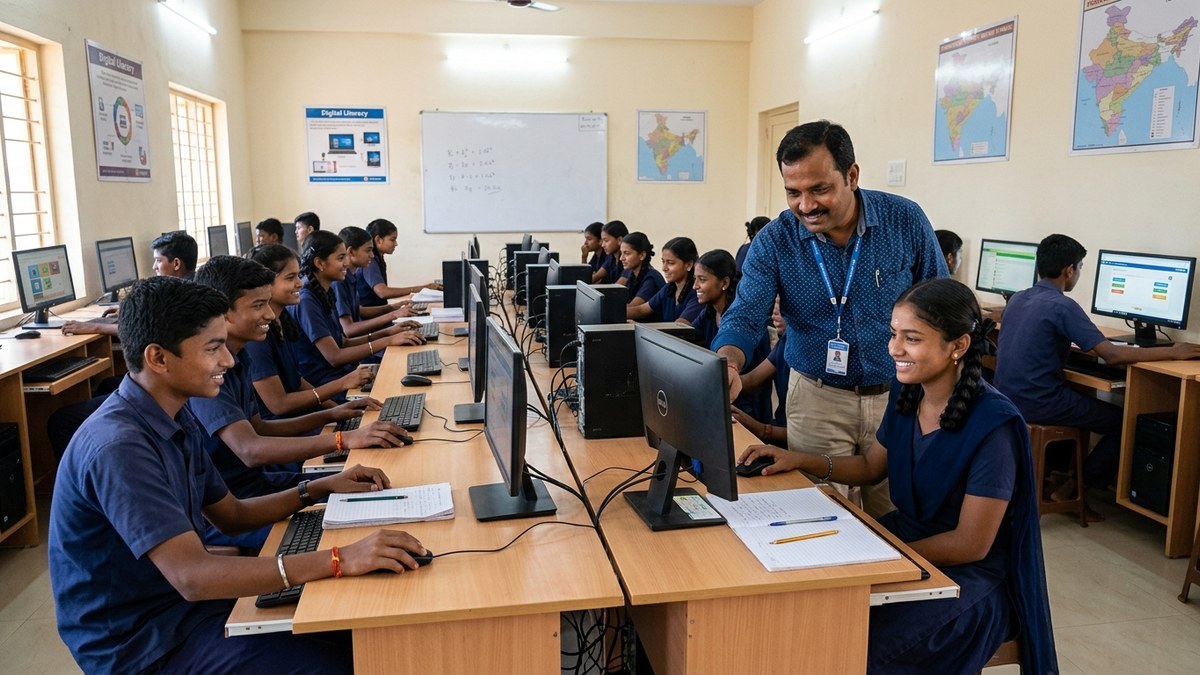
Most teachers think technology is optional. It’s not. Parents in 2026 expect organized systems. They want attendance tracking. They want progress reports. They want structured curriculum delivered professionally. When you use proper education software, you can charge 30-40% more than your competition.
This is where APNA PC changes the game. For Rs.30,000, you get a complete bundle: education software, a Mini PC (i3 7th Gen, 8GB RAM, 128GB SSD), monitor, keyboard, mouse, webcam, headset, plus 3 years warranty and installation. You’re not just buying hardware. You’re buying the ability to run a professional Point of Digital Learning.
Teachers using proper technology don’t just earn more per student. They attract more students. Parents see professionalism. They see structure. They see results. How technology is helping teachers manage multi-grade classrooms isn’t just a nice-to-have feature. It’s your competitive advantage in 2026.
Location Matters. Specialization Matters More.
Your city determines your baseline rate. But what you teach determines whether you’re earning minimum wage or building real wealth from home tuition.
Generalist tutors (helping kids with whatever homework they have) are commoditized. Every parent knows five of them. They’re interchangeable. They’re cheap.
Specialists command premium rates. A teacher who specializes in CBSE board exam preparation, or competitive exams like JEE/NEET, or coding for kids, or spoken English can charge 2-3 times more than a generalist.
If you’re running a POD with structured curriculum and technology, you’re not competing on price anymore. You’re competing on outcomes. Parents will pay Rs.500-800 per student monthly for a well-organized group class with proven results. They’ll pay Rs.1,500+ per hour for one-on-one specialized coaching.
Check what the Central Board of Secondary Education (CBSE) expects from board exam preparation. Align your curriculum. Charge accordingly.
The Real Cost of Undercharging
When you undercharge, you don’t just lose money. You lose time and energy that could go toward better students, better systems, better growth.
If you’re teaching 20 hours per week at Rs.400 per hour, you’re earning Rs.8,000 weekly. If you raise rates to Rs.700 per hour (reasonable for 2026), you’re earning Rs.14,000. Same hours. Same effort. Rs.6,000 more every week.
But most teachers don’t raise rates. Why? Fear. They think they’ll lose students. They think they’re not “worth it.” They think parents can’t afford it.
Here’s what actually happens when you raise rates professionally: you lose 10-15% of students but earn 25-35% more because you’re serving fewer, more committed families. Your workload decreases. Your stress decreases. Your income increases. Everyone wins.
How to Structure Tuition Fees in India for 2026
Stop thinking of tuition as hourly work. Think of it as a business with multiple revenue streams.
- One-on-one home tuition: Rs.500-1,000 per hour (depending on specialization and location)
- Group classes at a POD: Rs.200-500 per student monthly
- Online specialized coaching: Rs.800-2,000 per hour
- Exam preparation packages: Rs.10,000-50,000 for complete board exam prep (4-6 months)
- Doubt-clearing sessions: Rs.100-300 per 30-minute session (can be done in batches)
Parents don’t think in hourly rates anymore. They think in outcomes. They think in packages. They think in results. Structure your pricing around what they care about.
If you’re serious about this, you need systems. You need a Point of Digital Learning setup. You need education software. You need professional tools. This is exactly what APNA PC gives you. Buy APNA PC today and start running a professional operation instead of a side gig.
Your Competition Is Already Charging More
The teachers who are thriving in 2026 aren’t the ones who undercut on price. They’re the ones who invested in systems, technology, and specialization. They’re the ones running PODs. They’re the ones using education software. They’re the ones charging what they’re actually worth.
You can continue undercharging. Or you can look at what successful educators are doing and match their strategy. Start with freelance teaching jobs from home if you need to, but don’t stay there. Build toward a structured POD model. Invest in technology. Specialize. Raise your rates.
The Digital India initiative has created unprecedented opportunity for home-based educators. Parents are ready to pay for quality, organized, technology-enabled learning. The question is whether you’re ready to deliver it and charge accordingly.
Your tuition fees in India should reflect your value. In 2026, that value is higher than you think. Price accordingly.
Frequently Asked Questions About How much to charge for tuition in India
What is a fair hourly rate for home tuition in India in 2026?
For primary grades, Rs.300 to Rs.600 per hour is common in tier-2 cities and Rs.600 to Rs.1,200 in metros. Secondary and board-exam tutoring runs higher, often Rs.600 to Rs.1,500 per hour. Competitive exam coaching for subjects like JEE or NEET can go well beyond that for experienced tutors.
How much should a POD charge per student?
Group classes at a Point of Digital Learning typically charge Rs.150 to Rs.500 per student per month, depending on batch size and subject. This is lower per student than one-on-one tuition but scales better since one educator teaches many students with one computer setup.
Why do specialized tutors charge more than general tutors?
A generalist who helps with whatever homework shows up is easy to replace, since every neighbourhood has several. A tutor who specializes in board exam prep, competitive exams, coding or spoken English solves a specific, high-stakes problem, so parents pay a premium for that focus rather than shopping around.
Will I lose students if I raise my tuition fees?
Usually a small share, often around 10 to 15 percent of price-sensitive families. In exchange, tutors commonly see their income rise because the students who stay are more committed and the workload per rupee earned goes down. Raising rates gradually, with clear communication, keeps most families.
Does using a computer and software help justify higher tuition fees?
Yes. Parents increasingly expect attendance tracking, progress reports and a structured curriculum, which a phone cannot deliver properly. A reliable computer running real education software lets you present tuition as an organized service rather than casual coaching, which supports charging more.
The Central Board of Secondary Education publishes its official syllabus, sample papers and marking schemes on cbse.gov.in, which tutors can align their board-exam coaching and pricing against.
Explore become an edupreneur and how to one room to learning hub checklist.