
Your Child’s Day is Chaos Without a Homeschooling Timetable for Indian Parents
Let’s be honest: most parents who start homeschooling think they can wing it. They believe structure will emerge naturally once the kids settle down. It won’t. By week two, your living room becomes a battleground. Your child is watching YouTube at 10 AM. Math happens at 4 PM when everyone’s tired. Nobody knows what’s happening tomorrow.
Here’s the truth: a solid homeschooling timetable for Indian parents isn’t restrictive. It’s liberating. It gives your child predictability. It gives you sanity. And it actually works within the reality of Indian homes, where power cuts happen, relatives visit, and kitchen duties don’t pause for academics.
This guide shows you exactly how to build a homeschooling daily schedule India that fits your family, your curriculum, and your life.
Key Takeaways
- A homeschooling timetable for Indian parents gives children predictability and spares parents from making decisions every few minutes.
- The article suggests five core blocks: morning academics, a mid-morning break, subject rotation, lunch and rest, and practical learning such as art, sports or coding.
- A sample schedule for classes 3 to 5 starts around 8:00 AM with maths and English together, then science or social studies and a rotating creative block.
- Make it stick with a printed chart on the wall, flexibility within structure and your child’s help in designing it.
- Plan for Indian realities: power cuts, guests and a child who struggles or finishes early, and use DIKSHA and CBSE resources on a reliable computer.
Why a Homeschool Routine for Kids Actually Matters
Children’s brains crave rhythm. Not rigidity. Rhythm. When your child knows that 9 AM is always math time, their brain preps itself. They don’t waste mental energy wondering what’s next. They just show up and work.
A homeschool routine for kids also protects you from burnout. You stop making decisions every five minutes. You stop feeling guilty about unstructured time. You follow the plan. The plan works. Everyone wins.
Plus, when you apply for board exams or transition back to formal school, your child already knows how to follow structure. They’re not shocked by bells and schedules.
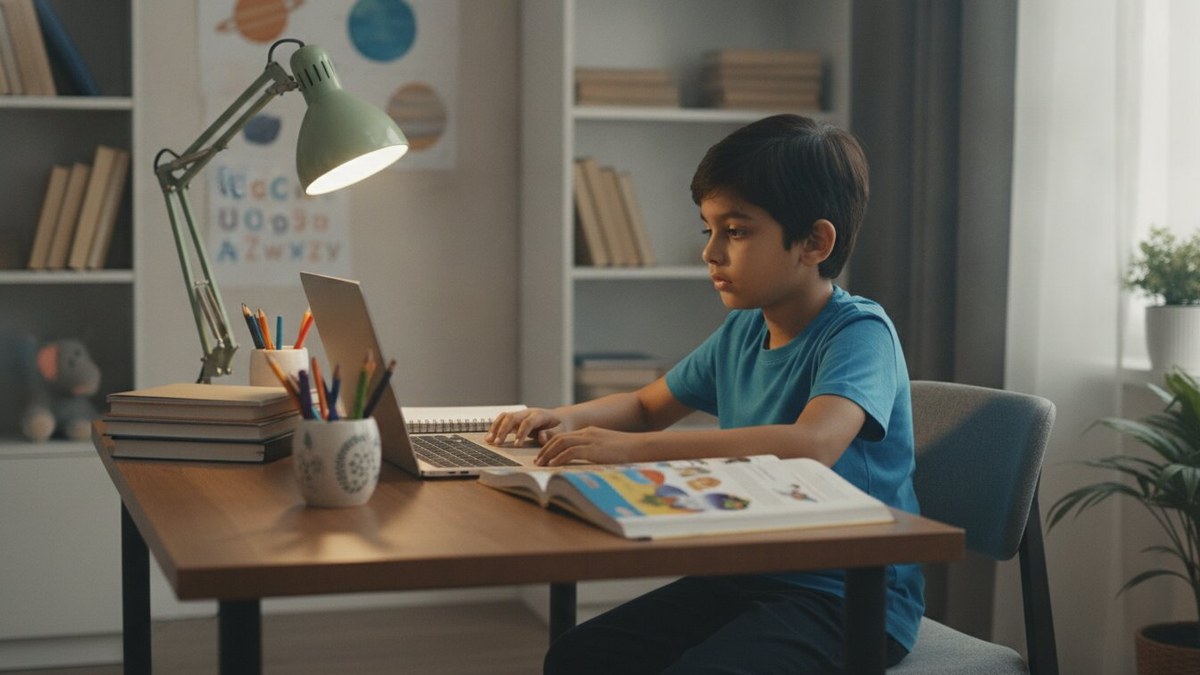
The Core Blocks: Building Your Homeschooling Daily Schedule India
Don’t overthink this. Your homeschooling timetable for Indian parents should have five core blocks.
- Morning Academics (90 minutes): Math and language together. Start between 8-9 AM when minds are sharpest. No exceptions. This is non-negotiable time.
- Mid-Morning Break (30 minutes): Snacks, movement, fresh air. Let them run around. Literally.
- Subject Rotation (90 minutes): Science, social studies, or electives. Alternate which subject you teach first each day so boredom doesn’t settle.
- Lunch and Rest (60 minutes): Actual lunch. Not rushed. Not at the desk. Sit together.
- Practical Learning (60 minutes): Art, projects, sports, music, coding. This isn’t filler. This is where real learning happens.
That’s five hours of structured learning. That’s enough. Most homeschooled children outpace their school peers because every minute counts.
Sample Homeschooling Timetable for Indian Parents: Class 3-5
8:00-8:15 AM: Arrival routine. Wash hands, sit down, open notebooks. No screens.
8:15-9:45 AM: Math and English together. Teach one concept. Practice together. Let them work independently while you supervise.
9:45-10:15 AM: Break. Water, snacks, movement.
10:15-11:45 AM: Science (Monday, Wednesday, Friday) or Social Studies (Tuesday, Thursday). Hands-on experiments beat textbooks every time.
11:45 AM-12:45 PM: Lunch and rest.
12:45-1:45 PM: Art, music, sports, or coding project. Rotate weekly.
1:45 PM onwards: Free time. Reading, play, outdoor activities.
This homeschooling daily schedule India gives you structure without suffocation.
Making Your Homeschool Routine for Kids Actually Stick
Most timetables fail because parents don’t track them. Use a printed chart. Stick it on the wall. Check it off daily. Your child sees progress. You see what’s working and what isn’t.
Most people don’t realise that flexibility within structure is key. If your child is deep into a science experiment at 11:30 AM, don’t stop them at 11:45. Let it run. Adjust the next day. The timetable serves you. You don’t serve it.
Also, involve your child in creating the timetable. When they help design it, they own it. They’re more likely to follow it.
Tech Tools That Actually Help (And One You Should Know About)
A good homeschooling timetable works better with the right setup. You need a reliable computer for accessing educational resources, video lessons, and online assessments. Resources like DIKSHA and CBSE offer excellent free content aligned with Indian curriculum.
If your home setup is weak, consider APNA PC. It’s a complete education bundle at Rs.30,000 that includes education software, a Mini PC (i3 7th Gen, 8GB RAM, 128GB SSD), monitor, keyboard, mouse, webcam, headset, plus 3-year warranty and installation. It’s designed exactly for Indian families doing homeschooling. No complicated setup. Just plug and teach.
Also worth bookmarking: the government’s Digital India portal from MeitY, which regularly lists new digital learning initiatives for Indian families.
Beyond hardware, use a simple Google Sheet or printed calendar. Apps like Toggl help you track time blocks. But honestly, paper works best for most families. Something about writing it down makes it real.
Adjusting Your Homeschooling Timetable for Indian Parents: Real Scenarios
Scenario 1: Power cuts. Plan outdoor activities during typical power cut hours. Keep worksheets printed. Have a backup schedule that doesn’t need electricity.
Scenario 2: Guests or family events. Don’t abandon the schedule. Compress it. Do 30 minutes of math, skip the break, do 30 minutes of science, call it done. Consistency matters more than perfection.
Scenario 3: Your child is struggling with a subject. Extend that time block by 15 minutes. Reduce something less critical. Adjust weekly, not daily.
Scenario 4: Your child finishes work early. This is good. Add extension activities: research projects, reading, creative writing. Never let them think finishing early means free time immediately.
The Bigger Picture: Why Structure Matters for Homeschooling in India
If you’re considering homeschooling in India, you’re already thinking differently about education. A solid timetable proves to boards, relatives, and yourself that homeschooling isn’t chaos. It’s deliberate. It’s measurable. It works.
Check out the Apni Pathshala blog for more homeschooling strategies specific to Indian families.
Your Action Plan This Week
Don’t wait for the perfect moment. This week, sit down with your child. Design one homeschooling timetable for Indian parents that fits your family. Print it. Pin it. Start Monday. Track it for two weeks. Then adjust.
That’s it. You’re not building a perfect system. You’re building a working system. And that changes everything.
Frequently Asked Questions About Homeschooling timetable for Indian parents
What is a good homeschooling timetable for Indian parents?
Use five blocks: ninety minutes of morning maths and language, a break, ninety minutes of rotating subjects, lunch and rest, then an hour of practical learning.
What time should homeschooling start?
The article suggests starting between 8 and 9 AM, when minds are sharpest, with maths and language first.
How do I handle power cuts and guests while homeschooling?
Plan outdoor activities for usual power cut hours and keep printed worksheets. When guests come, compress the day instead of abandoning it.
How do I make a homeschool routine stick?
Use a printed chart on the wall and tick items daily. Involve your child in designing it and keep flexibility within the structure.
What resources help with homeschooling in India?
DIKSHA and CBSE offer free content aligned to the Indian curriculum. A reliable computer helps you access video lessons and online assessments more easily than a phone.
DIKSHA is the Government of India’s digital platform offering curriculum-aligned e-content for learners and teachers.