
Cambridge Homeschooling in India: What Parents Actually Need to Know
Your child doesn’t need a uniform or a school building to get a world-class education. Cambridge homeschooling in India is no longer fringe. It’s mainstream. Thousands of Indian families are ditching the daily commute, the exam pressure cooker, and the one-size-fits-all classroom model. Instead, they’re choosing cambridge homeschooling in india for flexibility, personalised learning, and genuine depth. But here’s what most parents get wrong: they think it’s cheaper, easier, or somehow less rigorous than traditional school. It’s none of those things. It’s just different. Better for some kids. Not for others.
Let’s be honest: the decision to homeschool using the Cambridge curriculum is enormous. It affects your family’s routine, your child’s social life, your own work schedule, and yes, your wallet. This guide cuts through the confusion and gives you the real numbers, the actual boards you can choose from, and the exact steps to get started with the Cambridge curriculum.
Cambridge Curriculum Cost in India: The Real Breakdown
Most people don’t realise that cambridge curriculum cost india varies wildly depending on how you structure your homeschool. There’s no single price tag. You could spend Rs.50,000 a year or Rs.5,00,000 a year. Both are valid.
- Curriculum materials and books: Rs.15,000 to Rs.40,000 per year. Cambridge textbooks, workbooks, and past papers aren’t cheap. But they’re thorough.
- Online tuition or coaching: Rs.30,000 to Rs.2,00,000+ per year. This depends entirely on whether you tutor your child yourself or hire external support. Many parents hire subject specialists for maths, science, and English.
- Exam registration fees: Rs.8,000 to Rs.15,000 per subject. IGCSE homeschooling india typically involves 5-7 subjects. Do the maths.
- Home learning setup: One-time cost of Rs.30,000 to Rs.1,00,000 for a decent computer, internet, and software. A reliable home setup is non-negotiable. Consider the APNA PC bundle at Rs.30,000, which includes education software, a Mini PC with i3 7th Gen processor, 8GB RAM, 128GB SSD, monitor, keyboard, mouse, webcam, headset, plus 3-year warranty and installation. This removes the tech barrier entirely.
- Extracurriculars and enrichment: Rs.20,000 to Rs.1,00,000+ per year. Sports, music, coding, debate clubs. Cambridge homeschooling doesn’t mean isolation.
Total realistic annual cost: Rs.1,00,000 to Rs.3,50,000 for most families. Some spend less if they’re disciplined. Some spend more if they hire premium tutors or enrol in hybrid PODs (Points of Digital Learning) run by trained educators in their community.

Which Boards Recognise the Cambridge Curriculum?
Here’s the truth: Cambridge isn’t technically a “board” in the Indian sense. It’s a curriculum and examination system. But several recognised bodies in India facilitate the Cambridge curriculum. You need to understand the difference.
- Cambridge International (CIE): The original. Run by the University of Cambridge. Offers IGCSE (International General Certificate of Secondary Education) at ages 14-16 and A-Levels at ages 16-18. Recognised globally. Exams conducted in India through registered centres.
- ICSE with Cambridge elements: Some Indian schools blend ICSE with Cambridge content. Not pure Cambridge, but a hybrid.
- NIOS (National Institute of Open Schooling): Indian government board. Allows homeschooling. Can be paired with Cambridge materials. More affordable than pure Cambridge but less internationally recognised.
- State boards with Cambridge supplements: A few states allow homeschooling under their board while using Cambridge textbooks as reference. Check your state’s education department rules.
Most serious cambridge homeschooling in india families choose pure Cambridge IGCSE. It’s rigorous, internationally accepted, and the exam structure is clear. Your child sits for external exams. There’s no ambiguity about whether they’ve “passed”.
How to Start Cambridge Homeschooling in India: Step by Step
Don’t jump in blindly. This process takes 2-3 months of planning before you even buy a textbook.
Step 1: Audit your child’s readiness. Cambridge homeschooling isn’t for every kid. Your child needs self-discipline, the ability to work independently for 3-4 hours daily, and genuine interest in their subjects. If they’re 12 and need constant supervision, reconsider. Homeschooling amplifies personality traits. Independent kids thrive. Dependent kids struggle.
Step 2: Research exam centres near you. Contact Cambridge International directly or check their website for registered exam centres in your city. You cannot sit Cambridge exams at home. Your child must go to an authorised centre. This matters for logistics and costs.
Step 3: Decide your structure. Will you teach your child entirely yourself? Hire tutors for specific subjects? Enrol in a hybrid POD where a trained educator guides your child 2-3 days weekly in a community learning centre? Each model has different costs and outcomes. Most working parents choose the hybrid model.
Step 4: Get the curriculum documents. Download the Cambridge syllabus for each subject from their official website. These are free and essential. They tell you exactly what your child needs to learn, what skills matter, and what the exams will test.
Step 5: Buy materials strategically. Don’t buy everything at once. Start with textbooks and workbooks for core subjects (English, Maths, Science). Add optional subjects later. Use past papers from previous years (available free online) for practice. Join online communities of Indian homeschooling parents on Facebook or WhatsApp. They share resources constantly.
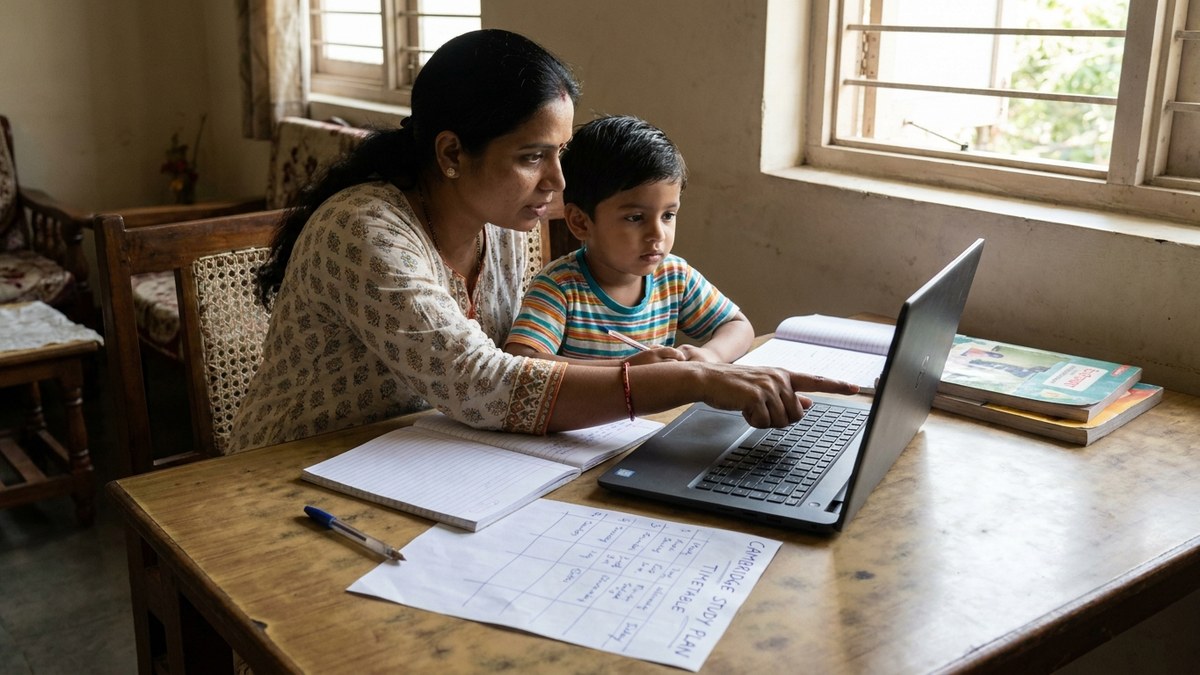
Step 6: Create a realistic timetable. Cambridge homeschooling requires 25-30 hours of study weekly. That’s not optional. Check our detailed homeschooling timetable for Indian parents to see how other families structure their days.
Step 7: Register with Cambridge. Once you’ve prepared for 3-6 months, register your child as a private candidate with a Cambridge exam centre. Registration typically opens 4-5 months before exam dates. Fees vary by subject and centre.
The Real Advantages of the Cambridge Curriculum
- Curriculum is rigorous and internationally benchmarked. Your child isn’t competing only against Indian students.
- Flexibility. You set the pace. Bright kids can accelerate. Struggling kids can slow down without shame.
- No rote learning culture. Cambridge exams reward critical thinking, not memorisation.
- Global recognition. IGCSE and A-Levels open doors to universities worldwide, not just India.
- Customisation. Your child can choose subjects aligned with their interests, not a preset stream.
The Real Challenges You’ll Face
- Isolation. Your child won’t have daily peer interaction unless you deliberately create it through clubs, sports, or POD enrolment.
- Parental burden. Even with tutors, you’re the primary manager of your child’s education. This is exhausting.
- Exam pressure. External exams create real stakes. There’s no internal assessment cushion.
- Limited social proof in India. Your child’s qualification might raise eyebrows from traditional employers or universities. This is changing, but it’s real today.
Final Reality Check
Cambridge homeschooling in india works brilliantly for families who are intentional, disciplined, and willing to invest time and money. It fails miserably for families who treat it as a cheaper alternative to school or a way to avoid parenting. The curriculum is demanding. The exams are tough. Your involvement is non-negotiable.
If you’re considering this path, visit the India Ministry of Education website to understand state-level homeschooling regulations. Also check UNESCO global education research on homeschooling outcomes. Read real stories on the Apni Pathshala blog from families already doing this.
Then decide. Not based on cost or convenience. Based on what’s best for your specific child.