
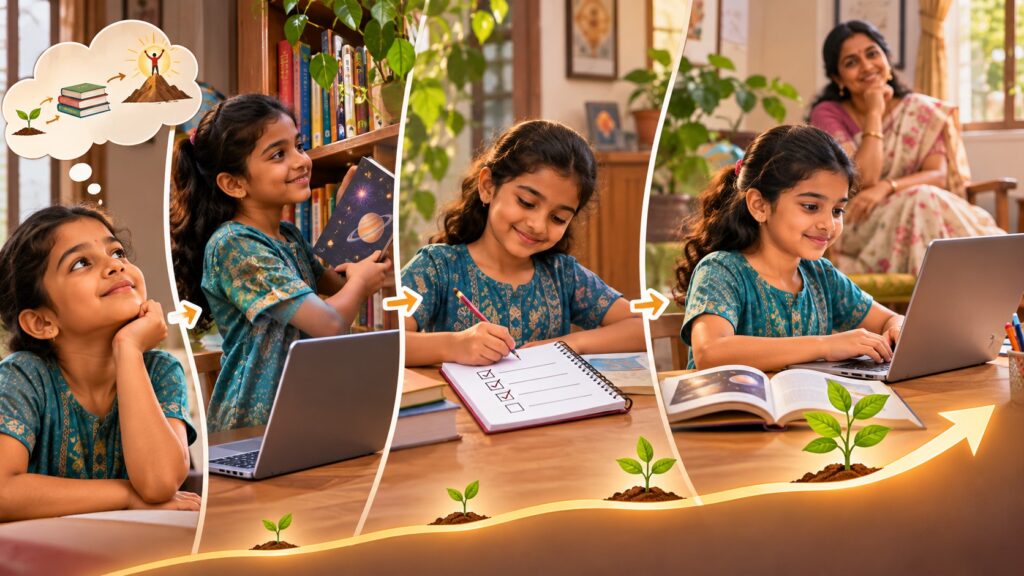
Every parent hopes their child will do well. But doing well in school and knowing how to learn independently are not the same thing. A child may earn high marks by following instructions, memorising answers and preparing for exams, yet feel lost when asked to solve a new problem alone.
A self-directed learner can ask questions, find useful resources, practise, seek help and keep going when something is difficult. This does not mean leaving children to teach themselves. It means giving them support while helping them gradually take charge of their learning. (Why we’re building an AI tutor for every child in India)
Start with meaning
Children are more likely to learn when they can see why something matters. A maths problem becomes more interesting when it helps them work out the cost of a cricket match, plan a trip or compare phone data plans. A science lesson can begin with a question about a pressure cooker, a plant on the balcony or why the Moon seems to change shape.
The syllabus still matters. So do practice and foundational skills. But when learning connects to a child’s questions and everyday life, schoolwork can feel less like a pile of tasks and more like a way to understand the world.
Parents can help by asking, “What do you think is happening?” or “How could we find out?” They do not need to know every answer. Sometimes the best response is, “Let’s investigate it together.”
Protect curiosity and motivation
Children are curious before anyone gives them a worksheet. They want to know how things work, why rules exist and what happens if they try something different. That curiosity can fade when every activity is judged only by marks, speed or whether the answer matches the textbook.
Rewards and reminders can help children get started, but they cannot create a lasting interest in everything. Intrinsic motivation grows when a child has some choice, can notice progress and is allowed to make manageable mistakes. A child who enjoys drawing might explore geometry through patterns. A child interested in football might learn about statistics by comparing players’ performance.
This does not mean every lesson must be entertaining. Some learning takes effort. The goal is to help children see that effort can lead to understanding and growing confidence. Curiosity and creativity are not extra-curricular.
Parents create the conditions
Parents are not expected to become full-time teachers. Their role is to make learning possible: protect some unhurried time, provide books and materials where they can, notice a child’s interests and respond to questions with interest rather than irritation.
It helps to praise the process: “You tried another way,” or “You found a useful clue,” rather than focusing only on a high score. When children struggle, resist the urge to take over immediately. Offer a hint or ask what they have tried so far. Then step back as they become more capable.
Parents also set the emotional climate. Children are more willing to ask for help when they are not afraid of being called careless, slow or foolish. A home does not need expensive equipment to support learning. Attention, encouragement and time matter too. For practical ideas, see Pedagogy for Parents: FAQs on Raising Self-Directed Learners.
Teachers and mentors guide without doing everything

Teachers remain essential. A good teacher notices what a child understands, chooses a useful next step and helps them think through a problem. Mentors can widen a child’s view of what is possible: a neighbour who repairs computers, an aunt who runs a business, an older student who loves biology, or a coach who teaches persistence.
The support children need changes over time. At first, an adult might model how to begin. Later, they can ask questions, offer feedback and let the child make more decisions. The aim is not to remove guidance, but to use it in a way that builds independence.
Friends make learning social
Learning is not always a solitary activity. Friends can compare ideas, explain a method in everyday language, share discoveries and encourage one another to keep trying. Teaching a friend can also reveal what you understand—and what you still need to work out.
Parents can make room for this by encouraging study groups, shared projects and conversations across age groups. Learning together should not turn into a race to finish first. Children benefit when they can cooperate and ask questions without worrying about looking clever.
An AI tutor can offer help on demand
An AI tutor can explain a concept in different ways, give practice questions and respond patiently when a child asks the same question again. This can be useful when a parent is busy or a teacher is helping another student. It can also help a learner explore a question that arose outside class. (Why don’t parents encourage their kids to use AI for learning?)
For example, CBSE Eklavya offers a learning companion for students. A computer such as the Apna PC can provide access to learning tools and content. Through Apni Pathshala, children can learn alongside peers in a supportive community; TeachToEarn helps parents explore setting up community learning spaces.
Technology is most useful when it helps a child think, practise and ask better questions. It should not become the child’s only teacher or a machine for producing answers to copy. Adults still need to help children check information, notice when they are stuck and connect learning to real life.
The aim is gradual independence
Self-directed learning is not a switch a child flips on one day. It develops through repeated chances to choose a question, pursue it, ask for help, reflect and try again. A parent can start small: invite a child to choose one topic this week, then help them decide how to explore it and what they would like to share afterwards.
Marks may show how a child performed on a particular test. A child’s questions, persistence, growing confidence and ability to learn something new tell us something more: they are becoming ready to keep learning long after the school day ends.