
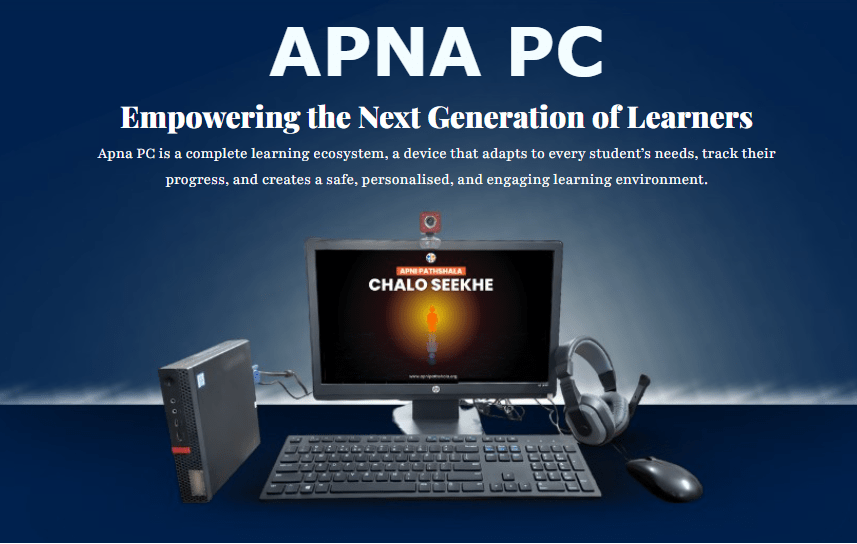
Most families today already have devices at home. What they don’t have is a structured learning system. And that’s the real problem.
A laptop or tablet by itself does not improve academic outcomes. Without a clear process, it often becomes a distraction machine—videos, shortcuts, and superficial learning. The families who see real results are not the ones with better hardware, but the ones with better systems.
Parents often lose momentum because there is no defined workflow, no consistent tracking, and no timely correction. If you want your child to actually improve, you need to convert screen time into a repeatable, measurable learning process. That’s exactly where APNA PC can become a powerful home learning engine.
Why Device Strategy Impacts Learning Outcomes ?
Most students use devices passively. They watch videos, copy answers, and jump between tasks without focus. This creates the illusion of productivity but leads to very little retention.
The difference between average and high-performing students is not access to content—it is how that content is used. A structured device strategy ensures that every minute spent on the screen leads to a clear output.
When families treat devices as part of a system—with defined goals, workflows, and checkpoints—learning outcomes improve significantly. Without this structure, even the best technology fails to deliver results.
The key is simple: focus on one high-impact learning goal per week. Trying to do too many things at once only leads to confusion and inconsistency.
Using APNA PC as a Daily Learning Engine
To make APNA PC effective, it must be used within a consistent daily structure. Random usage leads to random results.
A simple and powerful daily workflow includes four stages. First, concept learning, where the student spends focused time understanding a topic through videos or reading, while taking notes in their own words. This ensures active engagement rather than passive consumption.
Next comes practice, where the student applies what they’ve learned by solving questions. This step is critical because it exposes gaps in understanding. Students should resist the temptation to immediately look up answers.
The third stage is writing. This is where real learning happens. When a student writes answers or explains concepts in their own words, it forces clarity and strengthens retention.
Finally, the review stage involves identifying mistakes and correcting them immediately. This prevents errors from becoming habits.
When this loop is followed daily, APNA PC transforms from just another device into a structured learning engine.
How Parents Can Monitor Progress Better ?
Many parents either step back completely or become overly controlling. Neither approach works.
The more effective method is weekly, evidence-based supervision. Instead of monitoring every study session, parents should review outcomes at the end of the week.
Start by looking at what the child has actually produced—notes, written answers, completed exercises. Then check whether errors are reducing or repeating. Finally, assess writing quality. Can the child explain concepts clearly, or are they simply copying?
This kind of review removes unnecessary conflict. Instead of arguments about effort, discussions are based on visible evidence. It also helps build the child’s confidence, because progress becomes measurable and visible.
A Home Implementation Model That Actually Works ?
One of the most common mistakes families make is trying to fix everything at once. This usually leads to inconsistency and burnout.
A better approach is to start small and build gradually. Begin with one subject—preferably the most important or the weakest. Apply the daily workflow consistently for one week without making changes midway.
Once the routine becomes stable, you can expand the system to include additional subjects. The key is to avoid constant changes. Stability is what builds discipline, and discipline is what drives results.
Scaling should only happen after the process is predictable and consistent.
What Changes When You Get This Right ?
When APNA PC is used as a structured system rather than just a device, the changes are noticeable.
Students develop better study habits and become more disciplined in their approach. Last-minute stress reduces because learning becomes continuous rather than reactive. Writing improves, which directly impacts exam performance. Most importantly, academic consistency increases.
These improvements are not the result of motivation or pressure. They are the outcome of a well-designed process.
Risk Controls and Quality Safeguards
Even a good system can fail without proper safeguards. That’s why it’s important to define a few non-negotiables from the start.
There should be a fixed daily study time, and the writing step should never be skipped. Weekly reviews must happen without fail, and repeated mistakes should be corrected immediately.
Small lapses, if ignored, can quickly become bigger problems. Early intervention keeps the system on track and ensures consistent progress.
What Most People Miss at the Start ?
Most families focus on tools—apps, platforms, features—rather than on the process of learning itself.
They ask which resource is best, instead of asking how learning will be structured and measured.
Clarity on three things makes all the difference: what the student needs to achieve, how they will study, and how progress will be tracked. Getting this right at the beginning prevents weeks of confusion later.
What You Should Do Next ?
Don’t overcomplicate the process.
Choose one high-impact goal for the next seven days. It could be improving performance in one subject, reducing repeated errors, or building writing discipline.
Then follow the system consistently without changing it midway.
If you want a dependable setup that helps you implement this approach effectively at home, explore APNA PC here:
👉 https://www.teachtoearn.in/apna-pc/
Because the truth is simple.
Devices don’t improve learning. Systems do.
And the earlier you standardize your approach, the faster your child’s outcomes will improve—and stay improved.