
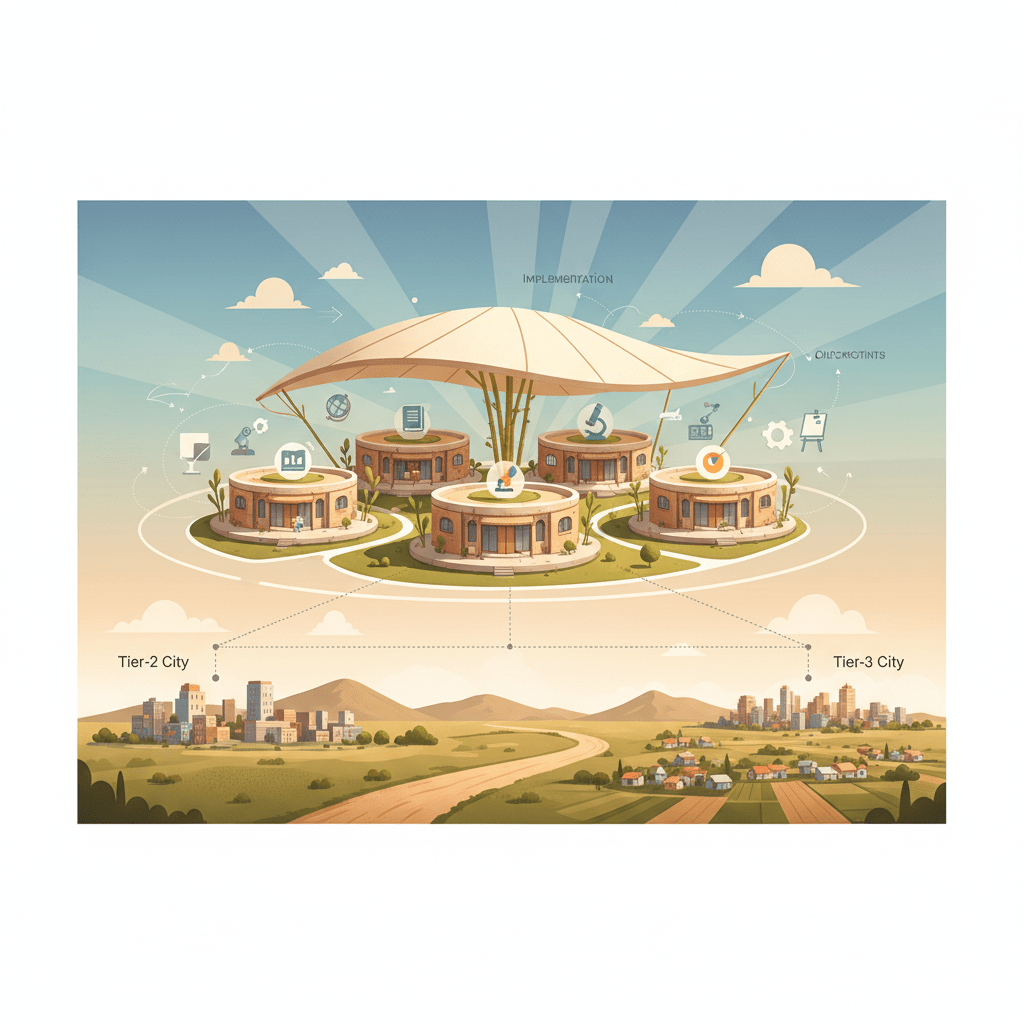
Across Tier-2 and Tier-3 cities in India, parents are becoming more serious about education than ever before. They are investing heavily in schools, tuition classes, and digital tools because they want their children to have better opportunities and stronger futures. Yet many families still feel disappointed with learning outcomes.
Children spend long hours studying, but confidence, writing quality, and deep understanding often remain weak. The issue is usually not effort. The issue is that most learning systems are fragmented, overcrowded, and difficult to personalize.
This is why microschooling is gaining attention across India. Microschools and learning PODs create smaller, calmer, and more focused learning environments where children receive better attention and progress becomes easier to track.
For Tier-2 and Tier-3 cities especially, this model has huge potential because it combines:
- community trust,
- affordable implementation,
- structured learning,
- and stronger parent involvement.
When supported by systems like APNA PC, microschooling can become a practical and scalable way to improve learning outcomes without creating excessive cost pressure.
Why School Transformation Needs Practical Models ?
Many schools want to improve learning outcomes, but teachers are already overloaded and parents are becoming more demanding. Adding more apps, more homework, or more tests does not automatically solve the problem.
What schools and communities really need are systems that are:
- simple to implement,
- easy to maintain,
- and focused on visible outcomes.
Microschooling works because it simplifies learning into smaller groups, clearer routines, and better correction loops. Instead of trying to “manage large batches,” facilitators can focus on helping students actually improve.
This reduces stress for both students and educators.
What a Modern Learning System Should Look Like ?
A strong microschool or POD is not built around random teaching. It follows a clear and repeatable structure.
Good systems usually combine:
- guided teaching,
- digital learning support,
- writing-based practice,
- and regular feedback.
Children should not just “watch content.” They should actively produce work:
- written answers,
- worksheets,
- recall summaries,
- and problem-solving exercises.
This creates measurable progress instead of passive screen time.
When learning becomes output-focused, confidence improves naturally.
Why Small Learning Groups Work Better ?
Large classrooms make personalized correction difficult. Students who need the most support often get the least attention.
Microschools and PODs solve this by creating:
- smaller groups,
- calmer environments,
- faster feedback,
- and more participation.
Children feel more comfortable asking questions, making mistakes, and improving step by step.
This is especially important in Tier-2 and Tier-3 cities where many students are first-generation digital learners and need more guided support.
How Technology Should Support Learning ?
Technology should make learning clearer and more organized—not more distracting.
One major problem today is unstructured device usage. Students jump between videos, apps, games, and random browsing without real focus.
APNA PC helps create a learning-first setup where:
- sessions follow fixed workflows,
- distractions reduce,
- and learning outputs become easier to track.
The goal is not “more technology.”
The goal is better learning habits.
Technology should support:
- comprehension,
- writing,
- practice,
- and recall.
It should never replace thinking.
How to Implement Microschooling Without Chaos ?
Many learning initiatives fail because they try to change everything at once.
A better approach is to start small.
Begin with:
- one grade group,
- one subject,
- and one clear learning goal.
Run structured weekly sessions and track:
- writing quality,
- repeated mistakes,
- participation,
- and recall ability.
Only expand after the system becomes stable and predictable.
Slow growth with strong systems is far more sustainable than rapid expansion with confusion.
Why Parent Communication Matters So Much ?
Parents lose trust when they cannot clearly see progress.
Simple weekly communication works much better than long reports.
Each update can include:
- one improvement,
- one challenge area,
- and one next-step focus.
This helps parents stay connected without creating anxiety.
Over time, trust grows when families consistently see visible learning progress.
How AI Can Be Used Responsibly ?
AI can become a powerful learning support tool if used carefully.
The safest learning flow is:
Attempt → Assist → Rewrite → Recall
This means:
- students first try independently,
- AI helps explain doubts,
- students rewrite concepts in their own words,
- and later test recall without help.
This protects writing ability, conceptual understanding, and exam readiness while still using AI productively.
What Most People Miss at the Start ?
Many people focus too much on:
- technology,
- branding,
- or rapid scaling.
But the real foundations are much simpler:
- clear routines,
- small groups,
- visible outputs,
- and consistent correction.
Children improve when systems become predictable and supportive.
What to Do Next ?
If you want to explore microschooling or POD-based learning in your community, start small and stay consistent.
Focus on:
- one learning group,
- one structured routine,
- and one visible outcome system.
Do not overcomplicate the process in the beginning.
And if you want a dependable setup to support structured digital learning, explore APNA PC here:
👉 https://www.teachtoearn.in/apna-pc/
Because meaningful educational change does not always begin with large campuses or expensive infrastructure.
Sometimes it begins with one room, one caring mentor, and one consistent learning system.