
Priya’s daughter is nine. She is smart, curious, and asks a hundred questions a day. Last week, she asked, “Mamma, why does Rahul’s house have a computer and we don’t?” Priya did not have a good answer. She knew her daughter needed one. She just could not figure out when the “right time” was.
There is no right time. There is only the time before the gap starts and the time after. Every month without a computer is a month where a child builds habits around consumption instead of creation. They learn to scroll, not to build. They learn to watch, not to make.
Every child deserves their own computer. Not a shared family phone. Not a borrowed laptop from a cousin. Their own machine, sitting on their desk, ready when they are.
Why a Phone Is Not a Computer
Most Indian families where a computer is missing rely on a smartphone. The child uses it for YouTube, WhatsApp, and maybe a Google search before an exam. Parents think this counts as “digital learning.” It does not.
A phone is designed for consumption. The screen is small. The keyboard is virtual. The operating system is built for scrolling social media, not for building projects. A child on a phone is a viewer. A child on a computer is a creator.
The difference matters at every level. A child typing an essay on a phone develops thumb-typing habits that are useless on a keyboard. A child researching on a phone learns to skim headlines, not read and evaluate information. A child coding on a phone? That is not possible.
DIKSHA, India’s national digital learning platform, offers thousands of courses. But try completing a structured course on a 5-inch screen. The experience is frustrating, and most children give up within a week.
What Changes When a Child Gets Their Own Computer
The transformation is not subtle. Children who receive their own computer develop three habits that children without one simply cannot replicate.
They learn to type properly. Ten-finger typing on a real keyboard. This sounds basic, but in a world where every exam, job application, and professional communication happens on a keyboard, typing is as fundamental as writing with a pen. Children who start at age 8 or 9 build a skill that compounds for life.
They learn to explore independently. A child with their own computer does not wait for a teacher to assign something. They open Scratch, search for a tutorial, and try building a game on their own. That self-directed curiosity is the foundation of real learning.
They learn to create. Writing a story. Designing a poster. Coding an animation. Recording a voice note. These are not just computer skills. These are thinking skills expressed through a machine.
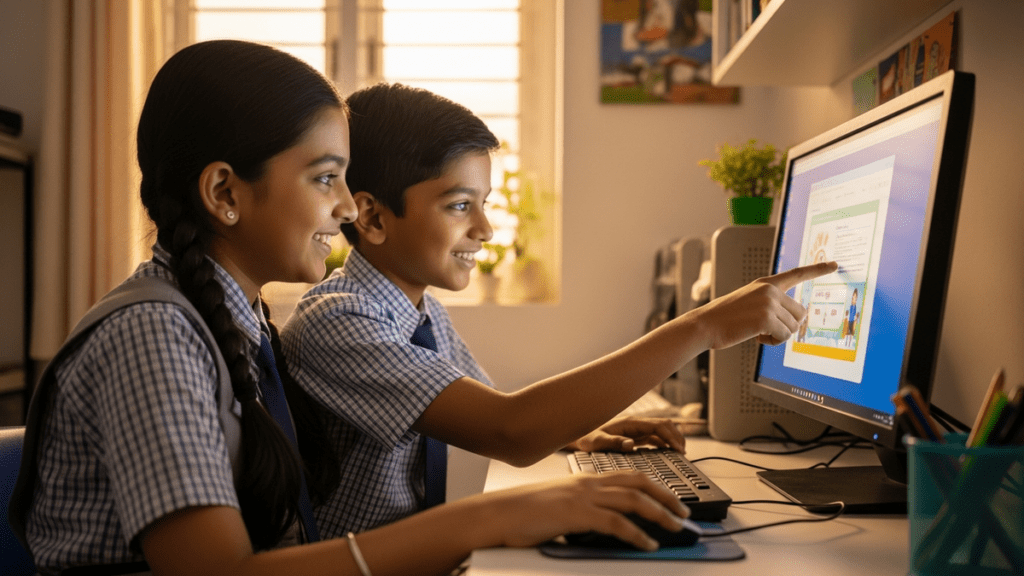
UNESCO’s education research consistently shows that children with personal computer access at home perform better academically. Not because computers make them smarter, but because computers give them a place to practice being curious.
The Cost Question Parents Should Be Asking
When parents hear “computer for my child,” they imagine spending ₹50,000-₹70,000 on a laptop. That number stops the conversation. But the question is not whether you can afford a computer. The question is whether you can afford not to have one.
A complete computer setup, including a monitor, CPU, keyboard, mouse, and pre-loaded software, costs around ₹30,000. That is less than what many families spend on a year of private tuition. And unlike tuition fees that repeat every month, a computer is a one-time investment that lasts three to five years.
Think of it this way. If your child uses a computer for 3 years, the cost works out to ₹830 per month. That is less than a single tuition class. And the skills they build, typing, coding, researching, and creating, are worth far more than any single subject they learn in tuition.
How to Make It Happen
Setting up a computer for your child does not require a separate room or a fancy desk. A clean table, a power socket, and a Wi-Fi connection are enough. The child will figure out the rest faster than you expect.
Look for a computer that comes complete. Monitor, keyboard, mouse, and CPU all in one package. Look for one that has educational software pre-loaded, so your child does not need to wait for you to install anything. Look for one with a warranty, because children are not always gentle with machines.
APNA PC offers all of this at ₹30,000. It comes with an Intel Core i3 processor, 8GB RAM, a 128GB SSD, and a three-year warranty. The software is ready from day one: Scratch for coding, LibreOffice for writing, Blender for 3D design, and VS Code for more advanced projects.
Most parents who buy a computer for their child report the same thing within the first month. The child uses it more than expected. They learn things nobody taught them. They start showing their parents what they built. That is the moment the investment pays off.
Ready to give your child their own learning machine? Get APNA PC at ₹30,000 a complete bundle with everything your child needs to start learning, creating, and exploring on their own.