
In a town called Bhind in Madhya Pradesh, a 12-year-old girl named Suman built her first animation last month. She used Scratch on a computer she had never seen before. It took her three days. She showed it to her parents, her neighbors, and her teacher. Nobody in her family had ever touched a computer before.
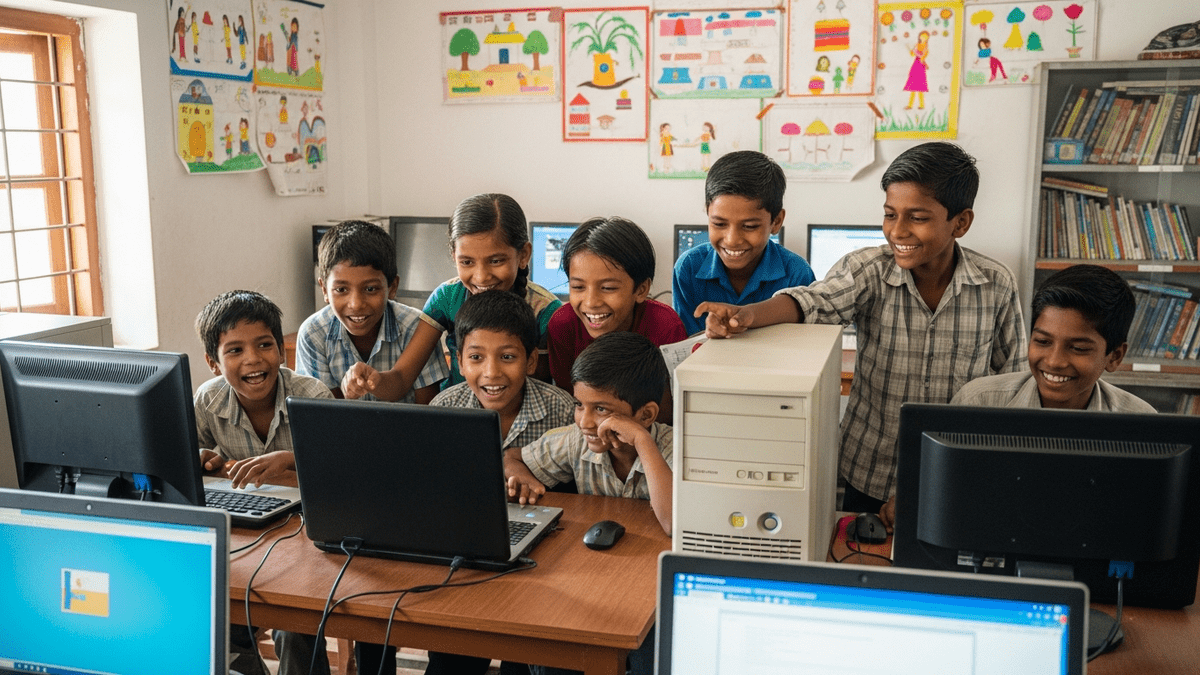
Suman does not live in Bangalore. She does not go to a fancy school. She does not have a tech-savvy family. She learned to code because someone in her community set up a learning POD with four APNA PC setups. That is all it took.
Across India’s smallest towns, this story is repeating. Children who had never seen a computer are building projects, learning to type, and discovering skills that will shape their futures. The tool making this possible is not expensive. It is not complicated. It is an affordable computer in India called APNA PC.
Why Small Towns Were Left Behind
India’s EdTech revolution built apps for metro cities. Coding platforms target Bangalore parents. STEM labs open in Delhi and Mumbai. The children in small towns were ignored. Not because they are less intelligent. Because they are less visible.
A child in a small town has access to a school, a coaching center, and a phone. That is it. No coding bootcamps. No STEM workshops. No digital libraries. The school teaches the textbook. The coaching center teaches the textbook again. The phone is for entertainment.
The result is predictable. Small-town students score well on board exams but struggle in college when they encounter digital tools for the first time. They are smart, hardworking, and capable. They just never had the chance to prove it.
The digital divide in small towns is not just about hardware. It is about mindset. Parents in small towns do not know what their children could learn on a computer. They have never seen a child code. They have never seen a digital project. They do not know what is possible. A learning POD changes that by showing them.
When a child in a small town builds a Scratch animation and shows it to their parents, the entire neighborhood sees what is possible. The mindset shifts from “computers are for rich people” to “my child can do this too.” That shift is more powerful than any advertisement.
How APNA PC Changes the Equation
APNA PC is not a high-end gaming rig. It is not a premium laptop. It is a practical, affordable computer designed for Indian students. Intel Core i3 processor. 8GB RAM. 128GB SSD. Pre-loaded with Scratch, LibreOffice, VS Code, Blender, and Arduino IDE.
At ₹30,000, it costs less than a year of coaching fees in most towns. It comes complete with a monitor, keyboard, mouse, and CPU. A family plugs it in and starts using it. No installation headaches. No compatibility issues.
For a learning POD, 4-5 APNA PC setups serve 15-20 children in rotating batches. The total investment is ₹1,20,000-₹1,50,000. That is less than what many families spend on coaching in two years.
APNA PC was built for this exact scenario. Not for metro families who can afford any laptop. For small-town families who need a reliable, affordable machine that works from day one.
The Ripple Effect
When one child in a small town learns to code, the entire community notices. Parents talk. Neighbors ask questions. Other families want the same for their children. The demand grows organically.
A learning POD in a small town does not need advertising. It needs one success story. One child who built something impressive. One parent who told their neighbors. Within weeks, the POD is full.
The ripple effect goes beyond education. A learning POD creates a local educator. It gives children a reason to stay in their town instead of migrating to a metro for opportunities. It shows parents that quality education does not require a ₹2 lakh annual school fee.
The best part is that the technology keeps getting more affordable. A computer that cost ₹50,000 five years ago costs ₹30,000 today. A learning POD that was a dream two years ago is a business model today. The barriers are falling. The opportunity is growing.
Start a TeachToEarn Learning POD in your town. The model works anywhere. The demand is everywhere. The only missing piece is someone willing to start. Get APNA PC at ₹30,000.
DIKSHA — India’s national digital learning platform. UNESCO global education research.
Ready to bring APNA PC to your community? Get APNA PC at ₹30,000 and start changing education in your town.