Picture a bright ten-year-old sitting in a classroom of sixty students, raising her hand every few minutes, and never once getting called on. She’s not struggling. She’s bored. She already knows the answer. This is the quiet crisis playing out in thousands of Indian classrooms every single day, and it’s exactly why micro-school India educators and parents are talking about could change everything.
The Real Problem With One-Size-Fits-All Classrooms
India’s government schools and even many private schools operate on a simple assumption: if you put children of the same age in the same room with the same textbook, learning will happen. For some kids, it does. For most, it doesn’t.
A teacher managing sixty students can’t pause to check whether the child in row four has understood fractions before moving on to division. There’s a syllabus to finish, exams to prepare for, and a system that measures speed over understanding. The result is that children who need more time fall behind, and children who need more challenge switch off.
Parents feel this. They spend evenings at the kitchen table re-teaching what school was supposed to cover. Educators feel it too. Most teachers didn’t enter the profession to rush through a textbook. They wanted to actually reach children.
The system isn’t filled with bad teachers or careless parents. It’s filled with people working inside a structure that was never designed for personalized education. That’s the real problem.
The Opportunity Hidden in Plain Sight
Here’s what’s changed. Digital tools, affordable hardware, and platforms like DIKSHA — India’s national digital learning platform have made it possible for a single motivated educator to deliver high-quality, structured learning to a small group of students without needing a large school building or a massive budget.
The Digital India initiative has pushed connectivity into tier-2 and tier-3 towns. Parents in these areas are hungry for better options. They don’t want to send their child two hours away to a city school. They want something local, trusted, and genuinely effective.
A small learning centre run by a qualified educator in a neighbourhood can serve ten to twenty students with real attention, real feedback, and real results. That’s not a compromise. That’s actually a better learning environment than most expensive private schools can offer.
What a Micro-School Actually Looks Like
A micro-school isn’t a coaching class. It isn’t tuition. It’s a structured learning environment where a trained educator takes ownership of a small cohort’s academic growth across subjects, using a mix of curriculum, technology, and genuine human connection.
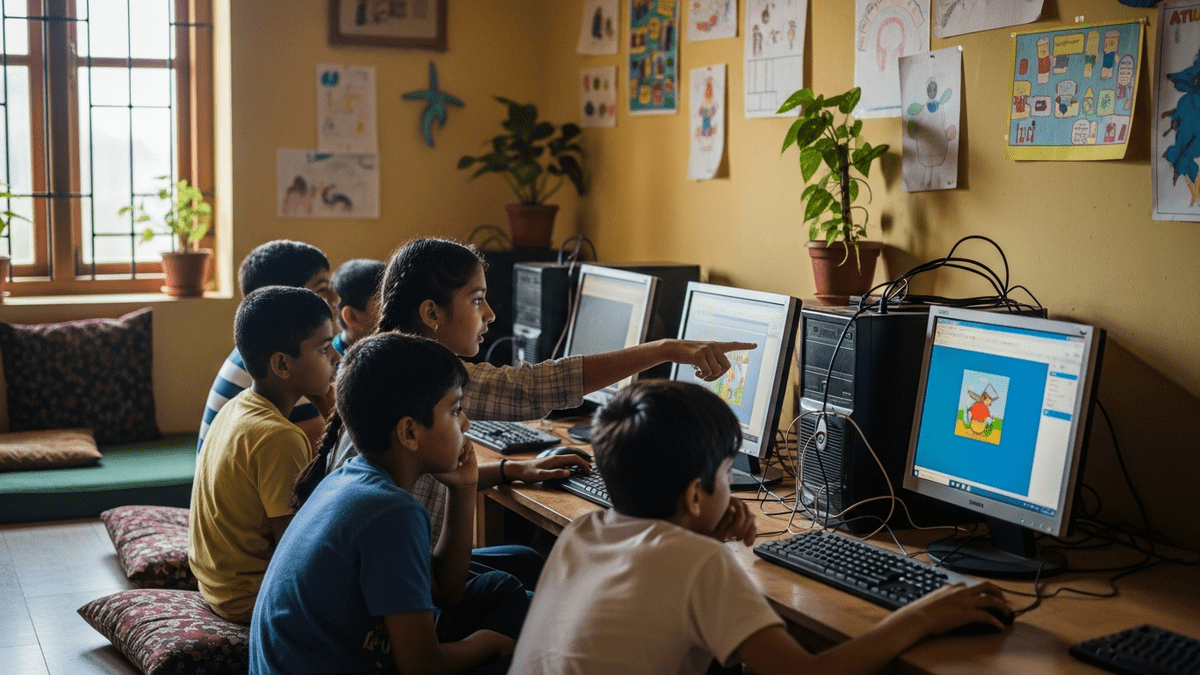
When you combine a dedicated educator with a proper digital classroom India setup, something shifts. Students get called on. Their questions get answered. Their pace is respected. A child who’s ahead gets stretched. A child who’s behind gets support before the gap becomes a crisis.
This model works because it removes the two biggest barriers to good teaching: too many students and too little time. When you’re working with fifteen children instead of sixty, you’re actually teaching, not just presenting.
How You Can Start One Right Now
You don’t need to build a school from scratch. The TeachToEarn Learning POD model is designed exactly for educators and parents who want to create a high-impact micro-school in their own community without the complexity of running a traditional institution.
Here’s what getting started looks like in practical terms:
- Identify a space in your home, community hall, or rented room that can seat fifteen to twenty students comfortably.
- Get set up with APNA PC, TeachToEarn’s all-in-one learning device priced at just ₹30,000, which gives you a complete digital classroom without expensive infrastructure.
- Follow the TeachToEarn curriculum and session structure so you’re not building content from zero.
- Enrol your first batch of students from your immediate neighbourhood. Word of mouth in a community this size travels fast.
- Track learning outcomes from week one. Parents will see the difference and tell others.
Understanding the financial side matters too. The TeachToEarn POD Economics breakdown shows clearly how a POD reaches break-even and starts generating sustainable income for the educator running it. This isn’t charity work. It’s a viable livelihood built around something meaningful.
India has hundreds of thousands of trained, passionate educators who are either unemployed or stuck in systems that don’t let them teach well. It has millions of parents who know their child deserves better but don’t know where to find it. Micro-schools are the bridge between those two realities.
The classroom of sixty isn’t going away overnight. But you don’t have to wait for the system to change before you do something about it in your own community.
Ready to build something that actually works? Start a TeachToEarn Learning POD today and take the first step toward running a micro-school that your neighbourhood will thank you for.