
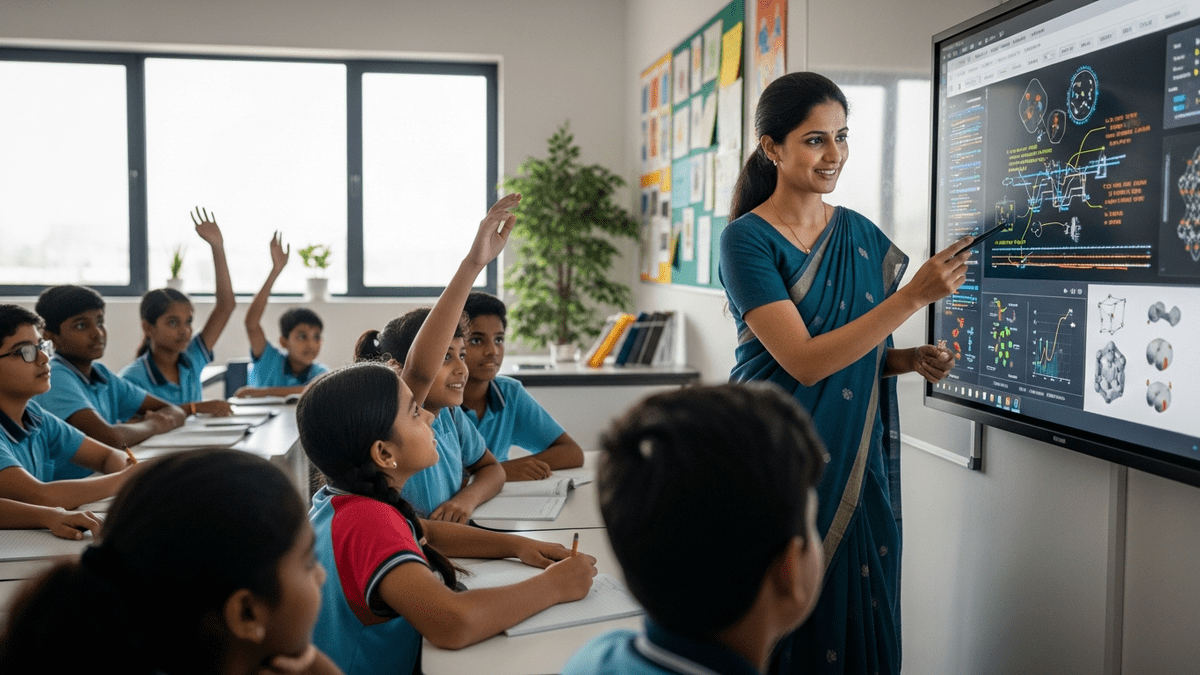
A teacher in a small town in Uttar Pradesh walked into her classroom one morning, switched on a digital screen, and watched thirty students lean forward at the same time. That single moment captured something that years of chalk-and-board teaching hadn’t managed to achieve. Interactive learning tools are doing exactly that across India right now, and the shift is faster and deeper than most people realise.
The Real Challenge Facing Indian Classrooms Today
Let’s be honest about what’s happening on the ground. Most government and private schools are still running on infrastructure that was designed for a different era. Blackboards, rote learning, and one-size-fits-all teaching methods dominate the landscape. Students who don’t grasp a concept in the first pass often get left behind, with no system to catch them.
The digital classroom India needs isn’t just about putting a screen in front of students. It’s about changing how learning happens, making it two-way, visual, and personalised. Without that shift, even expensive hardware sits unused in a corner.
There’s also the issue of teacher confidence. Many educators want to use technology but haven’t been trained to integrate it meaningfully. The tools exist, but the bridge between the tool and the classroom practice is often missing. That gap is costing students their potential.
National platforms like the DIKSHA national digital learning platform have made quality content available for free, yet adoption remains uneven. The problem isn’t access to content alone. It’s the absence of a structured, supported environment where teachers can actually use these resources with confidence.
Why the Opportunity Has Never Been Bigger
Here’s what’s changed. EdTech tools have become dramatically more affordable, more intuitive, and more effective. A school or learning centre that sets itself up with the right technology today has a genuine competitive edge over those that wait.
The Digital India initiative has pushed internet connectivity into rural and semi-urban areas at a pace nobody predicted five years ago. That infrastructure is now ready to support digital learning at scale. The question isn’t whether India is ready for tech-enabled classrooms. It’s whether you’re ready to lead that charge in your community.
Student engagement is the metric that matters most, and it’s the one that interactive tools move most dramatically. When a student can watch a concept animated, answer a quiz instantly, and get feedback in real time, learning stops being passive. It becomes something they actually want to do.
This is the moment for teachers and school owners to act. Become an Edupreneur with TeachToEarn and position yourself at the centre of this transformation rather than watching it happen from the sidelines.
How to Set Up an Interactive Learning Environment That Actually Works
Start with the right hardware. TeachToEarn’s APNA PC is built specifically for learning centres and small schools in India. Priced at ₹30,000, it comes loaded with curated educational content and is designed to work reliably even in areas with inconsistent internet connectivity. It’s not just a computer. It’s a complete teaching station.
Pair the hardware with structured content. Don’t just hand students a screen and hope for the best. Map your digital content to your existing curriculum so that every lesson has a clear digital component. Start with one subject, get comfortable, and then expand. Small, consistent steps build lasting habits.
Train your teachers before you train your students. Run short internal sessions where educators explore the tools themselves, make mistakes in a safe space, and discover what works for their specific class. A teacher who’s confident with a tool will use it creatively. One who isn’t will avoid it entirely.
Track student engagement, not just test scores. Use the data that digital tools generate to understand which students are struggling and where. This kind of real-time insight is something a traditional classroom simply cannot offer, and it changes how you intervene and support learners.
To understand the financial side of running a tech-enabled learning pod, check out the TeachToEarn POD Economics breakdown, which walks you through costs, revenue potential, and how quickly you can reach break-even.
The shift to interactive learning isn’t a distant future. It’s happening in classrooms right now, and the schools that embrace it are already seeing the difference in student outcomes, parent trust, and enrolment numbers.
Ready to bring this transformation to your community? Start your TeachToEarn Learning Pod today and take the first step toward building a classroom that genuinely excites every student who walks through the door.