
Priya watched her nine-year-old son stare blankly at his math worksheet, frustration building with every unsolved problem. Science felt even worse. He’d memorize facts for exams but forget them days later. Like many Indian parents, she wondered if there was a better way. Then she discovered how to use a computer to build child confidence in math and science. Within weeks, everything shifted. Her son wasn’t just solving problems; he was excited about learning. This transformation isn’t magic. It’s technology meeting education in ways classrooms can’t match.
If your child struggles with numbers or avoids science homework, you’re not alone. Millions of Indian parents face the same challenge every day. The good news? A computer and the right approach can change everything about how your child feels about these subjects.
Why Math and Science Feel Hard for Many Students
Math and science aren’t just subjects. They’re confidence builders or confidence crushers. When a child struggles with a concept, shame often follows silently. They sit in class, unable to ask questions, falling further behind each week. Traditional teaching moves at one speed for everyone, leaving some kids lost and others bored.
Science becomes abstract and disconnected from reality when taught only through textbooks. How can a child visualize molecular structures or planetary motion from a flat page? Math feels like endless rules with no purpose. They memorize formulas but don’t understand why they matter. This disconnect kills curiosity and builds anxiety instead of confidence.
The classroom environment makes it worse. Students fear being wrong in front of their peers. They stop raising hands. They stop trying. By the time they reach higher classes, the gap between confident students and struggling ones becomes enormous.
How Computer-Based Learning Changes the Game
Math and science computer learning works differently from traditional classroom teaching. Your child learns at their own pace, without judgment from anyone. They can pause, rewind, and try again as many times as needed. There’s no embarrassment, no pressure, just steady progress.
Interactive simulations bring science alive in ways textbooks never could. A child can conduct virtual experiments, explore space, or build molecules on screen. They see instant results of their actions. Visual learning sticks better than words on a page. For math, gamified math apps turn practice into play. Solving problems becomes a challenge to win, not a chore to complete.
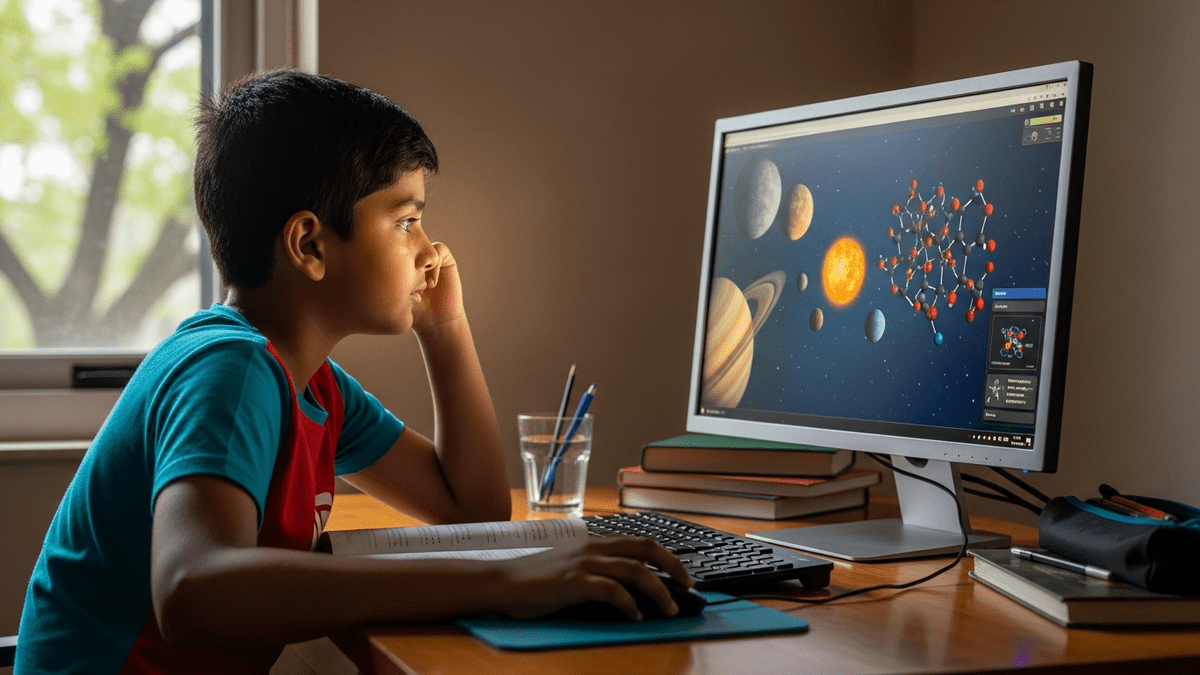
Instant feedback is game-changing for young learners. When your child makes a mistake, they know immediately and understand why. This builds problem-solving skills and deep understanding, not just test scores. Digital learning for math and science gives children complete control over their learning journey.
Practical Ways Parents Can Use a Computer for Math and Science Learning
Start with the right tools. APNA PC is designed specifically for Indian families. At just ₹30,000, it’s a complete bundle including education software, 3-year warranty, and professional installation. It’s not a luxury. It’s an investment in your child’s confidence and future academic success.
Set up a dedicated learning space at home. It doesn’t need to be fancy, just quiet and comfortable. Let your child explore educational platforms like the DIKSHA digital learning platform and NCERT official resources. Both offer free, quality content aligned with school curricula.
Use computer for math practice through adaptive apps that match your child’s current level. They won’t feel stuck or bored. Science simulations let your child experiment safely without expensive lab equipment. They can break things, try new approaches, and learn from mistakes without any consequences. This freedom builds real understanding.
Don’t just hand over the device and walk away. Sit with your child sometimes. Ask what they’re learning. Show genuine interest in their progress. When parents engage actively, children’s confidence grows much faster. They see that math and science matter to you too.
Track progress through the software’s built-in analytics tools. Most educational programs show exactly where your child excels and where they need more practice. Use this data to guide your support, not to pressure them. Celebrate small wins consistently. Progress builds confidence, and confidence builds even more progress.

Balance screen time with offline activities that reinforce learning. Use what they’ve learned on the computer to explore the real world together. Calculate distances on family trips. Observe nature and connect it to science lessons from the screen. Technology opens doors; real-world exploration walks through them.
Your child’s confidence in math and science isn’t fixed. It grows with the right support, the right tools, and your belief in them. Technology removes barriers that traditional classrooms can’t. It makes learning personal, visual, and achievable for every child.
Ready to give your child this advantage? The APNA PC, an affordable computer for learners makes it possible for every family. Learn more about Why Every Indian Child Deserves a Computer Before Age 12 and start your child’s learning journey today.
Your child’s potential in math and science is waiting to be unlocked. Explore APNA PC and watch their confidence soar.