CSR funds should not disappear into one-day events, photo opportunities, or equipment that nobody uses after the inauguration. If a company wants its education CSR to create visible community value right now, it should invest in TeachToEarn community-based learning digital PODs.
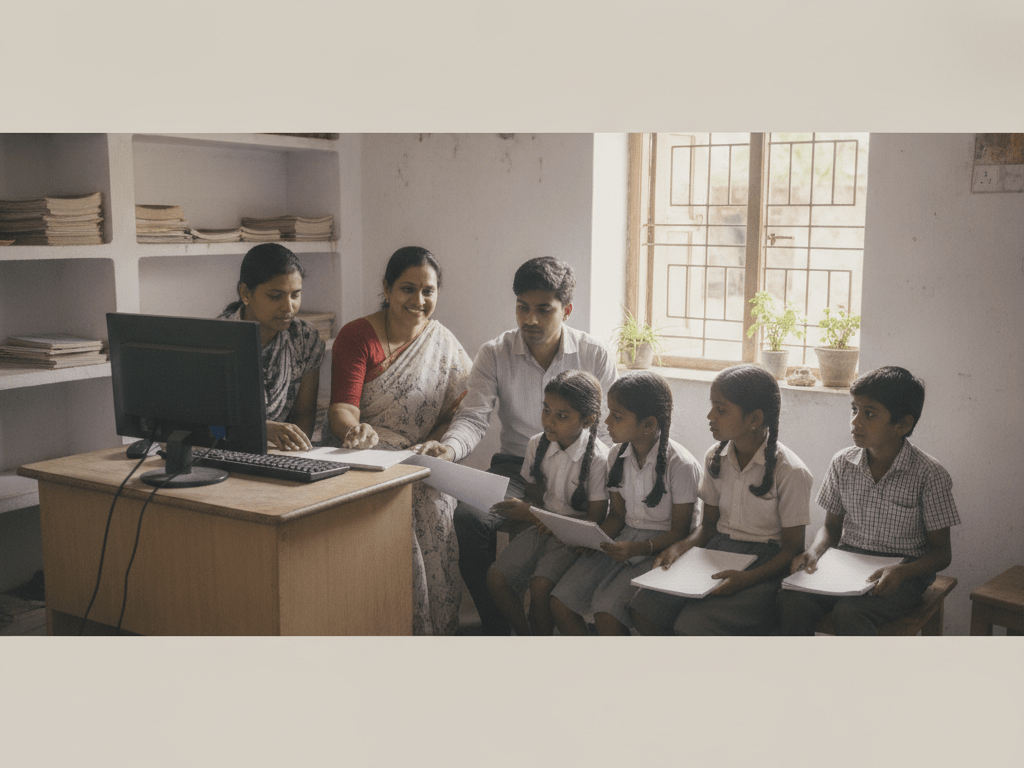
A POD is a small, local learning space where children can access a proper computer, guided digital learning, project work, AI-supported practice, and a mentor who helps them turn screen time into real work. It is practical, measurable, and close to the families who need it.
Why CSR Needs A More Visible Education Model ?
Companies already know that education is a strong CSR priority. Under India’s CSR framework, promoting education and employment-enhancing vocational skills are recognized areas for CSR activity. But the real question is not whether education is a valid theme. The question is: which education model gives the strongest visible return for the community?
Many CSR education projects are well-intentioned but weak in follow-through. A computer may be donated to a school, but no one tracks whether students use it meaningfully. A workshop may be conducted, but there is no monthly learning record. A classroom may be painted, but the child’s learning gap remains untouched.
Community digital PODs solve this problem because they combine access, mentoring, regular usage, and proof of learning in one small system.
A POD Is More Than A Donation
The biggest mistake in education CSR is treating hardware as the outcome. A device alone is not transformation. It becomes useful only when children use it regularly to read, write, calculate, create, research, practise, and present their work.
A TeachToEarn POD turns APNA PC into a shared community learning station. Children do not only watch videos. They type answers, create presentations, solve guided exercises, build simple projects, and save their progress. A local mentor keeps the routine alive and helps parents understand what is improving.
This is why a POD is stronger than a one-time computer donation. It creates a repeatable learning habit.
Why This Is The Right Moment ?
Parents are worried about learning gaps, screen addiction, rising tuition costs, and whether their children are ready for an AI-driven future. Schools are under pressure to show digital learning without spending like premium private institutions. Companies want CSR projects that are credible, locally useful, and easy to explain to stakeholders.
A community-based digital POD sits exactly at this intersection. It is affordable enough to replicate, structured enough to monitor, and human enough to build trust. It gives children access to digital tools without leaving them alone with a screen.
Most importantly, it creates visible outcomes. A CSR partner can see how many children attended, what activities were completed, what work was saved, and how parents responded during review sessions.
What A CSR-Funded POD Can Deliver ?
A strong POD should focus on practical learning evidence. Every week, children should produce something that can be saved or shown: a typed paragraph, a corrected worksheet, a reading summary, a science diagram, a maths practice record, a presentation, or a small project.
Over a month, this becomes a learning portfolio. The parent can see the child’s first attempt, improved version, and next learning goal. The mentor can identify where the child needs help. The CSR partner can review progress without relying only on attendance photos.
This makes the POD useful for children, credible for parents, and accountable for funders.
Better Use Of Funds Than One-Time Events ?
One-day CSR events may look impressive, but their impact is often hard to sustain. A POD keeps working after the photo is taken. The same setup can serve batches of children across the week. It can support homework, digital literacy, English practice, AI-assisted learning, project work, and career exposure.
It also creates local ownership. A community mentor, school partner, or edupreneur can operate the POD with a clear routine. Parents know where the learning happens. Children know when to come. The CSR fund supports a living system instead of a passive asset.
That is a much better story for any company: not “we donated computers”, but “we enabled a community learning POD where children build digital skills every week.”
How Companies Can Start Small And Scale ?
A company does not need to begin with a huge programme. Start with one location, one APNA PC-based POD, one trained mentor, and a simple 90-day plan. Track attendance, weekly activities, student work samples, parent review meetings, and mentor notes.
After 90 days, review what improved. Did students complete more written work? Did parents attend review sessions? Did children gain confidence using a keyboard, creating documents, or explaining their projects? These are practical signals that a CSR team can understand.
Once the model is proven, the company can replicate it across more neighbourhoods, schools, villages, or partner locations. Scale should come after the routine is working, not before.
A Strong Fit For Schools, NGOs, And Edupreneurs
TeachToEarn PODs also make collaboration easier. A school can provide space and student access. An NGO can support mobilisation and reporting. A local edupreneur can run the sessions. A CSR partner can fund setup, training, monitoring, and learning materials.
This creates a shared model where everyone has a clear role. The school gets visible digital learning. The community gets access. The company gets measurable education impact. Children get a place to practise skills they cannot build through textbooks alone.
Fund A POD That Shows Real Learning
If your company is planning education CSR, do not spend the budget only on events, banners, or unused infrastructure. Set up a TeachToEarn community-based learning digital POD and make every rupee produce visible student work.
Start with one APNA PC-powered POD, one mentor, and one 90-day learning plan. Use the POD to help children create, improve, save, and present their work to parents and funders.
Explore APNA PC here and begin building a CSR-funded learning POD that your community can actually use: https://www.teachtoearn.in/apna-pc/
The best CSR education projects are not the ones that look good for one afternoon. They are the ones children return to every week, because that is where learning becomes visible.