
Quality education small town India remains a significant challenge, with many parents struggling to find reliable learning options beyond basic schooling. Students in Tier 2 and Tier 3 towns often lack access to specialized coaching, experienced tutors, and modern learning resources that urban centers take for granted. The gap between rural and urban education continues to widen, leaving talented young minds without proper guidance and mentorship. This reality has sparked a revolution in how families approach learning—through home-based PODs (Points of Digital Learning) that combine affordability with excellence.
Why Quality Education Small Town India Matters Now
The education landscape in small towns has transformed dramatically over the past five years. Parents now understand that quality education small town India doesn’t require relocating to metropolitan areas or spending lakhs on boarding schools. Digital tools, structured curriculum frameworks, and dedicated educators have made it possible to deliver world-class learning right from home.
According to India’s Ministry of Education, approximately 65% of students in rural and semi-urban areas lack access to quality tutoring services. This gap directly impacts their competitive exam performance, skill development, and future opportunities. The solution lies not in waiting for government infrastructure but in empowering local educators to create POD learning centers using affordable technology.
APNA PC—a complete Rs.30,000 bundle—has revolutionized this possibility. This comprehensive package includes hardware, software, curriculum content, and teacher training, enabling educators to launch professional learning centers without massive capital investment.
How Learning POD Small Town Settings Work
A POD is a small group learning center (typically 8-15 students) operated from a home or community space. Unlike traditional tuition centers requiring expensive infrastructure, PODs leverage digital platforms combined with personalized teaching. Quality education small town India through PODs means students receive:
- Personalized attention from trained educators
- Access to DIKSHA digital learning platform and curated online resources
- Structured curriculum aligned with CBSE and state boards
- Regular progress tracking and parent communication
- Affordable fees (typically Rs.1,500-3,000 per student monthly)
The POD model works because it combines human touch with digital efficiency. Teachers use APNA PC to access lesson plans, create assessments, and track student progress. Students benefit from blended learning—part digital, part face-to-face—which research proves enhances retention and engagement.
APNA PC: The Game-Changer for Small Town Educators
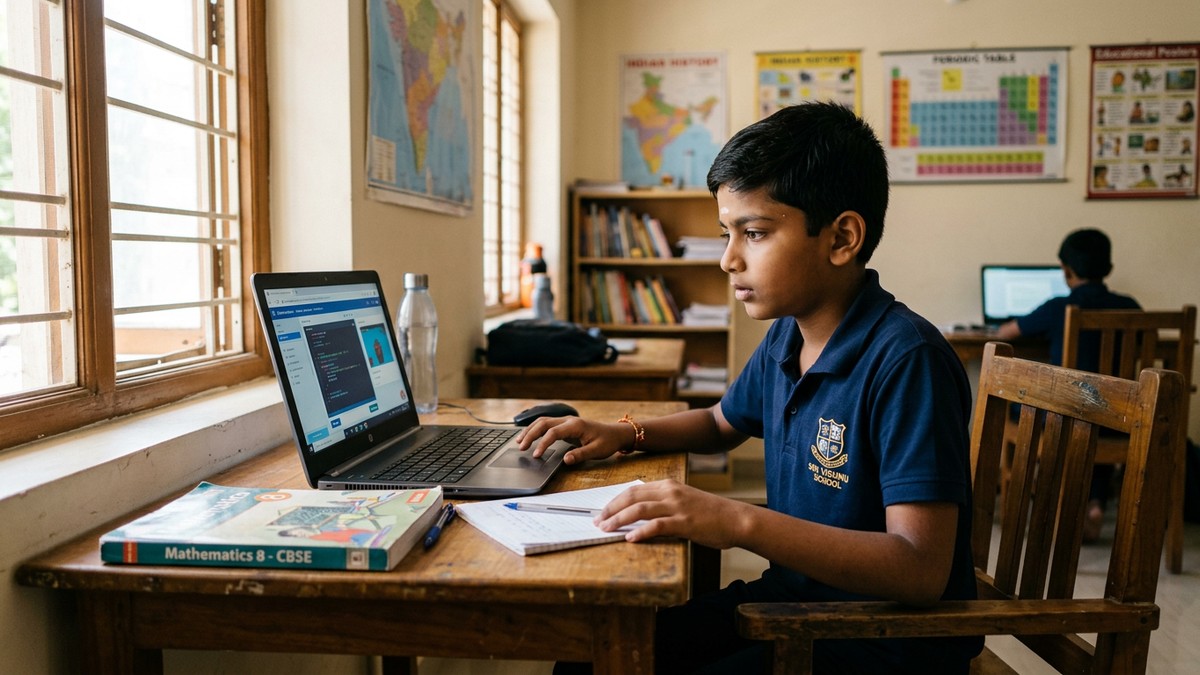
APNA PC is specifically designed for educators in small towns and villages who want to provide quality education small town India without overwhelming complexity or cost. For Rs.30,000, educators receive a complete ecosystem:
- Pre-loaded curriculum content (Math, Science, English, Social Studies)
- Teacher management software for attendance, assignments, and assessments
- Student progress dashboards visible to parents
- Training modules for educators on pedagogy and technology
- Technical support and regular content updates
This investment pays for itself within 2-3 months of operating a POD with 10-12 students. Educators report 40-50% higher student engagement compared to traditional tuition methods, directly translating to better academic outcomes.
Real Impact: Quality Education Small Town India Success Stories
Across Tier 2 and Tier 3 towns, POD educators using APNA PC have transformed learning outcomes. In Bihar, a former school teacher launched a POD serving 12 students and saw 85% of them improve their board exam scores by 15-20% within one academic year. In Madhya Pradesh, a homemaker created a POD focusing on competitive exam preparation, generating consistent income while helping 50+ students crack entrance tests.
These success stories share common elements: structured curriculum, regular parent engagement, and technology that simplifies rather than complicates teaching. Quality education small town India is no longer aspirational—it’s achievable and profitable for educators willing to embrace the POD model.
Building a Sustainable POD Business Model
Starting a POD requires minimal infrastructure but strategic planning. Here’s a realistic financial snapshot:
- Initial investment: APNA PC bundle (Rs.30,000) + basic furniture and internet (Rs.15,000-20,000)
- Monthly operational cost: Internet, utilities, content updates (Rs.3,000-5,000)
- Revenue potential: 12 students × Rs.2,000 monthly fee = Rs.24,000 gross revenue
- Break-even period: 2-3 months
- Scalability: Expand to 20-25 students or launch multiple PODs in different locations
Unlike franchise models requiring ongoing royalties, POD educators retain full control and profitability. Quality education small town India through this model creates economic opportunity while addressing genuine learning gaps.
Integration with Government Digital Initiatives
APNA PC integrates seamlessly with DIKSHA—India’s national digital learning platform—giving POD students access to millions of educational resources. This alignment with government frameworks ensures quality education small town India meets national standards while maintaining local relevance and affordability.
Educators can also leverage resources from India’s Ministry of Education, creating a hybrid model that combines government curriculum, APNA PC technology, and personalized teaching.
Why Parents Choose POD Learning Centers
Parents in small towns increasingly prefer PODs over traditional tuition for several reasons:
- Affordability: 40-50% cheaper than city-based coaching centers
- Proximity: No commute time, learning happens locally
- Personalization: Small batch sizes ensure individual attention
- Transparency: Digital dashboards show progress in real-time
- Proven methodology: Blended learning approach backed by research
Quality education small town India through PODs addresses the fundamental challenge: how to provide world-class learning without world-class prices or relocating families.
Getting Started: Your Path to POD Success
Aspiring educators should begin by assessing local demand, securing a suitable space (even a 300 sq ft room works), and investing in APNA PC. Training and support systems ensure success regardless of prior technology experience.
The opportunity is real and urgent. Thousands of small town families desperately seek quality education small town India alternatives, and educators equipped with APNA PC are meeting this need profitably and meaningfully.
Learn more about launching your learning pod small town India or explore how to transition from tuition teacher to learning POD model. Access additional resources through DIKSHA digital learning platform and India’s Ministry of Education for curriculum alignment and teacher development.
Quality education small town India is no longer a distant dream—it’s a business opportunity waiting for committed educators. With APNA PC’s Rs.30,000 complete bundle, you have everything needed to launch a thriving POD that transforms student outcomes while generating sustainable income. Start your own learning POD today and become part of India’s education revolution.