
Should You Learn to Code in the Age of AI? Here’s the Truth
Your child’s future doesn’t depend on whether AI can write code. It depends on whether they understand what code does.
Here’s the truth: Every parent in India is asking the same question right now. With ChatGPT, Claude, and GitHub Copilot writing entire programs in seconds, should students still learn to code in the age of AI? The answer is more nuanced than a simple yes or no.
Most people don’t realise that coding skills for students have never been about memorising syntax. They’ve always been about problem-solving, logic, and breaking down complex ideas into simple steps. AI hasn’t changed that. It’s amplified the need for it.
Let’s be honest: The student who doesn’t understand code will be useless with AI coding tools. The student who does understand code will be unstoppable with them.
Why Coding Remains Non-Negotiable for Indian Students
Think of coding like learning mathematics. When calculators arrived, schools didn’t stop teaching math. They stopped teaching rote calculation and started teaching mathematical thinking. The same shift is happening with code.
Global research backs this shift. UNESCO global education research makes the same argument: education systems everywhere are moving away from rote memorisation towards problem-solving and computational thinking. Coding is one of the clearest ways to teach that thinking.
Here’s what’s actually happening in the job market:
- Companies aren’t hiring fewer programmers. They’re hiring programmers who can direct AI, evaluate AI-generated code, and solve problems AI can’t yet handle.
- Coding teaches computational thinking, which applies to every field from medicine to agriculture to business.
- In India, with the Digital India initiative pushing tech adoption across sectors, basic coding literacy is becoming as essential as English.
- Students who learn to code develop debugging skills. They learn to fail, analyse failure, and iterate. That’s a life skill, not just a tech skill.
If your child learns coding now, they won’t be replaced by AI. They’ll be the person using AI to do what takes others weeks in days.
The Real Problem: Access and Quality Teaching
The bottleneck isn’t whether students should learn coding. It’s whether they have access to quality instruction and the right tools.
Most Indian schools teach coding as a checkbox subject. Students memorise syntax for board exams, forget it by June, and never actually build anything. That’s not learning to code. That’s theatre.
Real coding education happens when:
- Students have hands-on access to a proper computer setup, not a shared lab they visit once a week.
- A trained educator guides them through projects, not textbooks.
- They build real things they care about, not toy programs designed for exams.
- They understand the “why” behind each line of code.
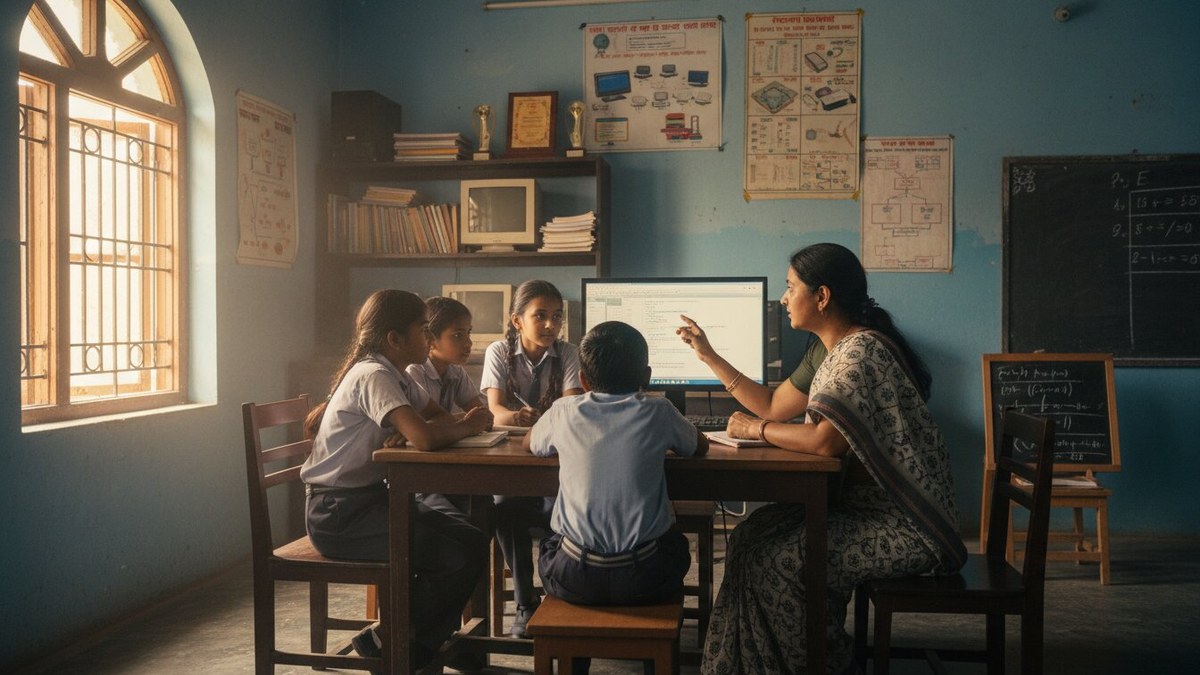
This is why the Point of Digital Learning (POD) model works. A trained educator running classes from a community centre or home, with proper equipment, creates the conditions for actual learning. Students don’t just pass exams. They develop skills.
How to Learn to Code in the Age of AI With AI Coding Tools
Here’s where it gets interesting. When students learn to code in the age of AI, AI coding tools become accelerators, not crutches. They are incredible for students who know coding fundamentals.
A student who understands loops, functions, and data structures can use GitHub Copilot to accelerate their work. They’ll know whether the AI-generated code is correct. They’ll spot bugs. They’ll modify it intelligently.
A student who doesn’t understand these fundamentals will paste AI-generated code into their project, have no idea why it works or doesn’t work, and be helpless when something breaks.
The irony is sharp: AI coding tools make it MORE important to learn coding fundamentals, not less.

What Indian Parents and Teachers Should Do Right Now
If you’re a parent and you want your child to learn to code in the age of AI properly, here’s your action plan:
- Don’t wait for your child’s school to teach coding properly. They might not. Find a qualified educator in your area or start a POD.
- Invest in proper equipment. A basic desktop setup with reliable software makes all the difference. APNA PC bundles (Rs.30,000) include everything needed: Mini PC, monitor, keyboard, mouse, webcam, headset, education software, 3-year warranty, and installation. No setup hassle.
- Focus on project-based learning, not exam preparation. Can your child build a calculator? A to-do app? A simple game? That’s real learning.
- Let them experiment with AI coding tools, but only after they understand the basics. Think of it as the difference between a learner driver using cruise control versus an unlicensed person pressing pedals randomly.
If you’re a tuition teacher, check out the how to prepare students for the AI job market guide. You’ll find practical strategies for teaching coding in the AI era. Also explore the Apni Pathshala blog for curriculum ideas aligned with CBSE standards.
The Bottom Line
Should students learn to code in the age of AI? Yes. Absolutely. But they should learn it properly, with the right equipment, the right teacher, and the right mindset.
The students who’ll thrive in the next decade aren’t those who can write code. They’re those who understand code deeply enough to work alongside AI. They’re the ones who can ask the right questions, evaluate the answers, and build things that matter.
That’s not a coding skill. That’s a thinking skill. And that’s what coding education should teach.
Start your child’s coding journey today. Get them the equipment they need. Connect them with a real educator. Watch them build actual projects. That’s how you prepare them for the AI age, not by hoping they’ll somehow figure it out.