
Your Students Aren’t Learning. Here’s Why.
Most teachers don’t realise they’re teaching at the wrong level. You spend hours preparing lessons, but your students forget everything by next week. You ask questions and get blank stares. You move through the syllabus but nothing sticks. The problem isn’t your effort. It’s that you’re not matching instruction to how the brain actually learns.
Here’s the truth: learning isn’t one thing. It’s six different things stacked on top of each other. This is Bloom’s taxonomy in education, and it’s the single most useful framework you’ll ever use as a teacher. Whether you’re a homemaker teaching your own children, a senior citizen mentoring grandchildren, a tuition teacher running classes, or an edupreneur building a learning centre, understanding these six levels will transform how your students absorb and retain information.
Let’s stop pretending that explaining something once means students have learned it. They haven’t. Not even close.
The Six Levels of Bloom’s Taxonomy
Bloom’s taxonomy levels work like a pyramid. Each level builds on the one below it. You can’t skip steps. Most teachers spend all their time at the bottom two levels and wonder why students can’t think critically.
- Level 1: Remember – This is pure recall. Students repeat facts, dates, definitions, formulas. “What is the capital of Maharashtra?” “Define photosynthesis.” It’s the easiest level and the most useless if it’s all you do. But it’s the foundation. You need basic knowledge before you can do anything else.
- Level 2: Understand – Students explain ideas in their own words. They summarise, classify, and interpret. “Why do plants need sunlight?” “Explain the difference between democracy and dictatorship.” This is where most tuition teachers stop. Students can pass exams here. But they can’t apply anything.
- Level 3: Apply – Now students use knowledge in new situations. They solve problems, build models, create examples. “If a train travels at 60 km/h for 3 hours, how far does it go?” “Write a dialogue using past tense.” This is where learning starts getting useful. Students connect theory to reality.
- Level 4: Analyse – Students break things apart and see how pieces connect. They compare, contrast, distinguish causes and effects. “Why did the British succeed in colonising India?” “What assumptions underlie this argument?” This is where critical thinking begins. Most Indian students never reach here because exams don’t demand it.
- Level 5: Evaluate – Students make judgments based on criteria. They critique, defend positions, justify choices. “Is this a reliable source?” “Which solution is best and why?” This requires confidence. Many students fear being wrong so they stay silent.
- Level 6: Create – The top level. Students design, build, produce original work. They write stories, compose music, develop solutions, invent. This is where learning becomes powerful. But it’s the rarest in Indian classrooms because it’s messy and unpredictable.
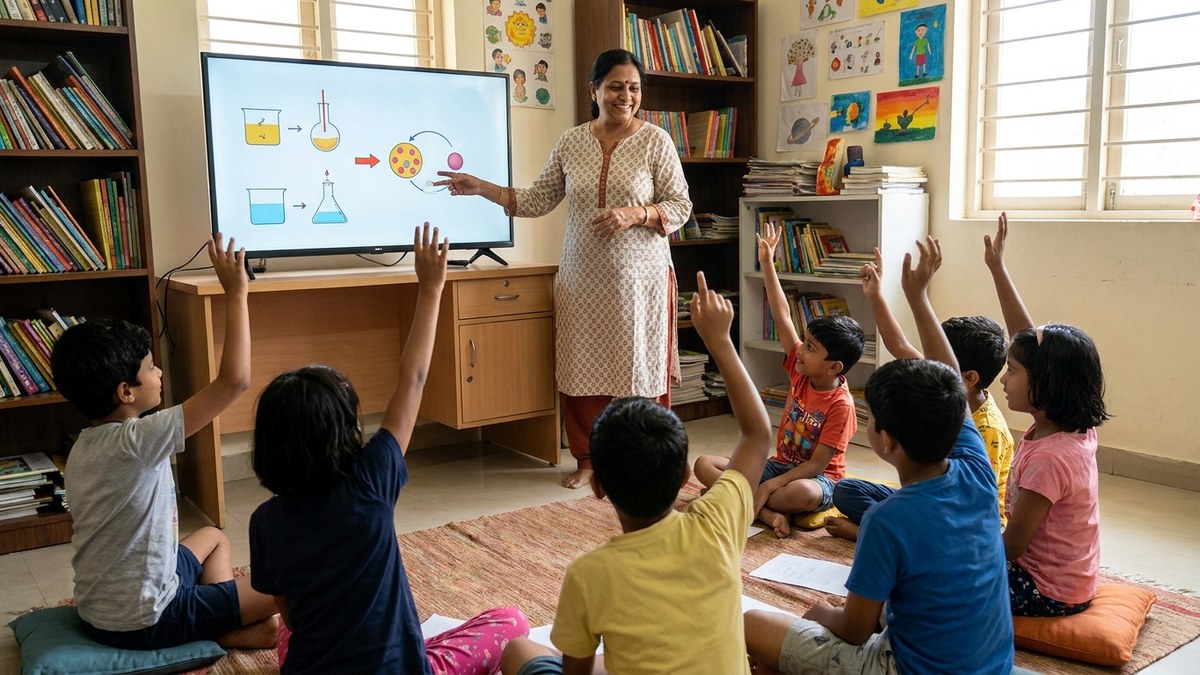
The Revised Bloom’s Taxonomy: What Changed
In 2001, educators revised the original taxonomy. They renamed the levels and flipped the order slightly. The revised Bloom taxonomy levels are now: Remember, Understand, Apply, Analyse, Evaluate, Create. The biggest shift? They moved “Create” to the top as the highest order thinking skill. They also changed the language from nouns to verbs, making it action-focused.
Why does this matter? Because it forces you to think about what you want students to DO, not just what they should KNOW. That’s a massive difference in how you design lessons.
Real Bloom’s Taxonomy Examples for Your Classroom
Stop guessing. Here are concrete examples you can use right now, whether you’re teaching online, running a tuition centre, or homeschooling.
Subject: English Literature (Story: The Thief’s Story)
- Remember: List the characters in the story.
- Understand: Explain why Hari was called a thief.
- Apply: Write a similar story set in your own neighbourhood.
- Analyse: Compare Hari’s character at the beginning and end of the story.
- Evaluate: Was Hari right to steal? Justify your answer.
- Create: Design a different ending where Hari becomes successful through honest work.
Subject: Mathematics (Topic: Fractions)
- Remember: Define a fraction and name its parts.
- Understand: Explain why 1/2 equals 2/4.
- Apply: If you have 3/4 of a cake and eat 1/4, how much remains?
- Analyse: Why is dividing by a fraction the same as multiplying by its reciprocal?
- Evaluate: Which method of solving fraction problems is most efficient and why?
- Create: Invent a fraction problem based on a real situation in your home.
See the difference? The lower levels are quick to assess. The higher levels take time but produce real learning.
Why This Matters for Your Teaching Business
Let’s be honest: if you’re running a tuition centre or a Point of Digital Learning (POD), your reputation depends on results. Parents don’t care about your teaching methods. They care that their child scores better and retains knowledge. Using Bloom’s taxonomy in education means you’re not wasting time on surface-level teaching. You’re building deep understanding.
When you teach using all six levels, something remarkable happens. Students stop asking “Will this be in the exam?” and start asking “Why does this work?” That’s when learning becomes permanent. That’s when word-of-mouth referrals start flowing.
If you’re homeschooling in India, Bloom’s taxonomy prevents the trap of thinking your child is learning just because they can recite facts. It pushes you to create, analyse, and evaluate alongside them.
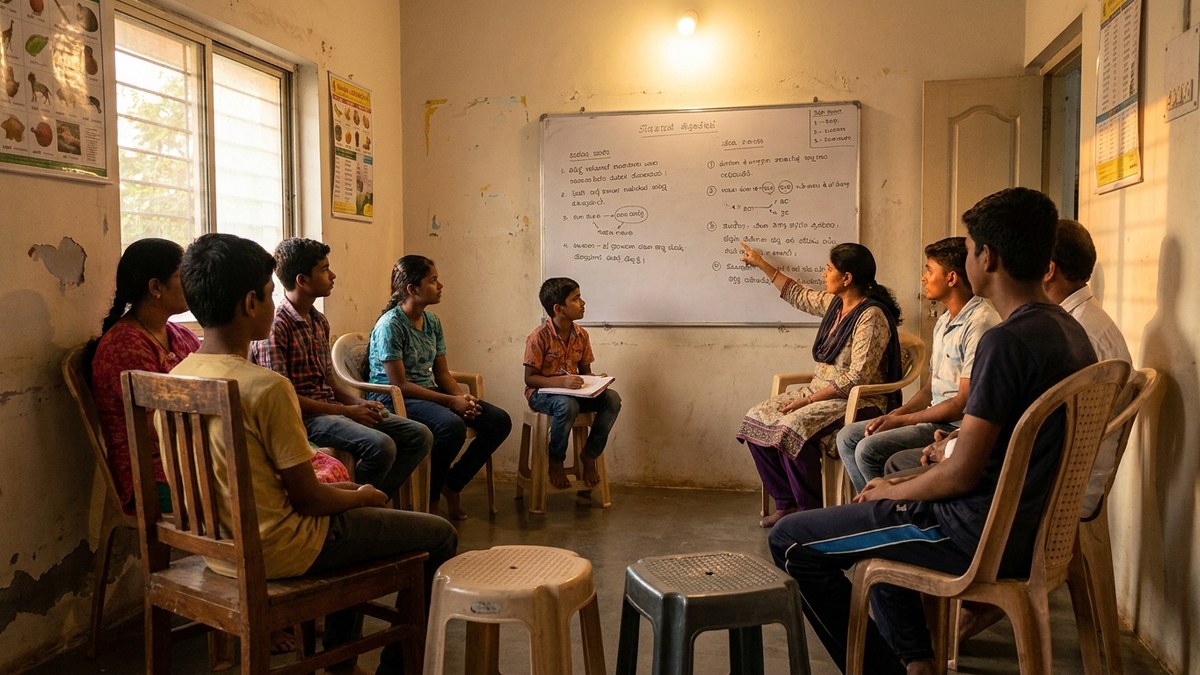
Building Your Teaching Infrastructure
Here’s what most teachers miss: you can’t teach higher-order thinking skills without the right tools. If you’re still writing lesson plans on paper and teaching from a textbook, you’re stuck at the bottom levels. Your students literally cannot reach the top.
This is why having proper technology matters. When you run a POD with APNA PC (Rs.30,000 complete bundle with Mini PC i3 7th Gen, 8GB RAM, 128GB SSD, monitor, keyboard, mouse, webcam, headset), you can create interactive lessons, show videos, use digital tools, and record sessions. Your students can create digital projects, analyse online resources, and evaluate real-world information. Suddenly, the top four levels of Bloom’s taxonomy become accessible.
You can also build your tuition centre website to showcase student projects and learning outcomes. Parents will see the difference immediately.
Want to dive deeper? Read Bloom’s Taxonomy explained – Simply Psychology for a comprehensive breakdown, or check Cornell University’s guide to Bloom’s Taxonomy for university-level applications.
Your Next Step
Stop teaching the same way and expecting different results. Start mapping your lessons to Bloom’s taxonomy levels. Ask yourself: Are my students only remembering, or are they creating? If they’re not reaching levels 4, 5, and 6, you’re leaving learning on the table.
Ready to build a proper learning centre that actually develops critical thinking? Start your TeachToEarn Learning POD today and get access to structured curriculum, technology support, and a community of educators doing this right.
Your students are waiting. The question is: will you teach them to remember, or teach them to think?