
Most people do not realise that how you take notes in class determines whether you pass or fail.
Your notebook is not a dictation book. It is not a transcript of everything your teacher says. Here is the truth: students who copy word-for-word score lower than students who write selectively. An student sitting in class has maybe 45 minutes to capture the essence of a lesson. Wasting time writing everything means you miss the logic. You miss the connections. You miss understanding.
Let us be honest. Most tuition teachers and parents never teach students how to take notes in class. They assume it happens naturally. It does not. Note-taking is a skill. Like any skill, it improves with practice and the right method.
This post shows you the best methods to take better notes, specifically for Indian classrooms and learning centres.
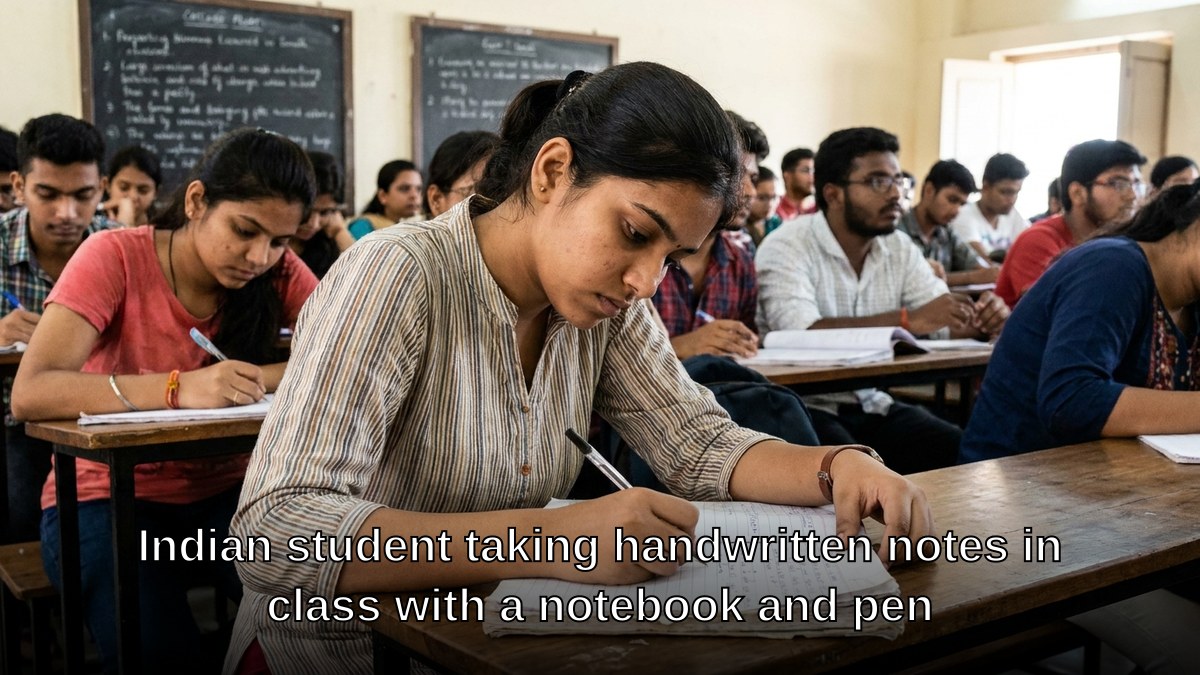
The Cornell Method: Structured Note Taking for Indian Classrooms
The Cornell Method works because it forces you to think while you write. Divide your notebook page into three sections. The right side (about 70% of the page) is for notes during class. The left side (about 25%) is for cues and keywords. The bottom (about 5%) is for a summary.
During class, write only key points on the right. Use abbreviations. Skip full sentences. After class, within 24 hours, fill the left side with questions that your notes answer. This is when real learning happens. Your brain connects ideas. You see gaps in understanding.
Why does this work in Indian schools? Because Indian exams test understanding, not memorisation. The Cornell Method builds understanding by forcing you to review and reflect. Teachers in PODs (Point of Digital Learning centres) often recommend this method because it works across subjects, from mathematics to social studies.
- Right column: Key facts, formulas, dates, definitions
- Left column: Questions that your notes answer
- Bottom section: 5-line summary of the entire page
- Review within 24 hours: This is mandatory
The Outline Method: Best for How to Take Notes in Class Quickly
The Outline Method is fast. It uses indentation and hierarchy to show relationships between ideas. Main topics get no indent. Sub-topics get one indent. Details get two indents.
Example from a history class:
- Mughal Empire (1526-1857)
- Akbar the Great
- Introduced Din-i-Ilahi
- Expanded empire to 4 million sq km
- Aurangzeb
- Last major Mughal emperor
- Expanded territory but weakened economy
This method trains your brain to listen for main ideas. You stop writing everything. You start filtering. This is exactly what exam success requires.

The Mapping Method: Visual Note Taking for Visual Learners
Some students think better in pictures. If you are one of them, the Mapping Method works. Write the main topic in the centre of the page. Draw branches for subtopics. Draw smaller branches for details. Connect related ideas with lines.
This method is especially useful in science classes. A biology lesson on photosynthesis becomes a visual map. Light goes to one branch. Water to another. Chlorophyll to another. Your brain sees the whole system at once.
The Mapping Method also helps you study faster. Instead of reading pages of notes, you review one visual map. Your memory works better with images than text.
The Sentence Method: Simple But Effective
Write one sentence per main idea. One sentence. Not a paragraph. Not a phrase. One complete sentence that captures the entire concept.
This forces clarity. If you cannot write one sentence that captures an idea, you do not understand it yet. Ask your teacher. Get clarification. This is how to take notes in class that actually stick in your memory.
The Sentence Method works best for subjects like English literature, history, and social studies where ideas matter more than formulas.
Five Practical Tips for Better Note Taking Right Now
- Use abbreviations aggressively. “Govt” instead of “Government”. “w/” instead of “with”. “b/c” instead of “because”. Speed matters.
- Leave space. Do not cram notes into every corner. Leave margins. Leave gaps between sections. You will add details later.
- Use symbols and arrows. “=” means “equals” or “results in”. “->” means “leads to”. “∴” means “therefore”. These save seconds.
- Review within 24 hours. Your brain forgets 50% of new information within one day. Review your notes the same day or next morning.
- Rewrite unclear sections. If your handwriting is messy, rewrite it immediately. Messy notes confuse you during revision.
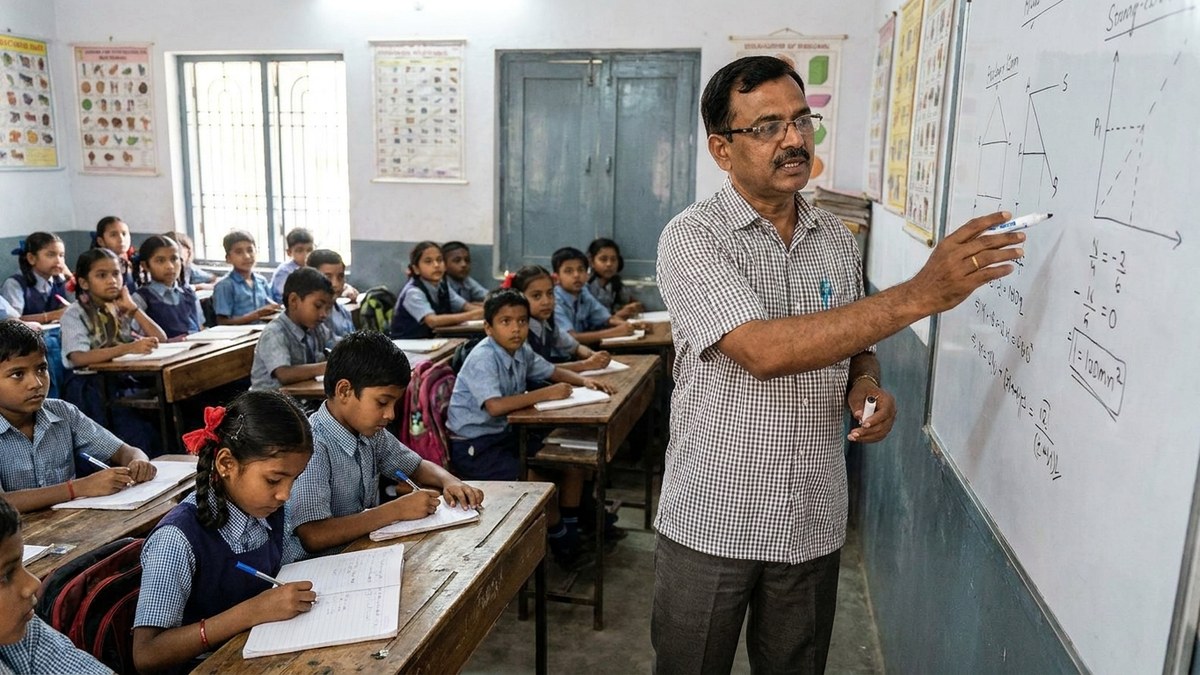
How Technology Helps: APNA PC for Digital Note Taking
Handwriting is still better for memory. But digital tools help you organize, search, and share notes. If you run a POD or teach tuition classes, APNA PC gives you the hardware to teach digital literacy alongside traditional note-taking.
APNA PC comes with education software, a 3-year warranty, and everything you need: Mini PC (i3 7th Gen, 8GB RAM, 128GB SSD), monitor, keyboard, mouse, webcam, and headset. All for Rs.30,000. Your students can learn digital note-taking apps. Teachers can demonstrate note-taking techniques on screen. Parents can see real-time progress.
This is especially useful if you understand learning styles for every student. Some students learn best by handwriting. Others by typing. APNA PC lets you teach both methods.
Special Considerations for Indian Students
Indian classrooms move fast. Teachers cover a lot of ground in 45 minutes. Your job is not to write everything. Your job is to capture the structure of the lesson.
Also, Indian exams test application, not just recall. Your notes should include examples. When your teacher gives an example, write it down. When you review, think of your own examples. This is how to take notes in class that prepares you for exams.
If you are a homemaker or senior citizen learning through a POD, these methods work just as well. The principles are universal. The only difference is your pace. You can take longer. You can ask more questions. You can review more thoroughly.
For deeper understanding of how different students learn, read about early childhood education in India and how foundational skills build over time.
Your notes are your study material. Make them count. Use one of these methods consistently. Review within 24 hours. Connect ideas to examples. This is how you move from passing to topping your class.
Ready to improve your teaching setup? Explore APNA PC and create a modern learning environment where students can learn both traditional and digital note-taking skills.
For official educational guidelines, check the Ministry of Education website for curriculum standards and learning recommendations.