
Your students walk out of class and you still don’t know what they actually learned.
Here’s the truth: most Indian teachers rely on end-of-unit tests to figure out if students understand the material. By then, it’s too late. Three weeks of teaching wasted on concepts that didn’t stick. Exit tickets in classroom assessment flip this completely. They’re simple, fast, and they work.
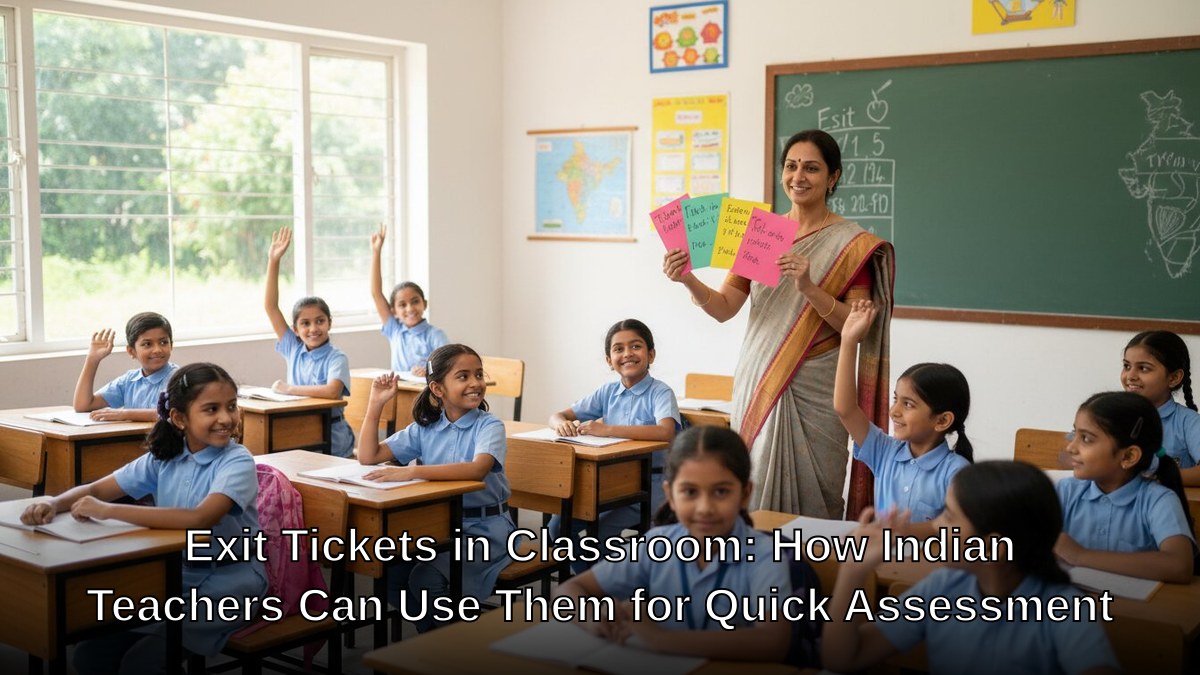
Exit tickets are small slips of paper or digital responses students complete before leaving class. One question. Two minutes. Done. You get instant feedback on what clicked and what didn’t. No waiting for semester exams. No guessing.
Let’s be honest: most Indian homemakers running tuition centres, senior citizens teaching in community learning centres, and edupreneurs building their POD (Point of Digital Learning) don’t have time for complicated assessment systems. Exit tickets fit perfectly into your schedule. They’re formative assessment strategies that actually work without adding hours to your marking pile.
Why Exit Tickets in the Classroom Actually Matter for Indian Teachers
The traditional exam culture in India focuses on summative assessment. You teach, students memorise, they take a test. But what about the learning happening in between? Exit tickets catch that moment.
Most people don’t realise that quick feedback changes everything. When you know within five minutes that students didn’t understand fractions, you can reteach it tomorrow instead of moving forward. When you see that 80% of your class got the concept, you can accelerate. This is differentiated instruction in real time.
In your tuition centre or community learning hub, exit tickets solve a specific problem. You’re teaching mixed-ability groups. Some students are ahead. Others are struggling. Exit tickets show you exactly where each student stands without embarrassing anyone in front of peers.
Consider this: a senior citizen teaching English in a village POD can use exit tickets to check pronunciation understanding. A homemaker running a maths tuition can use them to spot calculation errors before they become habits. An edupreneur building an online learning centre can use digital exit tickets to track progress across multiple batches.
Practical Teacher Exit Ticket Ideas for Indian Contexts
Stop overthinking this. Exit tickets classroom techniques don’t need to be fancy. Here are ideas that work in actual Indian classrooms:
- One-word exit ticket: Ask students to write one word that describes what they learned today. For a Hindi grammar class, it might be “sambandh” (relationship). For maths, “bhag” (division). Instant snapshot of what stuck.
- The three-two-one: Three things you learned. Two things you found confusing. One question you still have. Takes 90 seconds. Gives you everything you need.
- Misconception check: Write a deliberately wrong statement. Students mark it correct or incorrect and explain why. “All fractions are less than one.” Catches misunderstandings immediately.
- Application question: “How would you use this concept in real life?” Students connect learning to their world. You see if they truly understand or just memorised.
- Peer teaching prompt: “Explain this concept to someone who wasn’t in class today.” If students can teach it, they own it.
- Confidence scale: A simple 1-5 scale. “How confident are you with today’s topic?” Identifies students who need extra help without singling them out.

The beauty of these teacher exit ticket ideas is flexibility. You can use paper slips in a community centre with no electricity. You can use a digital form in a POD equipped with APNA PC. You can use a simple whiteboard in a tuition centre. The format doesn’t matter. The feedback does.
Getting Exit Tickets Classroom-Ready for Your Teaching Setup
If you’re running a tuition centre or learning POD, here’s how to actually implement this without chaos:
Set a routine. Same time every class. Same format. Students know what to expect. No explanation needed. This saves time and makes it a habit.
Keep it visual. Use a simple template. Students don’t need to write essays. Five to ten words maximum. You’re looking for signals, not speeches.
Read them fast. Literally tonight. Not next week. The feedback only works if you act on it. If you notice three students didn’t understand decimals, you adjust tomorrow’s lesson.
Share the results. Tell students what you noticed. “Most of you got the concept, but I saw confusion about remainders. Let’s spend 15 minutes on that.” Students feel heard. They see that their feedback actually changes what happens in class.
For more on managing this kind of quick assessment in your classroom, check out our guide on classroom management tips. And if you’re teaching mixed levels, our piece on differentiated instruction shows exactly how to use exit ticket data to teach different students differently.

Why Digital Exit Tickets in Classroom Settings Matter Now
If you’re serious about running a POD or scaling your tuition business, digital exit tickets change the game. You get instant data. You can see patterns across all your students. You can track progress over weeks and months.
This is where APNA PC comes in. For Rs.30,000, you get a complete bundle: education software, 3-year warranty, installation, and a Mini PC (i3 7th Gen, 8GB RAM, 128GB SSD) plus monitor, keyboard, mouse, webcam, and headset. Everything you need to run digital exit tickets in your learning centre.
Imagine this: you finish class, students submit their exit ticket responses through a simple form on your APNA PC, and within minutes you have a dashboard showing exactly where each student stands. No manual marking. No paper piles. Just data that helps you teach better tomorrow.
The Education in India system is changing. Digital tools are becoming standard. The Digital India initiative is pushing this forward. Teachers who adopt these tools now will lead their communities.
The Bottom Line
Exit tickets aren’t a trend. They’re a survival tool for teachers who care about actual learning, not just marks. They work in a village POD with no internet. They work in a tuition centre with 30 students. They work online. They work everywhere because they’re based on a simple principle: know your students’ minds before they leave the room.
Start this week. Pick one exit ticket idea from the list above. Use it in your next class. Read the responses. Change something tomorrow based on what you learned. That’s it. That’s the whole system.
Ready to build a proper learning centre with the right tools? Start your own TeachToEarn POD today and get everything you need to teach smarter, not harder.