AI Education is Already Here. Your Classroom Isn’t Ready.
Here’s the truth: It’s 2026, and AI education isn’t coming to Indian classrooms anymore. It’s already arrived. Teachers who refuse to adapt aren’t protecting tradition. They’re abandoning their students to a future they won’t understand.
The question isn’t whether AI learning tools will transform education. It’s whether you’ll lead that transformation or get left behind.
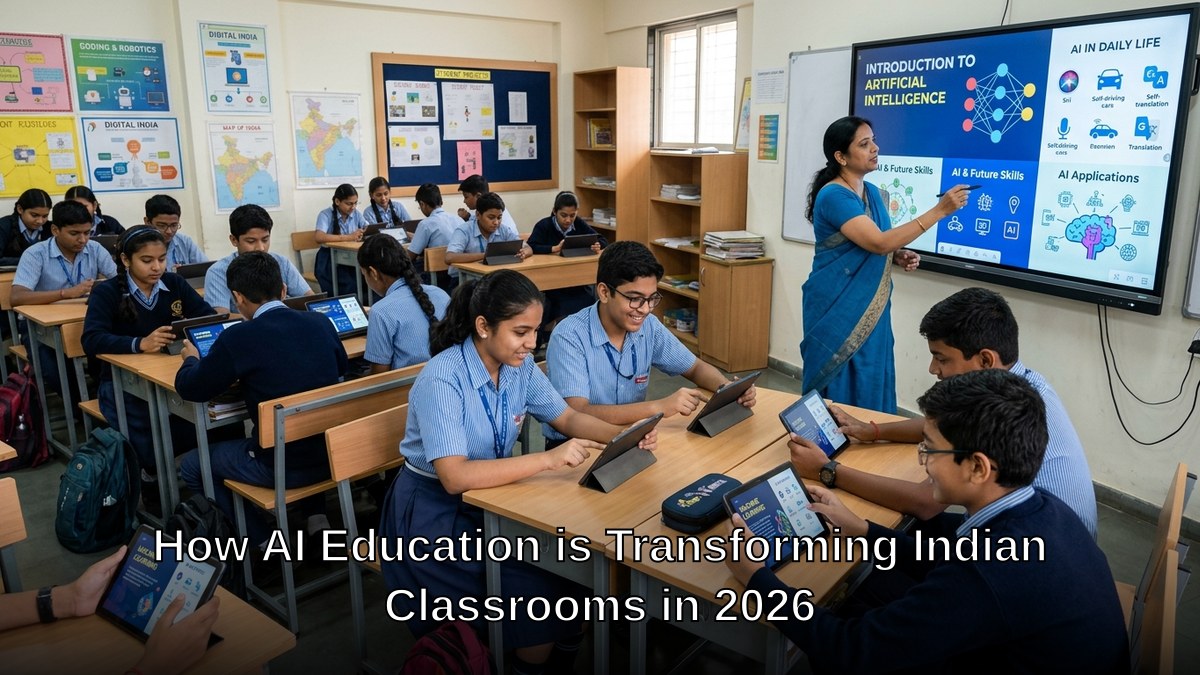
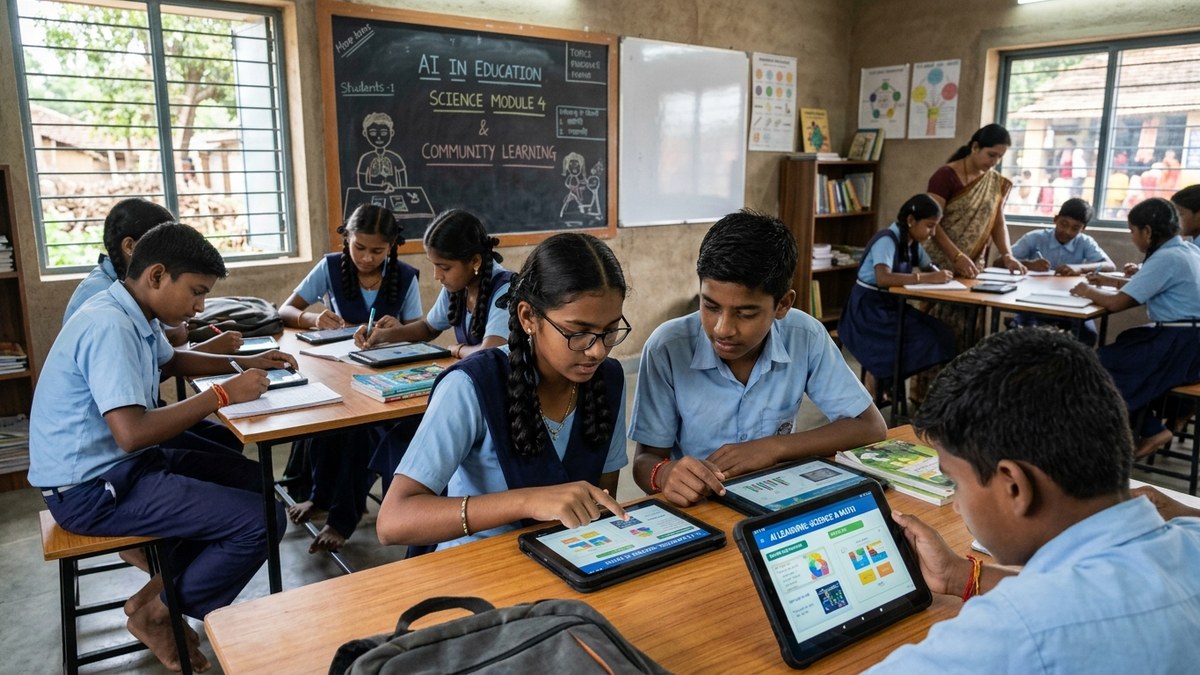
Let’s be honest. Most people don’t realise that AI education in India has moved beyond fancy experiments in Delhi and Mumbai. Village schools, tuition centres, and Points of Digital Learning across the country are already using AI to teach better. Students in tier-2 and tier-3 cities are getting personalized lessons. Teachers are spending less time grading papers and more time actually teaching.
This isn’t theoretical. This is happening now.
Key Takeaways
- AI education in Indian classrooms in 2026 is no longer limited to big-city schools; village schools, tuition centres and Points of Digital Learning are already using it.
- AI learning tools mainly do three things: personalise pace for each student, give teachers real data on where students are stuck, and free up time otherwise spent grading and tracking by hand.
- The approach is not about robots teaching; it is about removing repetitive work so teachers spend more time motivating students and clearing doubts.
- The government is pushing AI-powered learning through platforms like DIKSHA, but this works best when paired with a trained local educator who understands the students’ context.
- A Point of Digital Learning, run on an affordable complete setup like APNA PC around Rs.30,000, is a realistic entry point for a small, human-centred classroom using AI tools.
What AI Education Actually Means for Indian Teachers
When we talk about AI education, most people imagine robots teaching classes. Wrong. It’s simpler and far more powerful than that.
AI learning tools do three things that matter:
- Personalize at scale. Every student gets lessons matched to their pace, not the class average. A student struggling with fractions doesn’t waste time on material they already know. A fast learner doesn’t wait for others to catch up.
- Give teachers real data. You see exactly where each student is stuck. Not guesses. Not assumptions. Real patterns in real time.
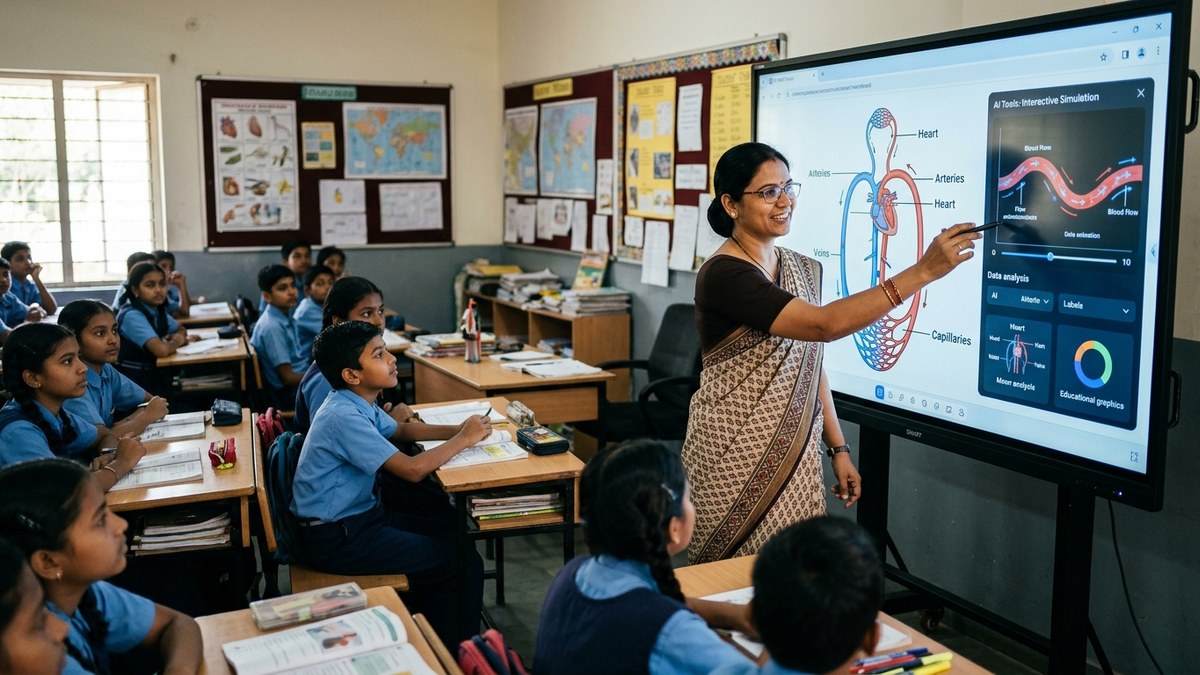
- Free up your time. Grading, tracking progress, creating worksheets. AI handles the repetition. You handle the human part: motivation, doubt-clearing, mentoring.
This is why AI personalized learning for Indian students is becoming standard in smart classrooms India. It’s not about replacing teachers. It’s about making teachers unstoppable.
You’ve probably heard that AI education is expensive. That’s outdated thinking. APNA PC changes the equation completely. For Rs.30,000, you get everything: Mini PC with i3 7th Gen processor, 8GB RAM, 128GB SSD, monitor, keyboard, mouse, webcam, headset, education software, 3-year warranty, and installation. That’s not a gadget. That’s your entry ticket to smart classrooms India.
Smart Classrooms India: Real Impact, Real Numbers
Schools and tuition centres using AI learning tools are reporting changes that matter. Student engagement up 40%. Time spent on personalized practice doubled. Teacher burnout down significantly.
But here’s what surprises most educators: the biggest gain isn’t in marks. It’s in confidence. Students who struggled for years suddenly understand concepts because the teaching pace matches their learning pace. That confidence spreads. They attempt harder problems. They ask better questions.
The government gets this. DIKSHA digital learning platform and the Ministry of Education are actively pushing AI-powered learning. But government platforms work best when paired with trained educators who understand local context. That’s where you come in.
A Point of Digital Learning (POD) run by a trained educator is the real future. Not massive schools with fancy labs. Not online courses watched alone at home. Small, local, human-centered learning spaces where an educator uses AI tools to teach better.
You can build that. Today.
The Three Barriers Stopping You (And How to Break Them)
Barrier 1: “I don’t have the hardware.” APNA PC solves this. One bundle covers everything you need. No separate purchases. No compatibility headaches. No setup confusion. Plug it in. It works.
Barrier 2: “I don’t know how to use AI tools.” You don’t need to be a programmer. The education software is built for teachers. Intuitive. Practical. Focused on what matters: student learning. Training and installation are included.
Barrier 3: “My students won’t adapt.” Stop underestimating them. Indian students take to AI learning tools faster than most adults expect. They’re already using AI in their daily lives. School is the one place where they’re not. That gap needs to close.
If you’re running a tuition centre or planning to start a home tuition business in your city, AI education is your competitive advantage. Not tomorrow. Now.
Your Move
The educators winning in 2026 aren’t the ones who resisted AI education. They’re the ones who grabbed it early, learned fast, and used it to teach better.
You have a choice. Stay where you are and hope things don’t change much. Or step forward and build something better for your students.
APNA PC makes that step affordable. The bundle includes everything. No hidden costs. No surprises. Just a complete system ready to power smart classrooms India in your community.
Your students deserve AI education. Your classroom can have it. The only question is: when do you start?
Explore APNA PC and transform your classroom today.
Frequently Asked Questions About AI education in Indian classrooms in 2026
What does AI education in Indian classrooms actually look like in 2026?
It means lessons that adjust to each student’s pace, dashboards that show teachers exactly where a student is stuck, and automated grading or progress tracking that frees teachers for actual teaching. It does not mean robots replacing human instructors; the technology handles repetition while the teacher handles motivation and difficult explanations.
Is AI education only reaching big cities in India?
No. Village schools, tuition centres and community learning points in tier-2 and tier-3 towns are already using AI-assisted tools, often through government platforms like DIKSHA alongside affordable local hardware. The spread is driven more by cheaper computer bundles than by city location.
Does AI education replace the need for a good teacher?
No. AI tools handle repetitive tasks like grading, tracking and generating practice material, but motivating a struggling student, building trust with parents and explaining a tricky concept in person still need a human teacher. The technology is support, not a substitute.
What equipment is needed to bring AI education into a small classroom or tuition centre?
A reliable computer with a webcam, stable internet and pre-loaded education software is the baseline, since AI tools run poorly on outdated hardware. A complete bundle that includes the machine, software, warranty and installation avoids piecing together separate purchases.
Can a home tutor realistically use AI education tools?
Yes. A trained home tutor running a Point of Digital Learning can use the same AI-assisted practice and tracking tools as a formal school, as long as the computer setup is dependable enough to run them without lag. Many of these tools are free or low cost for individual educators.
India’s National Education Policy 2020 explicitly calls for integrating artificial intelligence into teaching, learning and assessment, and the government-run DIKSHA platform is one channel through which this reaches classrooms.