
Your Child Can’t Concentrate? Here’s Why Distraction Wins Every Time
Most people don’t realise that concentration isn’t something you’re born with. It’s a skill you build, like learning to ride a bicycle. Yet millions of Indian students sit at their desks, stare at textbooks, and wonder why their minds wander to cricket scores and social media. Parents pull their hair out. Teachers feel helpless. But here’s the truth: the problem isn’t laziness. It’s the environment.
How to concentrate on studies depends less on willpower and more on what surrounds you. Your study space, your tools, your routine — these decide whether you focus or fail. Let’s stop pretending motivation alone will fix this.

The Five Non-Negotiable Rules for Study Concentration
Let’s be honest: you’ve read a hundred articles about concentration. Most of them are vague. “Find a quiet place.” “Remove distractions.” Sure. But what does that actually mean? Here are concrete, actionable steps that actually work.
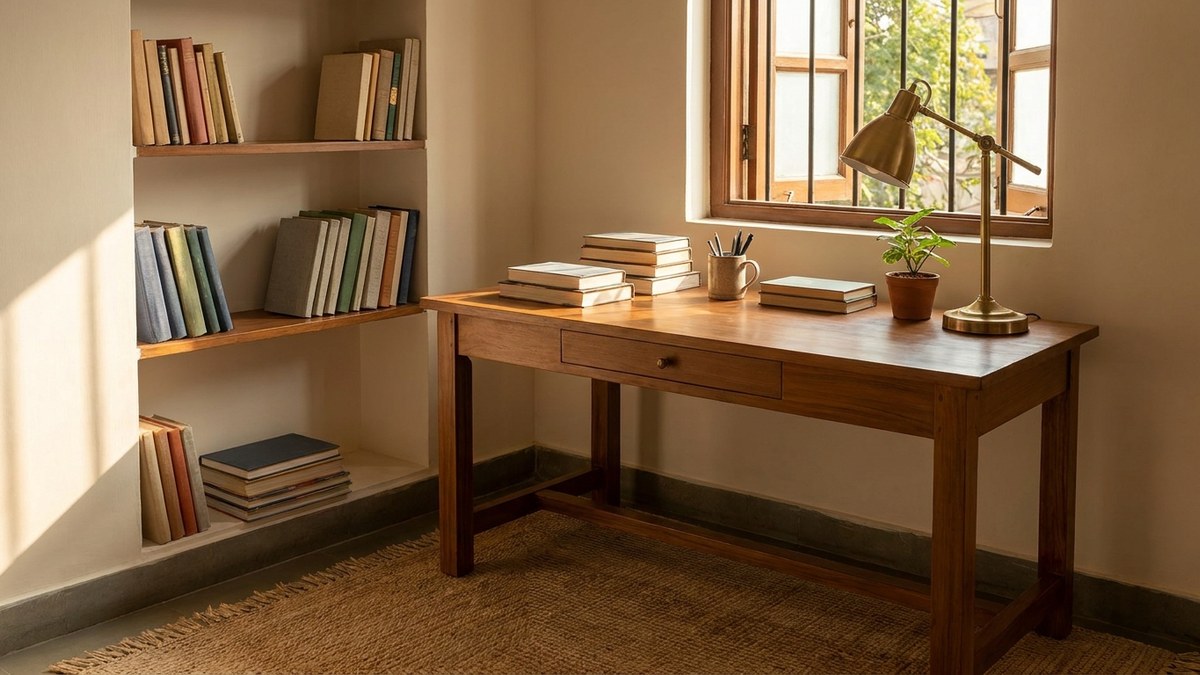
- Rule 1: Your study space must be separate from your entertainment space. If your child studies on the same bed where they watch YouTube, your brain never switches modes. Create a dedicated desk. Even a corner of the living room works if it’s consistent. This triggers your nervous system to shift into focus mode automatically.
- Rule 2: Phone goes into another room, not just silent mode. Out of sight, out of mind isn’t just philosophy. It’s neuroscience. When your phone is visible, your brain uses energy resisting it. That’s why study concentration tips always fail when the device is nearby.
- Rule 3: Study in 45-minute blocks with 10-minute breaks. Not 2-hour marathons. Your brain’s attention span peaks at 45 minutes. After that, you’re pretending to study. Set a timer. When it rings, step away. Stretch. Drink water. Return refreshed.
- Rule 4: The study area needs proper lighting and a good chair. Poor posture and dim light drain energy within 20 minutes. Your body sends fatigue signals. You blame yourself for lack of focus. It’s not you. It’s your setup.
- Rule 5: Have all materials ready before you sit down. Books, pen, notebook, calculator — everything within arm’s reach. Jumping up to find things breaks concentration and gives your mind an excuse to wander.
How to Focus on Studies Without Overthinking
Here’s what happens in most Indian households: a student sits down to study, immediately starts worrying about the exam, then worries about worrying, and suddenly three hours have passed with nothing learned. The mind becomes a washing machine of anxiety.
How to concentrate on studies without overthinking? Stop trying to control your thoughts. Instead, control your attention. When your mind drifts to exam stress or comparison with other students, acknowledge it and return to the task. Don’t fight the thought. Don’t judge yourself. Just redirect.
Use the “anchor technique.” Pick one thing to anchor your attention: the sound of your pen on paper, the feel of the textbook, the smell of your study space. When your mind wanders, return to that anchor. This is learning by doing — you’re actively training your focus muscle.
Most people don’t realise that overthinking happens because the material feels disconnected from reality. Make it real. If you’re learning history, imagine you’re there. If it’s math, solve problems that relate to your life. Engagement kills overthinking.
The Technology That Changes Everything
Here’s a hard truth: studying with outdated or inadequate tools is like trying to build a house with broken equipment. You work twice as hard for half the results.
If you’re running a tuition centre or learning hub, or you’re a parent serious about your child’s education, you need reliable technology. Not fancy. Not expensive. Reliable.
APNA PC is exactly that. At Rs.30,000, you get a complete bundle: Mini PC with i3 7th Gen processor, 8GB RAM, 128GB SSD, monitor, keyboard, mouse, webcam, headset, plus 3 years warranty and installation. No hidden costs. No surprises.
Why does this matter for concentration? Because a slow, freezing computer destroys focus faster than anything else. Your student sits down to study online, the system lags, frustration builds, and suddenly they’re checking their phone. With APNA PC, everything loads instantly. The learning experience stays smooth. Concentration stays intact.
Whether you’re accessing the DIKSHA platform for quality content or running a Point of Digital Learning centre, APNA PC handles it all without breaking a sweat. Learn more about APNA PC and how it transforms learning spaces.

Digital Detox Isn’t About Punishment
Let’s be honest: telling a teenager to stop using their phone is like telling water not to be wet. It won’t work.
Instead, reframe it. Digital detox isn’t about removing technology. It’s about using it intentionally. During study hours, the phone is off. During break time, they can use it guilt-free for 10 minutes. This creates rhythm. Your brain knows: study time is sacred, break time is free.
UNESCO research shows that students who follow structured breaks actually retain 30% more information than those who study continuously. The data is clear. Breaks aren’t laziness. They’re strategy.
The Real Secret: Environment Design, Not Motivation
Study concentration tips fail because they focus on willpower. “Just focus harder!” “Stop being lazy!” These statements ignore reality.
The real secret is environment design. When you design your space, your routine, and your tools correctly, how to concentrate on studies becomes automatic. You don’t have to fight for focus. It happens naturally.
For Indian homemakers running learning centres, for senior citizens mentoring grandchildren, for tuition teachers managing classrooms, and for edupreneurs building educational businesses, this principle applies everywhere. Get the fundamentals right: space, time, tools, structure. Everything else follows.
Start today. Redesign one study space. Set one timer. Remove one distraction. Watch what happens.