
The Home Tuition Business Opportunity Nobody Talks About
You have a skill. You have a home. You have zero idea how to turn that into income. This is where most people stop. They assume you need fancy credentials, a coaching centre, or a massive network to start a home tuition business. Wrong.
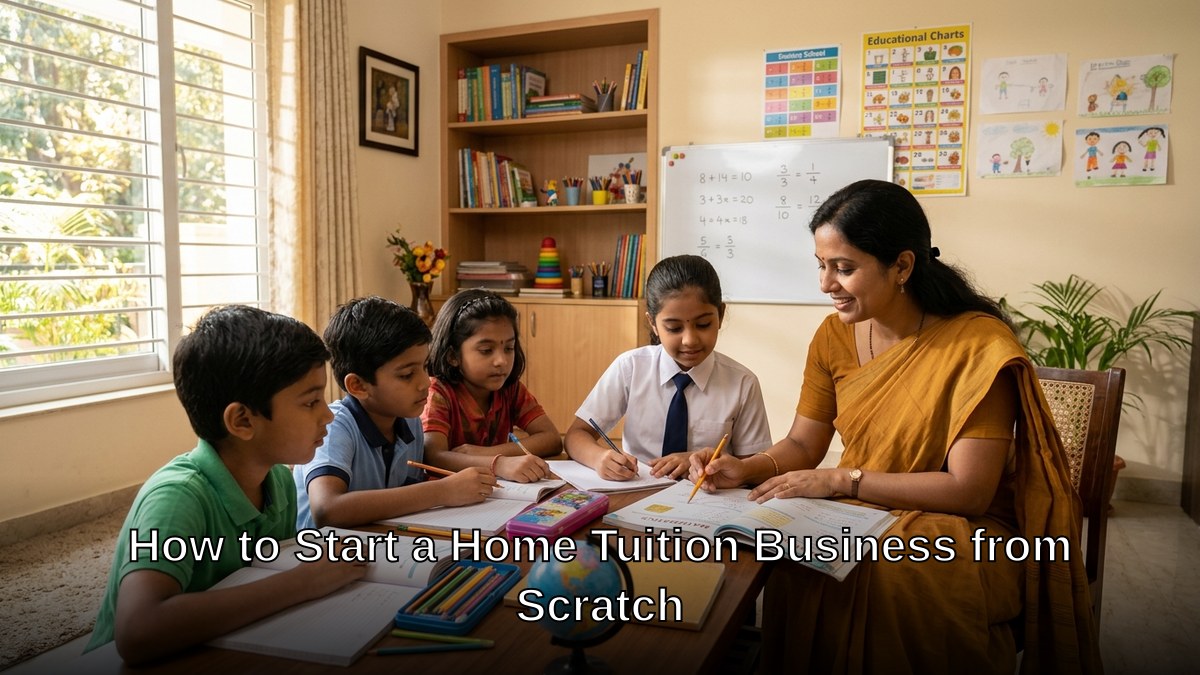
Here is the truth: the home tuition business in India is exploding because parents are tired of overcrowded classrooms and inflexible schedules. They want personalised attention for their children. They want someone trustworthy teaching in their living room. That someone could be you. Whether you are a homemaker looking to earn, a retired professional, or a trained educator, starting a tuition business from home is simpler than you think.
Most people dont realise that a home tuition business requires almost zero startup capital compared to opening a physical coaching centre. No rent. No electricity bills for a separate space. No staff. Just you, your expertise, and a small group of students.
Key Takeaways
- You can start a home tuition business from scratch with almost no capital, since there is no rent, no separate staff and no office to maintain.
- The first real decision is choosing one narrow niche, such as a single subject and grade range, rather than offering to teach everything to everyone.
- Parents want personal attention and a trustworthy adult teaching their child, which is exactly what a home setup offers over a crowded classroom.
- A quiet corner, a reliable computer and stable internet are enough to begin, with better equipment added only once the batch grows.
- Starting small with five to ten students and getting strong results builds the referrals that let the business grow on its own.
Step 1: Define Your Niche and Target Students
Dont try to teach everything to everyone. That is how you burn out in six months.
- Choose a subject you genuinely enjoy. Mathematics, English, Science, Languages, Coding, or even competitive exam prep like JEE or NEET.
- Pick a grade level or age group. Primary students need different teaching methods than Class 10 students.
- Decide your teaching format. One-on-one sessions pay more but require more time. Group tuition (4-6 students) balances income and workload.
Once you know your niche, finding students becomes predictable. Parents actively search for tutors in specific subjects. You are not competing with everyone. You are competing with maybe three other tutors in your neighbourhood.
Step 2: Set Up Your Home Learning Space
Your living room or a spare bedroom becomes your Point of Digital Learning (POD). This is a home or community learning centre run by a trained educator like you.
Lets be honest: your space does not need to be fancy. It needs to be clean, quiet, and equipped for learning. Here is what you need:
- A dedicated table and chairs for students
- Good lighting (natural light is best, but a bright LED bulb works)
- A whiteboard or blackboard for explanations
- Basic stationery (markers, chalk, erasers, notebooks)
- A computer or tablet for online classes and digital resources
If you are serious about scaling your home tuition business, invest in APNA PC. For Rs.30,000, you get a complete bundle: education software, 3-year warranty, installation, and a Mini PC with i3 7th Gen processor, 8GB RAM, 128GB SSD, monitor, keyboard, mouse, webcam, and headset. This is not just a computer. It is your business infrastructure. The webcam and headset let you conduct online classes. The education software helps you track student progress and create digital content. When you are ready to start a coaching centre in India, you already have the tech foundation.
Step 3: Price Your Services Correctly
This is where most home tutors leave money on the table.
Research what tutors in your area charge. In metro cities, expect Rs.300-800 per hour depending on the subject and student level. In smaller cities, Rs.150-400 per hour is standard. Do not underprice yourself thinking you will attract more students. You will attract the wrong students. Parents who pay more take education seriously.
Calculate your monthly target. If you charge Rs.500 per hour and teach 15 hours per week, that is Rs.30,000 monthly. Reasonable? Yes. Sustainable? Absolutely.
Step 4: Find Your First Students
You do not need a marketing agency. You need a strategy.
- Tell your friends, family, and neighbours. Word of mouth is still the most powerful tool. One satisfied parent tells five others.
- Create a simple WhatsApp status or post on local community groups mentioning your tuition services.
- List yourself on platforms offering freelance teaching jobs from home like TeachToEarn.
- Ask your first students for referrals. Offer a small discount if they bring a friend.
- Create a basic website or Google Business profile so parents can find you online.
Your first batch of students is the hardest to find. After that, referrals take over. One student leads to three more. That is how home tuition businesses grow.
Step 5: Build Systems and Scale
Most tutors stay small because they never build systems. You teach, collect fees, and repeat. That is not a business. That is a job.
Here is what a real home tuition business looks like:
- Track attendance and performance in a simple spreadsheet or app
- Send monthly progress reports to parents
- Create a fee collection schedule (weekly or monthly)
- Keep teaching notes so you remember what you taught each student
- Record video lessons for students to review at home
Once you have 8-10 students, you can hire another tutor and take a commission. Now you are earning from multiple tutors. Your home tuition business becomes scalable.
Want to learn more about what tutoring really means and its impact? Check out research on personalised learning. Also, see how UNICEF India education initiatives emphasize the importance of accessible, quality tutoring for underprivileged children.
Common Mistakes to Avoid
Starting a home tuition business is simple, but these mistakes will kill it:
- Taking too many students at once and burning out
- Not setting clear boundaries on timings and cancellations
- Ignoring parent communication and feedback
- Teaching without a structured curriculum or plan
- Accepting students you are not qualified to teach
The home tuition business rewards consistency and quality. Do both, and money follows.
Ready to transform your home into a learning hub? Start small. Start now. Get the right tools like APNA PC to support your growth, and build from there. Your first student is waiting.
Frequently Asked Questions About Start a home tuition business from scratch
How do I start a home tuition business from scratch with no experience?
Start by picking one subject and one or two grade levels you know well, then offer a free demo class to a handful of nearby families. Good results from a small first batch generate referrals, which is the cheapest and most reliable way to grow. Formal teaching experience helps but is not required.
How much money do I need to start a home tuition business?
Very little beyond a room you already have. The main costs are a reliable computer if you plan to teach online, basic furniture, and internet. Many tutors start for well under Rs.30,000 total and grow from the fees they earn.
What subject should I choose to start a home tuition business?
Pick a subject and grade level you are genuinely strong in rather than trying to cover every subject. A focused tutor for Class 10 maths or spoken English is easier to market than a generalist, and parents pay more for a specialist.
How many students should I take on when starting out?
Begin with five to ten students in one batch so you can give real attention and get strong results. A small group that improves quickly brings referrals faster than a large group taught poorly from day one.
Do I need a computer to start a home tuition business from scratch?
For purely in-person classes, a basic computer is enough for records and planning. If you want to teach online or reach students outside your neighbourhood, you need a reliable computer with a webcam and headset, since a phone cannot manage screen sharing well for a full class.
India’s National Education Policy 2020 acknowledges how widespread private supplementary tutoring already is among Indian students, which is the demand a home tuition business taps into.