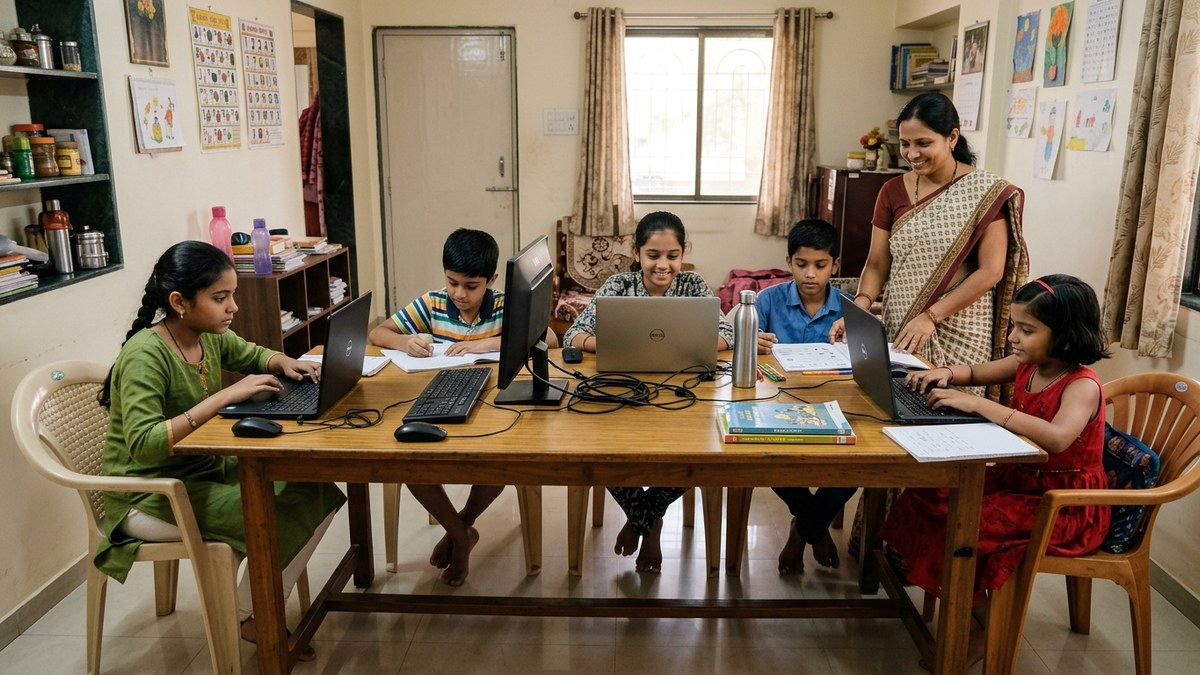
Your spare room. A few computers. Ten students. Rs 50,000 monthly income.
This is not a dream. This is what thousands of Indian educators are building right now through a point of digital learning. And you can too.
If you are a tuition teacher, a homemaker, or someone tired of the 9-to-5 grind, a digital learning center is your fastest route to financial independence. Not in five years. In five months.
Here is the truth: The education system in India is broken. Parents know it. Teachers know it. Students suffer because of it. But this gap is your opportunity. A point of digital learning fills that gap. It serves students who need personalized attention. It serves parents who cannot afford fancy coaching centers. And it pays you well.
Let me show you how.
Key Takeaways
- Anyone can start a point of digital learning from a spare room with a trained educator and a few working computers.
- Starting a point of digital learning fills a gap for students who need personal attention but cannot afford large coaching centers.
- A spare room and a few working computers are enough to begin a POD.
- Tuition teachers and homemakers are among those best placed to start a point of digital learning.
- Income from a POD builds gradually as more students join and word of mouth spreads.
What Exactly Is a Point of Digital Learning?
A point of digital learning, or POD, is a learning center run by a trained educator from home or a community space. Not a school. Not a franchise. Your own business.
Think of it as a tuition center, but smarter. You use technology. You teach 15-30 students per batch. You run multiple batches daily. You charge Rs 1,500 to Rs 3,000 per student monthly. You work 4-6 hours daily. Simple math: 20 students at Rs 2,000 each = Rs 40,000 monthly revenue.
The key difference? You are not competing on infrastructure. You are competing on quality teaching. On personalization. On results.
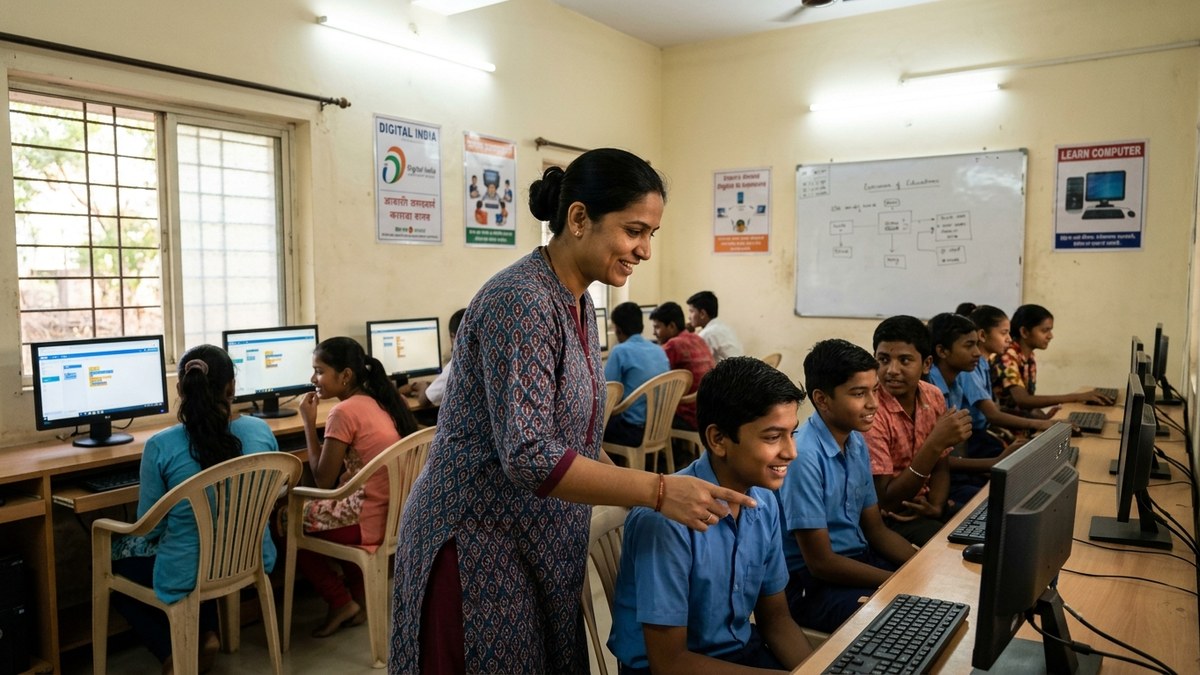
Most people dont realise that the education market in India is worth Rs 2.5 lakh crore. Most of that money flows to big coaching centers in metros. But 70% of India lives outside metros. They have no access to quality education. They have no access to digital learning. This is your market.
Why Start a Digital Learning Center Now?
The timing is perfect. Here is why:
- The Digital India initiative has brought internet to 500 million Indians. Demand for digital education is exploding.
- Parents are desperate for alternatives to traditional coaching. They want personalized learning. They want results.
- The barrier to entry has collapsed. You no longer need Rs 10 lakhs to start. You need Rs 30,000.
- Government recognition is coming. PODs are being formalized. You can start now and scale legitimately later.
Lets be honest: The next five years will see a massive shift from offline to blended learning in India. The winners will be those who start today. The losers will be those who wait.
How to Start Your Point of Digital Learning
Here is the step-by-step roadmap.
Step 1: Get Your Hardware Right
You need computers. Good ones. Not fancy. Not expensive. Reliable.
This is where APNA PC comes in. For Rs 30,000, you get a complete bundle: a Mini PC with i3 7th Gen processor, 8GB RAM, 128GB SSD, monitor, keyboard, mouse, webcam, headset, education software, 3-year warranty, and installation.
One APNA PC can run 3-4 students simultaneously. It is built for classrooms. It is built for you. Start with 5-6 units. That is Rs 1.5 to 1.8 lakhs. A small investment for a sustainable business.
Step 2: Choose Your Location and Space
You do not need a fancy office. A 200 sq ft room in your home works. A community center works. A rented space works. The key is: it must be accessible, quiet, and have good power backup.
Start small. Prove the model. Then scale.
Step 3: Decide Your Curriculum
Will you teach school subjects? Competitive exams? Coding? English? Skill training?
Pick one. Master it. Then expand. Do not try to teach everything from day one. You will fail.
Step 4: Get Trained
Pedagogy matters. You cannot just put students in front of a computer and hope they learn. You need to know how learning works. You need to know how to use technology to accelerate it.
TeachToEarn offers certification programs for POD educators. Get trained. Get certified. Get credible.
Step 5: Market Aggressively
Build a WhatsApp group. Post on Facebook. Talk to parents in your neighborhood. Offer a free demo class. Word of mouth is your best marketing. Satisfied parents will bring you 10 more students.
The Financial Reality
Let me break down the numbers for you.
Initial Investment:
- 5 APNA PC units: Rs 1.5 lakhs
- Furniture and setup: Rs 30,000
- Branding and marketing: Rs 20,000
- Total: Rs 2 lakhs
Monthly Revenue (at full capacity):
- 30 students at Rs 2,000 per student: Rs 60,000
- Minus electricity, internet, maintenance: Rs 5,000
- Net monthly income: Rs 55,000
Your investment breaks even in 4 months. By month 12, you are making Rs 5.5+ lakhs annually. By year two, you are running multiple batches and making Rs 10+ lakhs.
This is not theory. Hundreds of TeachToEarn educators are doing this right now.
Who Should Start a POD?
You should, if you:
- Are a tuition teacher wanting to scale your income
- Are a homemaker looking to start a digital coaching business
- Have teaching experience and passion for education
- Want to build something that matters, not just make money
- Are willing to work 4-6 hours daily consistently
You should not, if you are looking for passive income or a get-rich-quick scheme. This is a real business. It requires work. It requires commitment. But the returns are real.
The Bigger Picture
A point of digital learning is not just a business. It is a social mission. You are solving Indias education crisis. You are giving 30 students access to quality learning they would never have had. You are changing lives. And you are getting paid well for it.
This is the future of education in India. Decentralized. Personalized. Affordable. Scalable.
You can be part of it. You can start a point of digital learning today.
Or you can wait. Watch others build. And regret later.
Your choice.
If you are serious about starting, we have a complete roadmap. We have technology. We have training. We have community. We have everything you need to succeed. Reach out. Let us show you how.
The next 100 educators who start will capture 80% of the market in their regions. Will you be one of them?
You can also start a microschool with Rs 30,000 if you want a slightly different model. Either way, the time to start is now.
Frequently Asked Questions About Start a point of digital learning
What is a point of digital learning?
A point of digital learning, or POD, is a small learning center run by a trained educator, usually from a home or community space, that serves a group of students needing personalised attention. It combines a shared computer setup with hands-on teaching.
Who can start a point of digital learning?
Tuition teachers, homemakers, and anyone with teaching interest and a spare room can start a POD. No large investment or commercial space is required to begin.
How much space and equipment does a POD need?
A spare room and a few reliable computers are enough to start a point of digital learning. The setup can grow gradually as more students enrol.
How does a point of digital learning earn income?
A POD earns through monthly fees paid by enrolled students, and income grows as the educator builds a reputation and more families join. Word of mouth in the neighbourhood is often the main way a POD grows.
Is a point of digital learning different from a regular tuition class?
Yes, a POD typically combines a structured space, shared computer access, and personalised guidance, going beyond a traditional single-subject tuition class. It is built around building a small, well-supported learning community.
The Digital India programme has pushed for wider access to computer-based learning, a goal that community-run PODs directly support.