
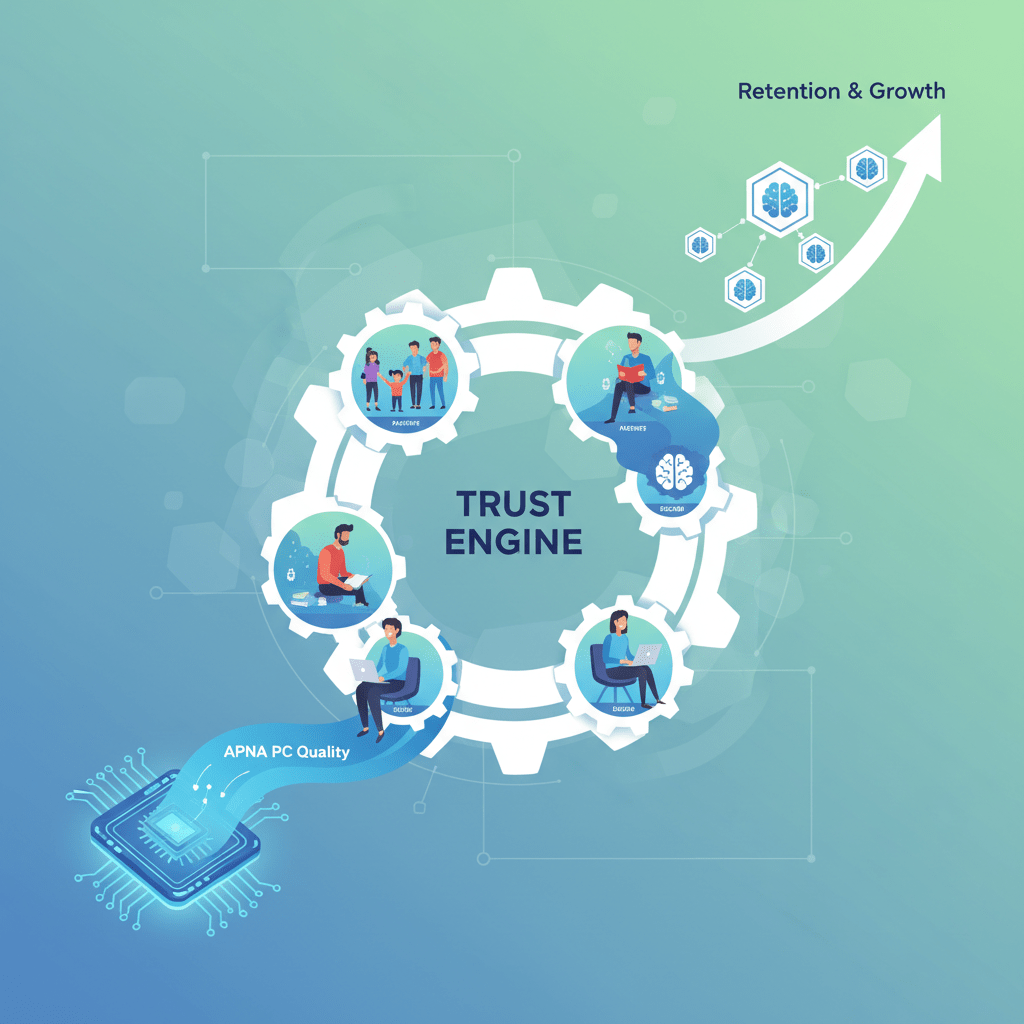
India’s education market has no shortage of demand. Parents are willing to invest in their child’s future, but many feel stuck between expensive schools, crowded tuition classes, and digital tools that create more confusion than clarity. Most families are not just looking for “more classes.” They are looking for a learning system they can trust.
This is where PODs are creating a real opportunity for edupreneurs, teachers, and school operators. A well-run POD is not just another tuition center with computers. It is a small, structured learning space where students receive focused support, parents get visibility into progress, and learning becomes more consistent.
When combined with APNA PC and simple operating systems, PODs can create meaningful learning outcomes while also becoming a stable and sustainable community initiative.
Why Many PODs Lose Momentum After a Strong Start
Many PODs begin with excitement and strong local interest, but after a few months, energy starts fading. The reason is usually not lack of students. The problem is lack of structure.
In many cases:
- Sessions become activity-heavy but outcome-light
- Mentors are enthusiastic but inconsistent
- Parent communication becomes irregular
- Student progress is not tracked clearly
When parents cannot clearly see improvement, they begin comparing the POD with cheaper tuition options. Slowly, retention drops and growth becomes difficult.
The real challenge is not marketing.
It is operating discipline.
The APNA PC POD Model: 4 Simple Systems That Build Trust
Strong PODs usually have four systems working together smoothly.
1. A Clear Learning Outcome System
Students should not just join a “batch.” They should join a learning journey with visible goals.
For example:
- Grade 5–6: better concept understanding and writing clarity
- Grade 7–8: stronger problem-solving and research habits
- Grade 9–10: better exam-answer structure and revision discipline
When goals are clear, mentors teach with focus and parents understand the value much faster.
2. A Fixed Session Structure
Children learn best when routines are stable.
A simple POD session can follow this structure:
- Concept warm-up
- Guided practice using APNA PC
- Written output or worksheet submission
- Feedback and correction
This consistency matters more than trying something “new” every day. Parents trust systems that feel organized and reliable.
3. A Parent Transparency System
Parents should not have to wait for exam marks to understand progress.
Simple weekly updates work best:
- One improvement
- One challenge area
- One next-step action
Short, honest communication builds confidence. In education, trust is often the biggest reason parents continue long term.
4. A Mentor Quality System
A POD becomes sustainable only when mentor quality remains consistent.
Mentors should follow simple playbooks for:
- Session flow
- Correction methods
- AI usage rules
- Handling struggling students
Without clear standards, quality starts dropping as the POD grows.
How to Position Your POD So Parents See Real Value
Many learning centers market features:
- “Smart learning”
- “AI-powered education”
- “Advanced technology”
But parents do not buy features.
They buy outcomes.
Your communication should answer three questions clearly:
- What will improve?
- How soon will it improve?
- How will parents see proof?
For example:
“Within 8 weeks, your child will show measurable improvement in writing quality, concept understanding, and learning confidence—with weekly progress updates.”
This feels much more trustworthy than generic technology claims.
What Edupreneurs Should Actually Track ?
Many people focus on vanity numbers like app usage or login hours. These do not build trust.
Better metrics include:
- Student retention
- Weekly assignment completion
- Improvement in corrected work
- Parent satisfaction
- Referral-based admissions
These indicators connect learning quality with long-term sustainability.
Using AI Responsibly Inside PODs
AI can improve learning speed, but it should never replace thinking.
A simple structure works best:
Attempt → Assist → Improve → Explain
Students first try independently. Then AI helps clarify doubts. After that, students improve their answer and explain what changed.
This protects understanding, writing ability, and exam readiness while still using AI productively.
Why APNA PC Helps PODs Stay Consistent ?
One major problem in digital learning is distraction. Students often move between unrelated apps, videos, and random browsing.
APNA PC helps create a more focused, learning-first environment where:
- Sessions remain structured
- Learning tools stay organized
- Students produce visible outputs
- Digital time becomes productive learning time
For parents, this creates reassurance because technology usage becomes connected to measurable learning outcomes.
What You Should Do Next ?
If you are planning to start or improve a POD, do not try to do everything at once.
Start with:
- One grade group
- One clear outcome track
- One structured session routine
- One weekly parent communication system
Keep the process simple and consistent for the first few weeks.
You can explore implementation ideas here: 👉 TeachToEarn Blog
And if you want a stable learning-first setup for your POD, start here: 👉 APNA PC
Because in education, growth follows trust.
And trust grows when parents can clearly see that children are learning with confidence, structure, and consistency.