“Give a child a scholarship, and you help one student. Build a community learning pod, and you create a learning ecosystem that can help hundreds.”
“We Already Spend on Education. Why Do We Need Another Model?”
Rajiv: Dr. Malpani, every year companies spend crores of rupees on education CSR. We fund school infrastructure, scholarships, and digital classrooms. Why do you believe community learning pods deserve attention?
Dr. Malpani: Because most education CSR spending focuses on inputs rather than outcomes.
We donate buildings, computers, projectors, tablets, and scholarships. These are useful, but they don’t automatically improve learning.
The real question is simple: What did the child learn?
Community-based learning pods focus on outcomes. They create local learning spaces where children use technology, AI tools, online resources, and peer learning to develop real skills. Instead of funding infrastructure that may remain underutilized, CSR can fund learning systems that produce measurable results.
“What Exactly Is a Community Learning Pod?”
Rajiv: Many people may not understand what a learning pod is.
Dr. Malpani: Think of it as a neighborhood learning hub.
A pod can operate from a community center, a school after school hours, a housing society, a village library, or even a spare room in someone’s home.
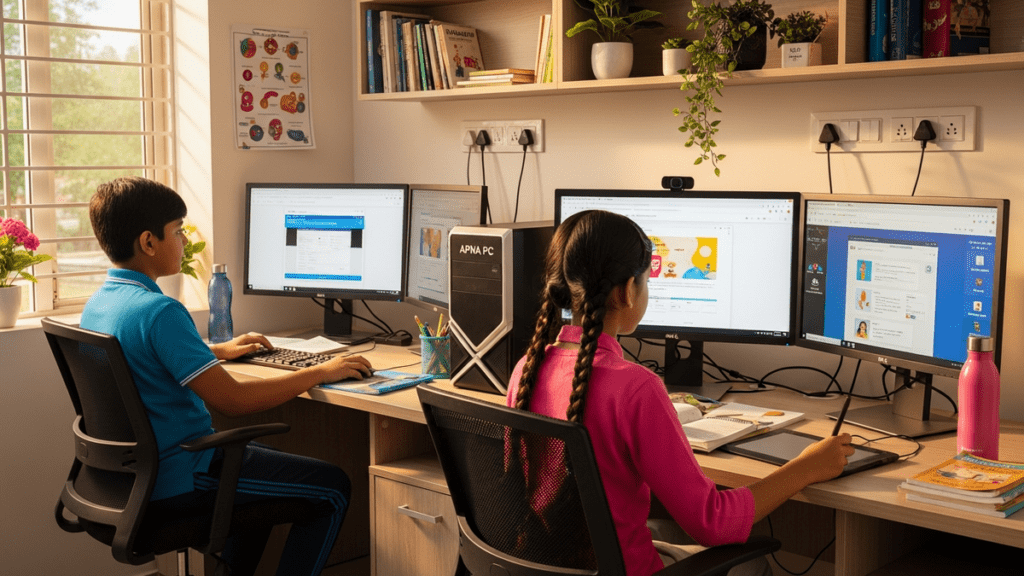
Using APNA PC and curated digital learning resources, a single facilitator can support 20 to 30 learners every day.
Children learn at their own pace. Older students help younger students. AI tutors provide personalized support. Parents remain actively involved.
Most importantly, learning becomes visible.
“How Is This Different from a Computer Lab?”
Rajiv: Many CSR projects already donate computers to schools.
Dr. Malpani: That’s exactly the problem.
Most CSR projects stop at hardware distribution.
A room full of computers does not create learning.
A learning pod combines:
- Structured learning pathways
- AI-assisted learning
- Community ownership
- Facilitator support
- Parent engagement
- Outcome tracking
Technology is only one component.
The real innovation is the learning model.
“Why Is This Especially Relevant for Tier-2 and Tier-3 India?”
Rajiv: Why do you think this model is particularly useful outside major cities?
Dr. Malpani: Because the learning gap is often largest there.
Children in smaller towns have ambition equal to students anywhere in the world. What they often lack is access.
They may not have:
- Good coaching centers
- Skilled teachers
- Career guidance
- Digital learning opportunities
A community learning pod solves all of these challenges at a fraction of the cost of building a new school.
One APNA PC can serve multiple learners every day. A pod with ten systems can support hundreds of students every month.
That is extraordinary leverage for CSR spending.
“How Can Companies Measure Impact?”
Rajiv: Every CSR team today is under pressure to show measurable impact.
Dr. Malpani: That’s another reason I like pods.
Traditional CSR education projects often report:
- Number of computers donated
- Number of classrooms painted
- Number of students enrolled
Pods can report outcomes that matter:
- Improvement in reading levels
- Improvement in writing quality
- Digital literacy growth
- AI literacy skills
- Student portfolios
- Project completion rates
- Parent engagement levels
Instead of measuring inputs, we measure learning.
That’s a far better use of shareholder money.
“What Makes Pods Sustainable?”
Rajiv: Many CSR projects collapse once funding ends.
Dr. Malpani: Sustainability is one of the biggest strengths of the pod model.
Because pods are community-owned, local stakeholders become invested in their success.
Parents contribute small amounts.
Local facilitators earn income.
Schools partner with pods.
Community organizations provide space.
CSR funding acts as a catalyst rather than a permanent dependency.
The goal is not to create charity.
The goal is to create self-sustaining learning ecosystems.
“What Skills Are Children Actually Learning?”
Rajiv: Are these pods mainly for academics?
Dr. Malpani: Academics are only one part.
The future belongs to learners who can:
- Think independently
- Use AI responsibly
- Communicate clearly
- Collaborate effectively
- Solve real problems
Pods help children develop these skills through projects, digital tools, peer learning, and self-directed exploration.
The child is no longer a passive consumer of education.
They become an active learner.
“What Would You Tell CSR Leaders?”
Rajiv: Suppose a CSR committee is deciding where to invest next year. What would your message be?
Dr. Malpani: I would ask a simple question:
Do you want to fund infrastructure, or do you want to fund learning?
Buildings are important.
Computers are important.
But neither matters if children are not learning.
Community-based learning pods offer something rare in education: low cost, high scalability, measurable outcomes, and local ownership.
A single pod can transform a neighborhood.
A network of pods can transform a district.
And because the model is built around community participation, the impact continues long after the CSR grant is spent.
The Bottom Line
India does not need more empty computer labs.
India needs more learning opportunities.
Community-based learning pods powered by APNA PC provide a practical, scalable, and measurable way for CSR funds to create lasting educational impact.
For companies looking to maximize both social return and learning outcomes, supporting community learning pods may be one of the highest-impact education investments available today.
To learn more about setting up a community-based learning pod, visit:
Because the future of education is not just about giving children access to technology.
It is about giving them access to opportunity.