
The POD vs Tuition Center Question Nobody Wants to Answer Honestly
Your tuition center is full. Your students love you. You’re making decent money. So why does it feel like you’re trapped?
Here is the truth: The tuition center model is dying. Not because teaching is dying. Because the infrastructure, margins, and scalability of traditional tuition centers cannot compete with what Point of Digital Learning (POD) businesses are building in 2026.
Most people do not realise that POD vs tuition center is not really a choice between two similar things. It’s a choice between an old system and a new one. And the money follows the new system.
Let us be honest: If you’re a homemaker, entrepreneur, or tuition teacher considering what to launch next, you need to see the real numbers. Not the glossy promises. The actual income potential, the actual costs, and the actual time you’ll spend working.
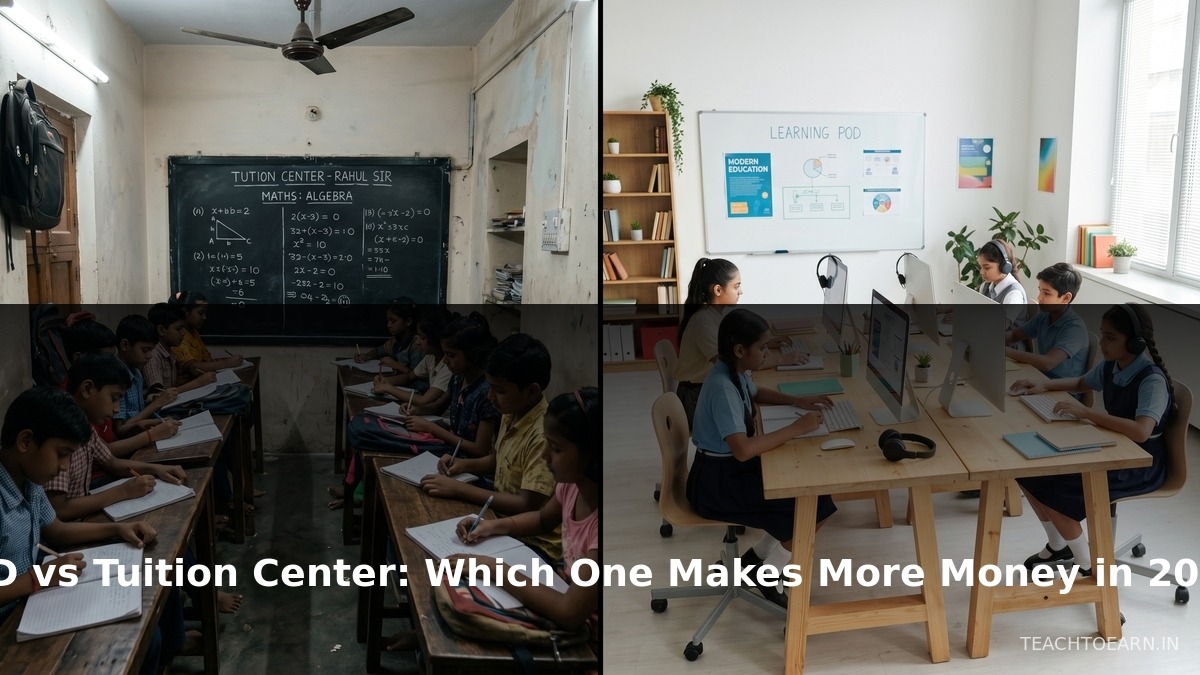
POD vs Tuition Center: The Income Reality
A traditional tuition center in India typically operates like this:
- Monthly rent: Rs.8,000 to Rs.20,000
- Capacity: 40-60 students across batches
- Fee per student: Rs.800 to Rs.2,000
- Monthly revenue: Rs.32,000 to Rs.1,20,000
- Operating costs (staff, utilities, materials): Rs.15,000 to Rs.40,000
- Net monthly income: Rs.17,000 to Rs.80,000
A POD (Point of Digital Learning) operates differently:
- Setup location: Home or small community space (rent: Rs.0 to Rs.5,000)
- Capacity: 20-30 students, but higher fee structure
- Fee per student: Rs.2,500 to Rs.5,000
- Monthly revenue: Rs.50,000 to Rs.1,50,000
- Operating costs (electricity, internet, software): Rs.3,000 to Rs.8,000
- Net monthly income: Rs.42,000 to Rs.1,42,000
The gap is not small. The gap is structural.
Why? Because POD businesses leverage technology. They don’t need massive physical infrastructure. They charge premium fees because they deliver premium outcomes. And they scale faster because the cost of adding one more student is nearly zero.
The Hidden Costs Nobody Talks About
Before you commit to either model, understand what you’re actually paying for.
Tuition centers drain money in ways that feel invisible until they add up:
- Rent increases every year (sometimes 10-15%)
- Staff salaries if you scale beyond yourself
- Furniture replacement and maintenance
- Electricity bills for a full building
- No technology advantage (just a room with benches)
- Physical space limits your student capacity hard
PODs have different cost structures:
- One-time technology investment (APNA PC bundle: Rs.30,000)
- Low monthly operational costs
- Software handles student management automatically
- Can run from home or partner with community centers
- Scalable without proportional cost increase
- Parents pay more because they see results faster
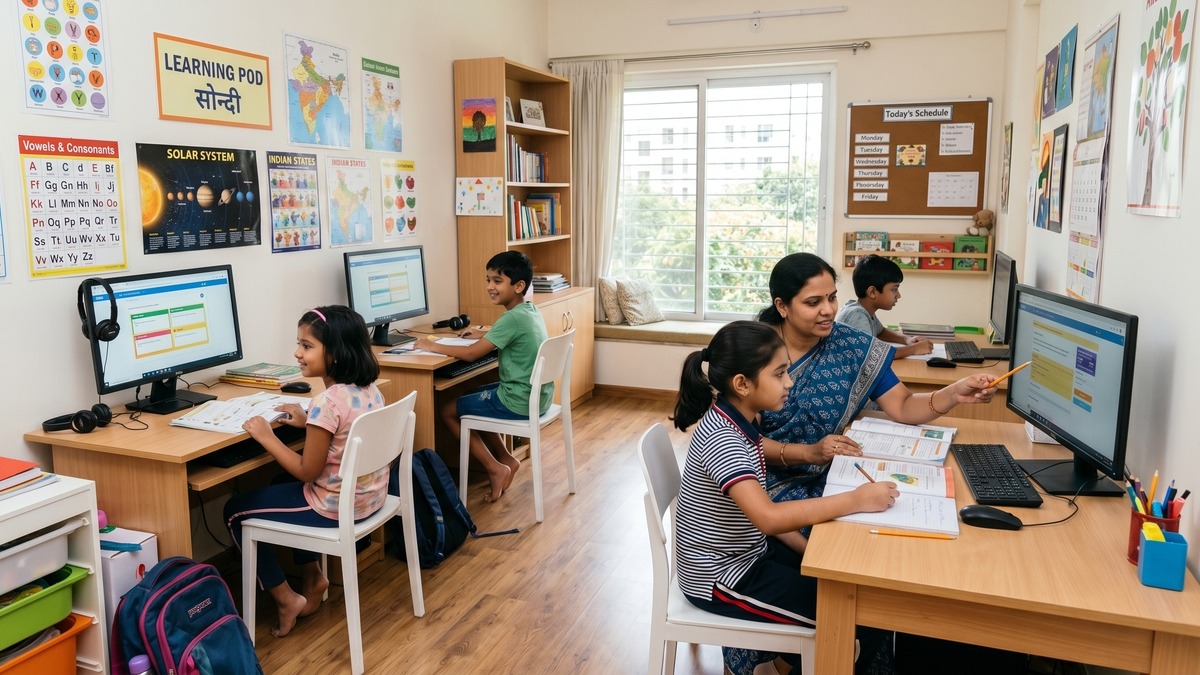
The APNA PC bundle is not just hardware. It’s your entire POD infrastructure. Rs.30,000 gets you the Mini PC (i3 7th Gen, 8GB RAM, 128GB SSD), monitor, keyboard, mouse, webcam, headset, education software, 3-year warranty, and installation. That’s your entire tech backbone. A tuition center cannot match this cost efficiency.

Why Parents Are Switching to PODs
Most people do not realise that parent behaviour has fundamentally changed. They no longer want their child in a crowded room with 50 other kids and a teacher who has no time for individual attention.
PODs offer what parents actually want:
- Smaller batches (15-20 students maximum)
- Technology-enabled learning (interactive, tracked, measurable)
- Personalized attention and progress tracking
- Flexible schedules (some PODs run morning and evening batches)
- Results (because software tracks every student’s performance)
This is why PODs command higher fees. Parents see the difference immediately. And they pay for it.
The Break-Even Question
Here is the truth: A POD breaks even faster than a tuition center.
Tuition center break-even: 6-12 months (you need to fill it with enough students to cover rent and operating costs).
POD break-even: 2-4 months (your initial investment is lower, and you reach profitability with just 20 paying students).
For detailed analysis on how these numbers work, read POD economics and break-even.
POD vs Tuition Center: Which One Should You Choose?
Choose a tuition center if:
- You have access to affordable space (Rs.5,000 or less)
- You want to hire staff and build a team
- You’re willing to work longer hours with lower per-student fees
- You prefer traditional teaching methods
Choose a POD if:
- You want higher margins and faster break-even
- You prefer working from home or a small space
- You want technology to do the heavy lifting (student management, progress tracking, parent communication)
- You want to scale without proportional cost increases
- You want to charge premium fees because you deliver premium results
For entrepreneurs and homemakers specifically: POD is the answer. You get to stay home, build a profitable business, and scale on your own timeline. For tuition teachers: POD is an upgrade, not a sideways move. You keep your expertise. You gain technology and better margins.
Learn more about the POD growth engine and how to build a parent-trusted learning center.
The 2026 Prediction
By 2026, POD vs tuition center will not even be a real comparison. PODs will be the default. Tuition centers that do not evolve will shrink. Parents will demand technology, data, and results. Teachers who provide that will earn more.
According to UNESCO education data, hybrid and digital learning models are growing at 3x the rate of traditional centers. India’s Government of India education portal is also pushing digital literacy in learning centers.
The infrastructure is shifting. The money is following.
Your move: Start a POD. Not next year. Not when you have more capital. Now. With Rs.30,000 and APNA PC, you have everything you need.
Start your POD today and join the educators who are already earning 2x what tuition centers make.