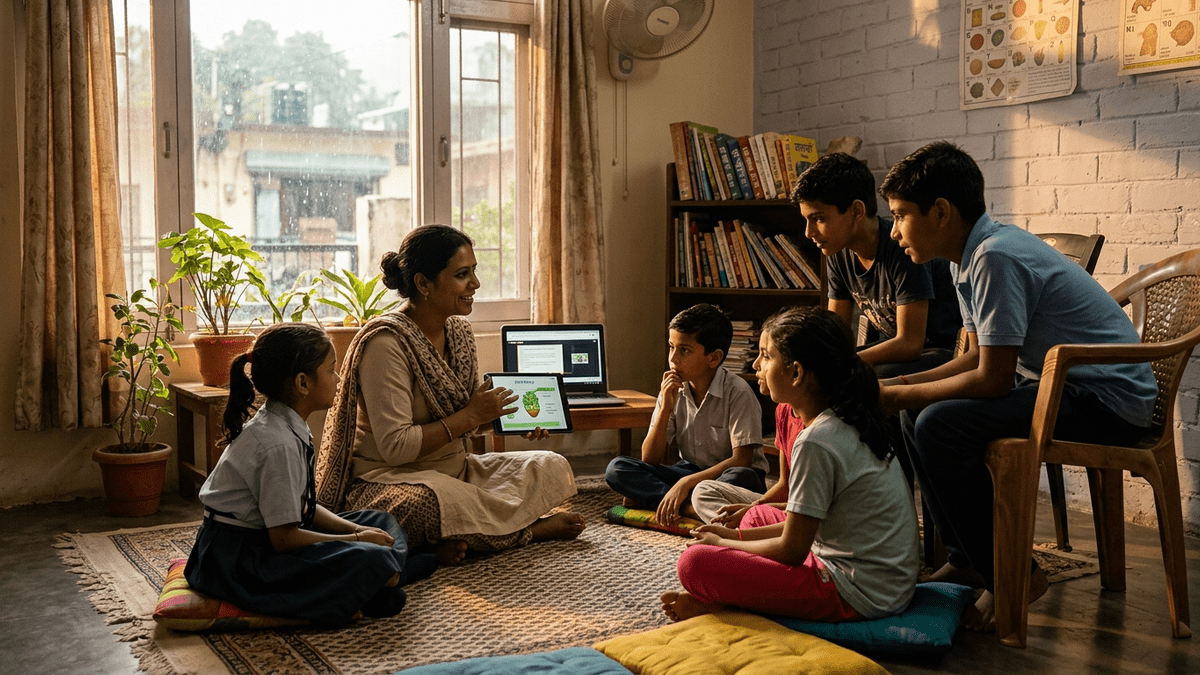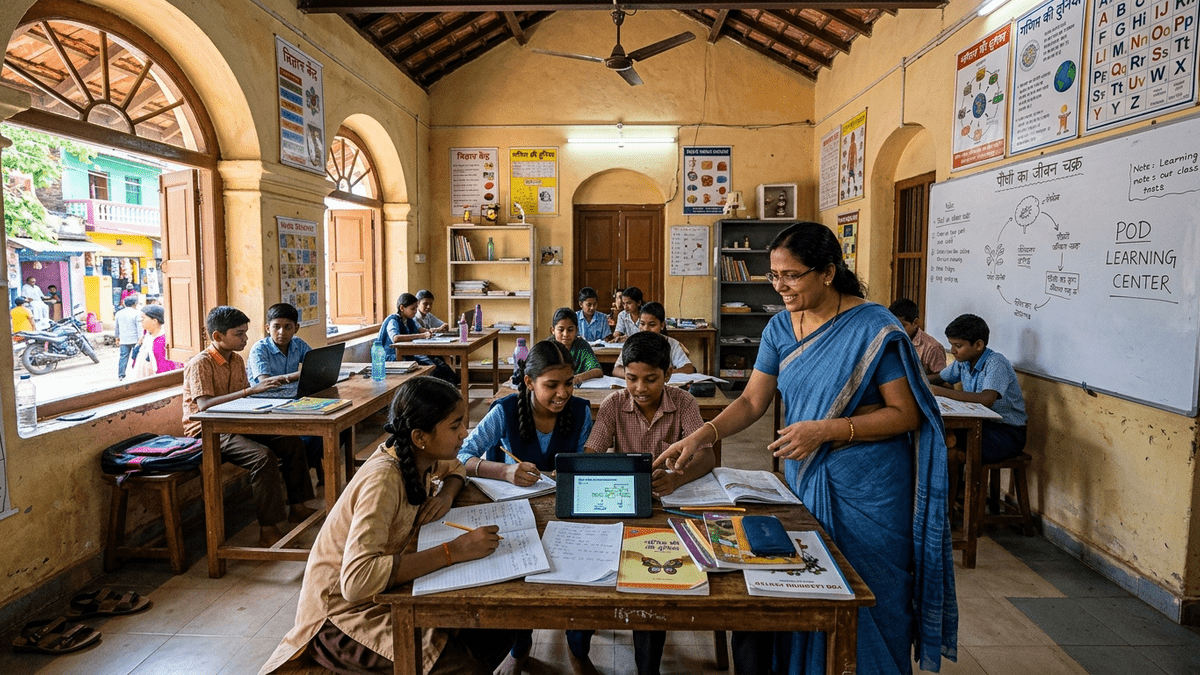
The future of education India is shifting away from one-size-fits-all classrooms toward flexible, adaptive learning environments. Learning PODs in small-town India embody this shift, creating spaces where 10-15 students learn together under guided instruction, supported by digital tools and personalized attention. This model bridges the urban-rural education gap while empowering local educators to become entrepreneurs.
What Are Learning PODs and Why Small-Town India Needs Them
A POD (Point of Digital Learning) is a micro-learning center operated from homes, community halls, or rented spaces. Learning PODs in small-town India function as hyper-local alternatives to traditional schools, offering flexible schedules, personalized curriculum, and community-based learning. Unlike large institutions, PODs adapt to local needs, whether that’s bridging language gaps, offering skill-based training, or preparing students for competitive exams.
Small-town India presents unique advantages for the POD education model. Population density is manageable, rent is affordable, and community trust runs deep. Parents in these areas actively seek alternatives to overcrowded government schools and expensive private institutions. The POD education model fills this gap with dignity and affordability.
The Economics: Why Learning PODs Small-Town India Make Business Sense
Starting a POD requires minimal capital compared to traditional schools. APNA PC (Rs.30,000 complete bundle) provides everything an educator needs: a pre-configured system with curriculum content, assessment tools, progress tracking, and digital learning resources. This eliminates the need for expensive software licenses or technical expertise.
In small-town India, monthly fees of Rs.500-1,500 per student are acceptable to parents. With 12-15 students per batch, monthly revenue reaches Rs.6,000-22,500. After accounting for rent (Rs.2,000-5,000), utilities, and educator salary, POD operators achieve profitability within 3-6 months. The POD education model thus becomes a sustainable income source for non-traditional educators, homemakers, and retired professionals.
Learning PODs Small-Town India: Bridging the Quality Gap
Quality education has always been a privilege in India. Urban students access trained teachers, digital resources, and competitive peer groups. Rural and semi-urban students often don’t. Learning PODs in small-town India democratize access by bringing curated, technology-enabled learning to every neighborhood.
The future of education India depends on localization. PODs use APNA PC to deliver content in regional languages, align with local board curricula (CBSE, ICSE, State Boards), and adapt pace based on student needs. This flexibility is impossible in rigid school systems. Teachers in PODs become mentors rather than lecturers, spending time understanding individual learning gaps.
According to DIKSHA digital learning platform, structured digital learning improves student outcomes by 23% when paired with personalized guidance. Learning PODs in small-town India leverage this by combining DIKSHA resources with APNA PC’s adaptive features, creating a hybrid learning ecosystem.
The Role of APNA PC in Scaling the POD Education Model
APNA PC (Rs.30,000 complete bundle) is purpose-built for educators running PODs. It includes pre-loaded curriculum for grades 1-12, automated progress tracking, parent communication tools, and offline functionality, critical in areas with unreliable internet. Educators don’t need IT skills; the interface is intuitive and designed for Indian classrooms.
The bundle covers hardware, software, training, and 12 months of support. This all-in-one approach removes barriers that typically prevent educators from going digital. In small-town India, where tech adoption is slower, APNA PC’s simplicity is revolutionary.
Real Impact: How Learning PODs Transform Communities
Across tier-2 and tier-3 cities, POD educators report transformative outcomes. Students show improved retention, better exam scores, and increased confidence. Parents appreciate the affordability, flexibility, and transparency. Communities benefit from local employment and reduced out-migration of youth seeking education elsewhere.
The POD education model also creates pathways for women educators. In conservative communities, home-based PODs allow women to teach while managing household responsibilities. This expands the educator pool and diversifies learning experiences for students.
Research on global education confirms that community-based learning models improve equity and access. Learning PODs in small-town India align perfectly with this evidence-based approach.
Challenges and How to Overcome Them
The POD education model faces challenges: regulatory clarity, parent awareness, and educator training. However, these are solvable. TeachToEarn’s POD Growth Engine provides comprehensive training, marketing templates, and compliance guidance. Educators receive ongoing support to scale sustainably.
Parent skepticism is common initially. Clear communication about outcomes, transparent fee structures, and trial classes build trust. Once results appear, improved grades, better attendance, student enthusiasm, word-of-mouth marketing drives growth.
The Future of Education India: PODs as the New Normal
Learning PODs small-town India represent a paradigm shift. Traditional schooling assumes standardization; PODs embrace customization. Traditional models require massive capital; PODs scale affordably. Traditional systems concentrate education in cities; PODs distribute it everywhere.
The future of education India will be hybrid, hyperlocal, and human-centered. PODs aren’t replacing schools; they’re complementing them, filling gaps, and proving that quality learning doesn’t require institutional complexity or urban location. With APNA PC (Rs.30,000 complete bundle) as the enabler, educators in small-town India can build thriving learning centers.
Getting Started: Your Path to Running a POD
Starting a POD requires three things: passion for teaching, community connection, and the right tools. APNA PC provides the tools. TeachToEarn provides the framework and support. You provide the commitment.
The process is straightforward. Identify your target community, secure a suitable space, set up APNA PC, complete training, and launch. Within weeks, you’ll have students. Within months, you’ll be profitable. Within a year, you’ll have transformed your community’s access to quality education.
Learning PODs small-town India aren’t a trend; they’re the inevitable future. Education is decentralizing, technology is enabling, and communities are ready. Bring a learning POD to your town and join thousands of educators transforming small-town India. Start your learning POD journey today.