A child who loves drawing gets told to focus on math. A student who codes brilliantly struggles to write a single paragraph with feeling. These aren’t rare stories — they’re patterns playing out in classrooms and learning pods across India every single day. Getting the balance between STEM and creative learning right isn’t a luxury for educators. It’s the foundation of a genuinely useful education.
Why Most EdTech Curricula Get the Balance Wrong
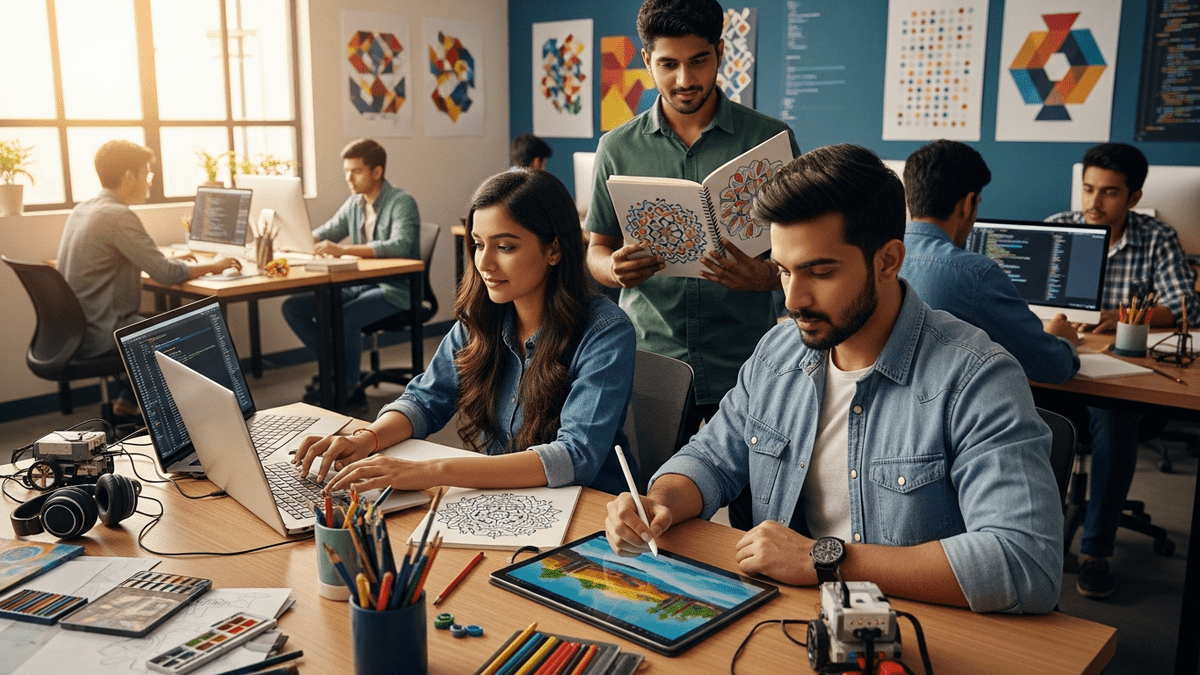
The EdTech curriculum India has seen over the last decade has been heavily weighted toward measurable outcomes — test scores, coding levels, math benchmarks. These things matter, but they tell only part of the story. Creative skills like storytelling, visual thinking, and collaborative problem-solving are harder to grade, so they tend to get deprioritized.
The result is students who can execute instructions but struggle to generate original ideas. They can follow a formula but freeze when a problem doesn’t fit the template. That’s a gap that shows up painfully in higher education and the workplace.
The India Ministry of Education has been pushing for a more holistic approach through the National Education Policy 2020, which explicitly calls for integrating arts and creativity into core learning. The intention is strong. The implementation, especially at the grassroots level, is still catching up.
For learning pod owners and independent educators, this gap is actually an opportunity. You’re not locked into a rigid school board structure. You can design a balanced education experience that most traditional institutions simply can’t offer.
The Opportunity Hidden Inside the Imbalance
When you create a learning environment that treats STEM and creativity as partners rather than competitors, students show up differently. They’re more engaged, more willing to take risks, and more likely to retain what they learn. That’s not just philosophy — it’s backed by how the brain actually works.
STEM education sharpens analytical thinking. Creative learning builds the ability to communicate ideas, empathize with users, and imagine solutions that don’t yet exist. Put them together and you get students who can both build a product and explain why it matters.
Platforms like the DIKSHA national digital learning platform offer a growing library of digital content that spans both technical and creative subjects. As an educator running your own pod, you can pull from these resources and layer your own creative projects on top, giving students a richer experience than either source alone could provide.
If you haven’t already explored what it means to Start a TeachToEarn Learning POD, now is a good time to look at how the model is built specifically for educators who want to teach with intention and earn sustainably while doing it.
How to Build a Balanced Learning Experience in Your Pod
Start by mapping your weekly schedule with both types of learning in mind. Don’t treat creative sessions as a reward for finishing STEM work. Give them equal standing. If students spend two hours on coding or math concepts, carve out dedicated time for storytelling, design thinking, or visual art connected to the same topic.
Use project-based learning to merge the two naturally. Ask students to build something — a simple app, a science model, a short film about a concept they’ve studied. The technical execution and the creative presentation become one task. Students stop seeing them as separate subjects.
Technology access matters here. Many students in semi-urban and rural areas don’t have reliable devices at home, which limits how much they can explore independently. The APNA PC — affordable computer for Indian learners is designed specifically for this context. At ₹30,000, APNA PC gives students in your pod access to a proper computing environment where they can practice both technical skills and creative tools without the barriers that expensive hardware creates.
Build reflection into your sessions. After every project, ask students to talk or write about what they made, why they made it that way, and what they’d change. This simple habit builds metacognitive skills that serve them in every subject and every stage of life.
Keep your own learning going too. The best educators in the EdTech space aren’t just delivering content — they’re constantly refining how they teach and what they believe balanced education actually looks like in practice.
If you’re ready to build a learning environment where students grow in every dimension, visit https://www.teachtoearn.in/start-a-teach-to-earn-learning-pod/ and take the first step toward launching your own TeachToEarn Learning POD today.