
Here’s the truth nobody wants to admit: most Indian parents don’t actually know the home tuition meaning, and they mix it up with coaching every single day. They use the terms interchangeably, hire whoever comes recommended, and then wonder why their child’s marks don’t improve. Let’s fix that.
Key Takeaways
- The home tuition meaning is simple: personalised, one-on-one academic support delivered at the student’s home, focused on that child’s own learning gaps.
- Coaching is batch-based, standardised teaching for groups, usually aimed at a specific exam such as JEE or board exams.
- Home tuition is remedial and supportive, while coaching is accelerated and competitive.
- Choose home tuition when a child needs gap-filling and attention, and coaching when the goal is exam racing with a large peer group.
- Many families do best by mixing both, using a tutor to fix basics and a batch for exam practice.
Home Tuition Meaning: What It Actually Is
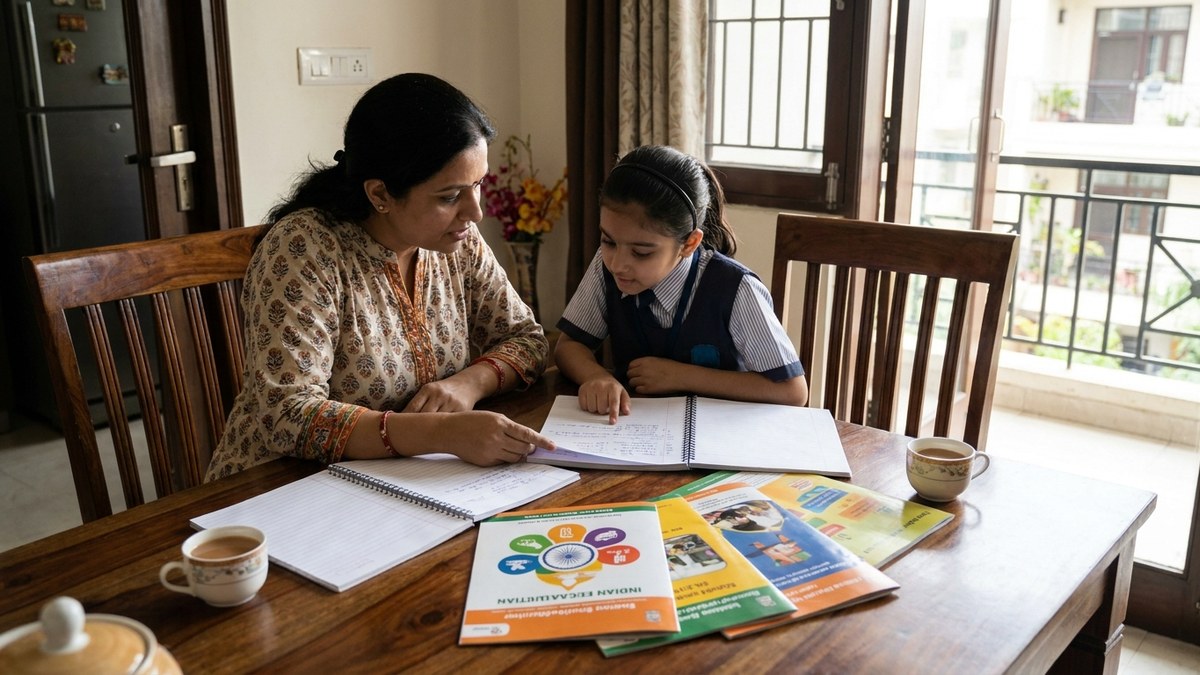
Home tuition is personalised, one-on-one academic support delivered at the student’s home. A trained educator works directly with your child, focusing on their specific learning gaps, pace and style. It’s customised. It’s flexible. It’s accountability in real time.
The tutor sits with your child, understands why they are struggling with quadratic equations or Shakespeare’s sonnets, and teaches accordingly. No batches. No scripts. No “we’ll cover this chapter next week because 30 other students are waiting.”
Home tuition is about filling gaps. It’s remedial, supportive and deeply personal. In fact, it sits much closer to traditional tutoring than to anything you will find in a crowded classroom.
What Coaching Actually Is
Coaching is batch-based, standardised instruction. Whether it’s JEE prep, board exam coaching or competitive exam training, coaching centres follow a curriculum designed for groups. The coach teaches the same content, the same way, to 20, 50 or 100 students at once.
Coaching is about racing ahead. It’s accelerated, competitive and goal-oriented toward a specific exam.
Home Tuition Meaning vs Coaching: The Core Differences
Let’s be honest: the difference shows up the moment you look at how each model actually works.
- Structure: home tuition is one-on-one or a tiny group. Coaching is batch-based, often 20 to 100+ students.
- Customisation: home tuition is personalised to your child’s gaps. Coaching runs a standardised curriculum.
- Pace: home tuition moves at the student’s speed. Coaching runs on a fixed timetable.
- Focus: home tuition builds fundamentals. Coaching targets exam performance and ranking.
- Cost: home tuition typically runs a few hundred rupees per hour. Coaching centres charge anywhere from Rs.5,000 to Rs.50,000 a month.
- Accountability: home tuition gives direct, immediate feedback. Coaching relies on periodic tests.
We break this down further in our guide to coaching vs tuition, covering exam pressure, classroom sizes and what actually works for Indian families. The bigger picture sits inside education in India, where both models run side by side.
When Your Child Needs Home Tuition
- They are struggling in specific subjects while doing fine in others.
- They need foundational concepts rebuilt from the ground up.
- They get anxious in group settings.
- They need flexible timing around irregular school schedules or health issues.
- They are falling behind and nobody has identified exactly where.
Home tuition is the safety net. It’s the teacher who sits with your child for 90 minutes and figures out they don’t actually understand fractions, and that’s why algebra seems impossible.
When Your Child Needs Coaching
- They are preparing for competitive exams like JEE, NEET or UPSC.
- They want to accelerate beyond the school curriculum.
- They thrive in a competitive, peer-learning environment.
- They are already strong in fundamentals and need to go deeper.
Coaching is the accelerator. It’s where your child competes, pushes harder and reaches beyond what school alone can offer.
The Smart Combination Most Parents Miss
Here’s what works: use home tuition to strengthen fundamentals and coaching to accelerate growth. Once you grasp the home tuition meaning, the choice gets easier. Child weak in English? Home tuition. Child wants to crack JEE? Coaching. Child needs both? Both. The two models aren’t rivals. They’re different tools for different jobs.
Why Home Tuition Works Better With the Right Setup
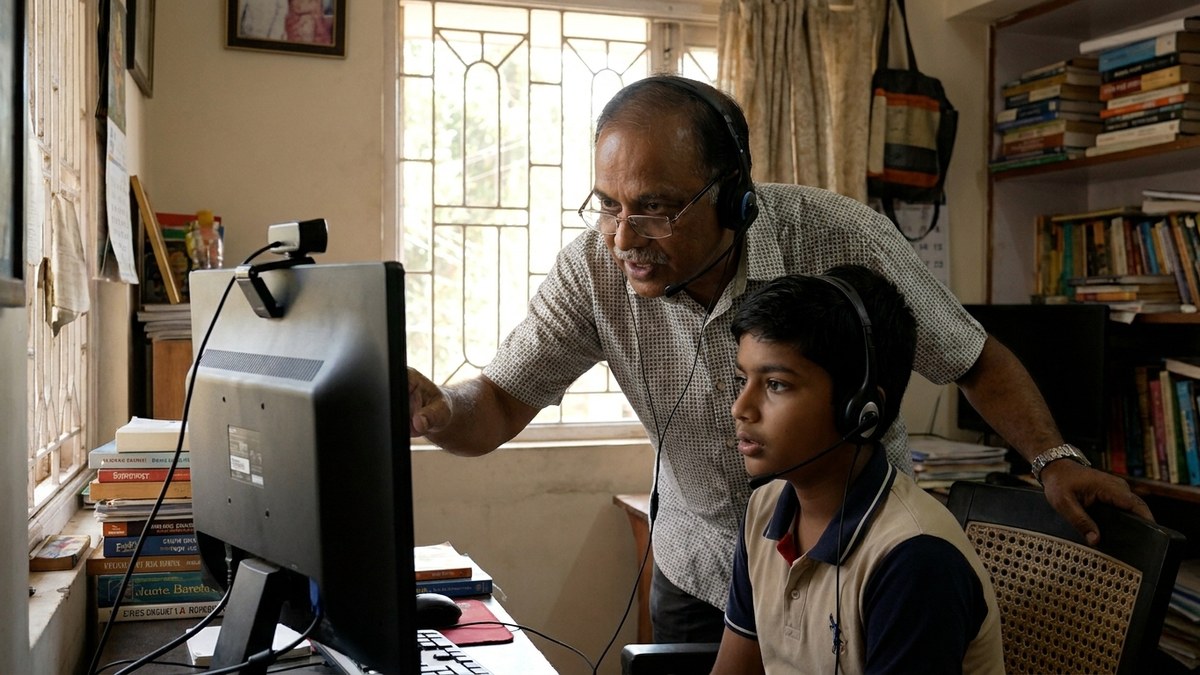
Home tuition has evolved. It’s no longer just a tutor with a notebook at the dining table. Today’s home tutors use digital tools, visual learning, interactive content and recorded sessions.
This is where APNA PC changes the game. The Rs.30,000 complete bundle (education software, 3-year warranty, installation, Mini PC with i3 7th Gen processor, 8GB RAM, 128GB SSD, monitor, keyboard, mouse, webcam and headset) turns any room into a professional learning space. Crystal-clear video calls, screen sharing, digital boards and recorded sessions for revision.
That’s the Point of Digital Learning (POD): a home or community learning centre run by a trained educator with proper technology. And if you’re the educator, the opportunity is real. Home tuition jobs across India are growing fast in 2026, and parents happily pay tutors who look and sound professional.
The Bottom Line
Home tuition and coaching serve different purposes. Don’t confuse them. Don’t use coaching as a substitute for home tuition when your child needs foundational help. Don’t use home tuition as a substitute for coaching when your child is ready to compete.
The home tuition meaning is simple: personalised, gap-filling, student-paced learning. Coaching is batch-based, exam-driven acceleration. Understand what your child needs. Choose accordingly.
Your child’s learning deserves clarity about what they’re getting and why.
Frequently Asked Questions About Home tuition meaning
What is the meaning of home tuition?
Home tuition is one-on-one or very small group teaching delivered at the student’s home. The tutor adapts to the child’s pace and fills specific gaps in understanding. It is personal and flexible, unlike a fixed batch class.
What is the difference between home tuition and coaching?
Home tuition is personalised and gap-focused, usually for one child. Coaching is batch-based and follows a fixed curriculum for a group, often built around one exam. Coaching moves fast, while tuition moves at the child’s speed.
Is home tuition better than coaching for school students?
It depends on the child. A student who is weak in basics usually gains more from home tuition because the tutor can go back and rebuild concepts. A student who is already strong and needs exam practice may do well in coaching.
Can a child take both home tuition and coaching?
Yes, many families do. The tutor fixes weak topics at home while the coaching batch gives exam-style practice. Just watch the total workload so the child still has time to rest and revise on their own.
How can a home tutor use a computer to help my child?
A shared family computer lets the tutor show worked examples, practice quizzes and videos on a bigger screen. It also makes it easy to type projects, fill forms and keep a record of progress, which is harder on a phone.
NEP 2020 stresses foundational learning and personalised support for each learner, which is the same gap-filling idea behind good home tuition.