
The Montessori Method of Teaching: Why Indian Educators Are Finally Paying Attention
Your child sits at a desk for 6 hours, copying what the teacher writes on the board. Nobody asks what they actually want to learn. This is the reality in most Indian classrooms. But there’s a different way. The Montessori method of teaching has transformed millions of classrooms worldwide, and it’s time Indian homemakers, tutors, and edupreneurs understood why.
Here’s the truth: traditional education trains obedience, not curiosity. The Montessori method does the opposite. It puts the child at the centre of their own learning journey. If you’re running a tuition centre, training as a teacher, or educating your own children at home, understanding the Montessori method isn’t optional anymore. It’s essential.
Let’s be honest. Most people don’t realise that Maria Montessori, an Italian physician and educator, developed this system over a century ago. Yet it remains one of the most effective educational approaches available. The Montessori method emphasises independence, hands-on learning, and respecting each child’s natural pace of development.
The 8 Principles of Montessori Method: What You Need to Know
The foundation of the Montessori method rests on eight core principles. Understanding these will help you decide if this approach works for your teaching style or learning environment.
- Principle 1: Child-Centred Learning. The child leads. Teachers observe and guide rather than dictate. Your role shifts from “sage on the stage” to facilitator. This requires patience and trust in the child’s innate desire to learn.
- Principle 2: Hands-On Learning. Abstract concepts mean nothing to a six-year-old. Give them materials to touch, manipulate, and explore. Wooden beads, sandpaper letters, and sensorial blocks aren’t toys. They’re learning tools that bridge the gap between concrete and abstract thinking.
- Principle 3: Mixed-Age Classrooms. Younger children learn from older peers. Older children reinforce their knowledge by teaching. This mirrors real life and builds community. It’s not chaotic. It’s intentional.
- Principle 4: Respect for Natural Development. Children develop in stages. A three-year-old’s brain works differently than a six-year-old’s. The Montessori method respects these windows of opportunity. You can’t rush development. You can only support it.
- Principle 5: Freedom Within Limits. Students choose their activities within a carefully prepared environment. They’re not running wild. Every choice is bounded by structure. This teaches responsibility and decision-making simultaneously.
- Principle 6: Prepared Environment. The classroom isn’t decorated for adults. It’s designed for children. Shelves are low. Materials are accessible. Everything has a place. Order in the physical space creates order in the mind.
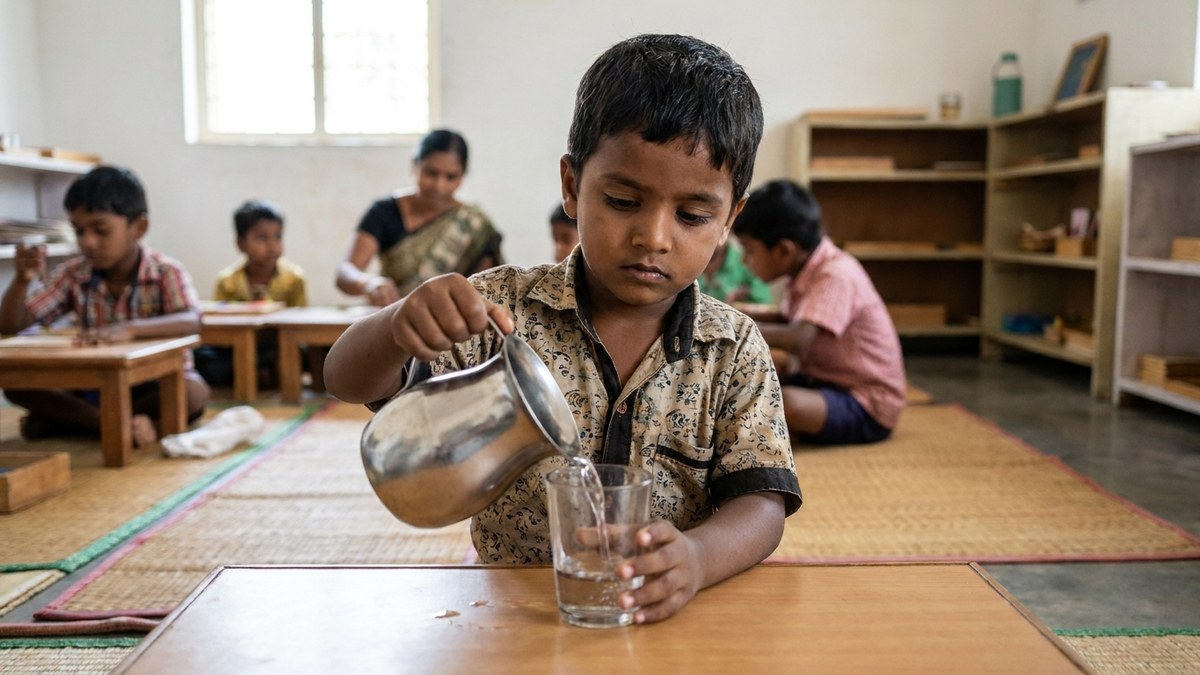
- Principle 7: Practical Life Skills. Pouring water, sweeping, folding clothes. These aren’t distractions. They’re the foundation of independence and concentration. A child who can care for themselves develops confidence that transfers to academics.
- Principle 8: Normalisation Through Concentration. When children engage deeply with meaningful work, they naturally develop focus and discipline. This is normalisation. It’s not punishment. It’s the child discovering their own capacity for sustained attention.
Real Benefits of the Montessori Method of Teaching for Indian Learners
Why should you care about the Montessori method? Because it works. Not in theory. In practice.
Children in Montessori settings develop stronger problem-solving skills. They’re not waiting for permission to think. They’re actively engaged in figuring things out. This matters in India, where competitive exams demand quick thinking and independent reasoning.
Independence develops faster. A child who chooses their own work, manages their own time, and corrects their own mistakes becomes self-reliant. They don’t need constant validation. They develop internal motivation. For parents juggling multiple responsibilities, this is invaluable.
Social skills improve naturally. Mixed-age environments and community-based learning create empathy. Children learn to collaborate, not just compete. In Indian society, where joint families and community networks matter, this alignment is powerful.
Concentration spans increase dramatically. When children engage with work they’ve chosen, they enter a state of flow. Hours pass. They’re absorbed. This deep focus becomes a habit that serves them in any field.
Creativity flourishes. The Montessori method of teaching rewards originality, not conformity. Traditional classrooms reward conformity. Montessori classrooms reward originality. A child who learns to trust their own thinking becomes a problem-solver, not a rule-follower.
How to Get Started with the Montessori Method: Practical Steps
Starting a Montessori-inspired learning space doesn’t require a fortune or a special degree. It requires intention.
First, observe children. Watch what naturally captures their attention. What problems do they solve on their own? The Montessori method begins with observation, not with a predetermined curriculum.
Second, prepare your space. You don’t need expensive Montessori materials. Start simple. Low shelves. Child-sized furniture. Materials organised by category. A home or community learning centre (POD) can be set up in a modest room.
Third, introduce practical life activities. Let children pour, clean, sort, and fold. These activities build the neural pathways that support academic learning. They’re not wasting time. They’re building foundations.
Fourth, follow the child. If a child is fascinated by insects, build learning around that interest. Mathematics, language, science, art. All can emerge from genuine curiosity.
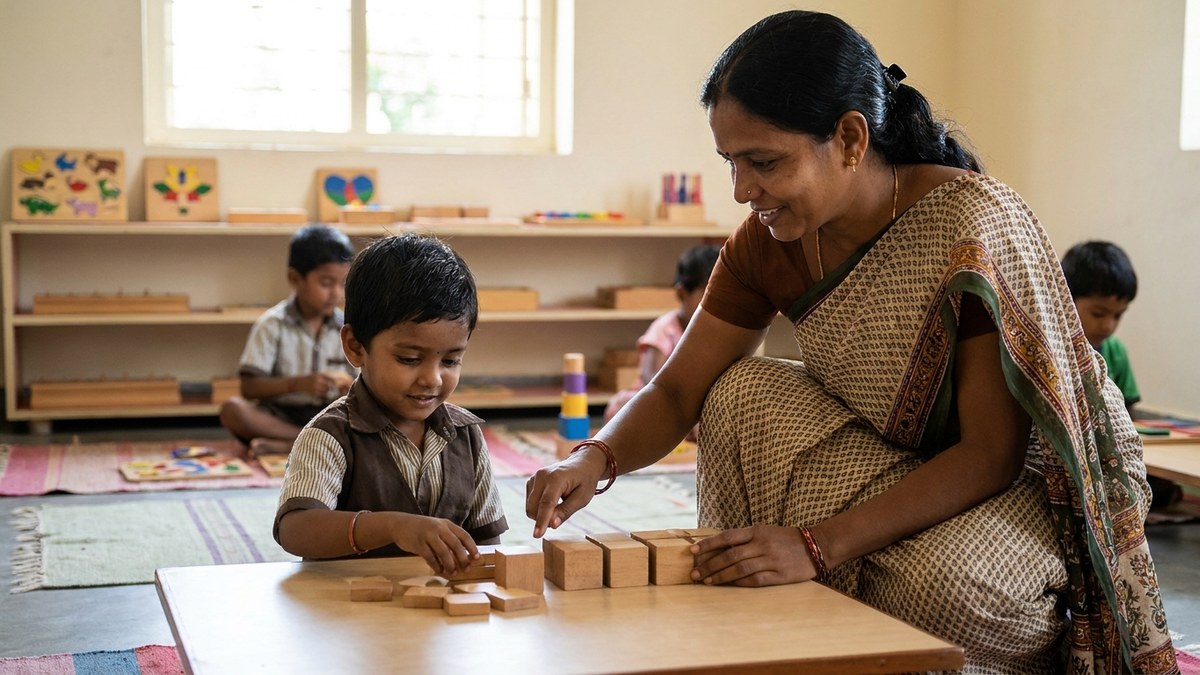
Fifth, train yourself. Whether you’re a homemaker, senior citizen, tuition teacher, or edupreneur, understanding the Montessori method properly matters. A nursery teacher training course fees and structured programs help you move beyond surface-level understanding. You can also explore special education teacher course in India to understand how Montessori principles support diverse learners.
Sixth, invest in the right tools. If you’re building a POD (Point of Digital Learning) or a home learning space, you need reliable technology. Educational software, video resources, and online materials support Montessori learning. An APNA PC bundle gives you everything: education software, a mini PC with solid specifications (i3 7th Gen, 8GB RAM, 128GB SSD), monitor, keyboard, mouse, webcam, and headset. Complete setup. Three-year warranty. Installation included. Rs.30,000 for the entire package. One investment that enables you to deliver quality Montessori education in your home or community learning centre.
Starting Your Montessori Journey Today
The Montessori method of teaching isn’t a luxury for wealthy families in metro cities. It’s a practical, proven approach that works in Indian homes, tuition centres, and community spaces. It respects the child. It respects the teacher. It produces independent, thoughtful, capable learners.
You don’t need permission to start. You need clarity and commitment. Begin small. Observe. Prepare. Trust the process. Your children, students, or community members will respond.
Ready to set up a proper learning space? Get APNA PC today and equip your POD with professional-grade technology. For more context on how education is evolving in India, check out education in India and official guidelines from the Ministry of Education.