Your Child’s Digital Learning Progress Is Invisible to You Right Now
Here’s the truth: Most Indian parents have no idea what their children actually learn during online classes. You see them sitting at the computer. You assume they’re studying. But what’s really happening on that screen? How much are they actually retaining? Are they just scrolling? The gap between what you think is happening and what’s actually happening is massive.
This is exactly why tracking your child’s digital learning progress has become non-negotiable. Not optional. Not nice-to-have. Essential. Whether your child attends a traditional school or learns through a Point of Digital Learning (POD) at home or a community centre, you need real visibility into their progress.
Let’s be honest: guessing doesn’t work anymore.
Why Parents Miss the Real Picture of Digital Learning
When your child attended physical school, you got report cards. You met teachers face-to-face. You could see their notebooks. Digital education stripped away all these touchpoints. Now you’re left wondering.
Most online platforms show activity logs. That’s not progress. That’s just proof they logged in. Your child could have watched the same video five times without understanding a single concept. The platform doesn’t tell you that.
This is where monitoring kids computer learning becomes different from traditional progress tracking. You’re not just looking at grades. You’re looking at:
- Time spent on each topic (not just total screen time)
- Quiz scores and where they got stuck
- Videos watched versus videos completed
- Assignments submitted and the quality of work
- Weak areas that need intervention
- Pace of learning compared to curriculum benchmarks
Without this data, you’re flying blind. Your child could be falling behind in mathematics while excelling in languages, and you wouldn’t know for weeks.
The Four Things You Must Track
Not all metrics matter equally. Stop drowning in data. Focus on these four things:
1. Concept Mastery – Did your child actually understand the topic or just complete it? Look for quiz scores above 75%. If they’re scoring 45%, they haven’t mastered it yet. Period.
2. Consistency – Digital learning requires discipline. Is your child showing up regularly? Are they learning at the same pace each week or is there a pattern of procrastination followed by cramming?
3. Engagement Depth – Surface-level engagement is useless. Are they taking notes while watching videos? Are they attempting practice problems? Or are they just clicking through?
4. Personalized Weak Spots – Every child struggles with different topics. Some kids hate word problems. Others freeze with grammar rules. Once you identify these weak spots through digital education tracking India platforms, you can address them immediately instead of waiting for the next exam.
Most parents track only grades. That’s backwards. Grades are the result. You need to track the process.
How to Actually Monitor Your Child’s Learning at Home
Here’s what works. Set up a simple system:
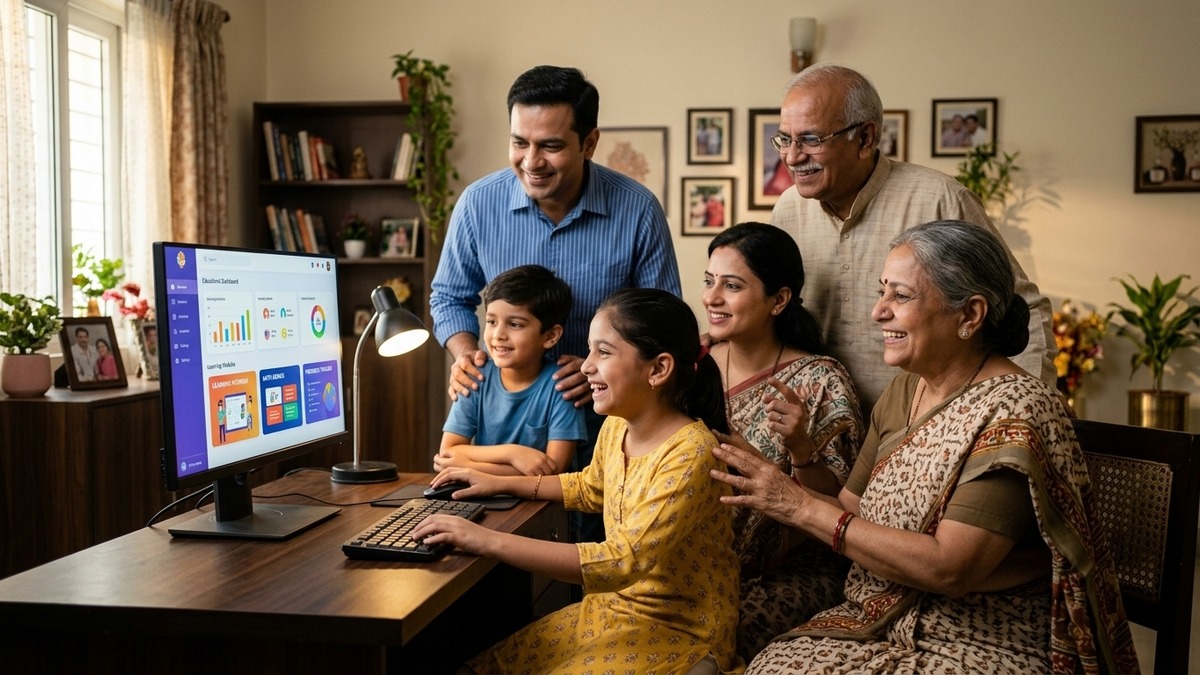
Daily Check-in (5 minutes): Ask your child what they learned today. Not “Did you study?” Ask specific questions based on the dashboard. “I see you scored 68% on the fractions quiz. What tripped you up?” This shows you’re paying attention and helps them reflect.
Weekly Review (15 minutes): Sit down with the digital progress report. Most education software now offers parent dashboards. Use them. Look for patterns. Is your child consistent? Are they struggling in specific subjects?
Monthly Conversation with Educator: If your child learns at a POD or with a trained educator, ask them to walk you through the progress data. What are they seeing? What interventions are they planning? A good educator welcomes this conversation.
You don’t need fancy tools for this. But you do need the right infrastructure. A proper computer setup with reliable education software makes this possible. This is where APNA PC comes in. The complete bundle gives you a dedicated learning device with built-in education software that tracks everything. Rs.30,000 for a complete setup including 3-year warranty, installation, and the hardware itself. No confusion about which software to buy separately. No compatibility issues. Just plug it in and start monitoring.
The Real Benefit: Early Intervention
Most parents discover their child is struggling only during exams. By then, it’s too late to fix anything meaningful. Digital education tracking India systems flip this around. You catch problems in week two, not week twelve.
Your daughter scores 52% on algebra. You see it immediately. You can spend extra time with her that weekend. You can reach out to her educator. You can explore the best AI tools for students that help visualize algebra concepts. The intervention happens while there’s still time to recover.
This early visibility is worth more than any report card.
Most people don’t realise that a safe digital learning space also includes transparent tracking. Your child learns better when they know progress is visible. It creates healthy accountability without being oppressive.
Check what official frameworks say about this. The India Ministry of Education emphasizes continuous assessment as a key component of learning. Digital tracking is how you implement continuous assessment at home. It aligns with what education experts recommend, not against it.
Start Today, Not Tomorrow
Your child’s digital learning progress won’t track itself. You need to be intentional about it. You need the right setup. You need the right mindset.
If you’re running a learning centre or thinking about starting one, this matters even more. Your students’ parents will demand to see progress. You need systems that show it clearly. This is how you build trust and retain families.
Stop assuming everything is fine. Stop waiting for report cards. Start tracking now. Set up APNA PC with its complete education software bundle. Commit to those weekly 15-minute reviews. Watch how quickly you’ll spot where your child needs help.
Your child’s learning journey deserves better than guesswork.
Ready to build a proper digital learning environment? Start a TeachToEarn Learning Pod today.