
What Is Vedic Maths and Why Your Kids Need It Now
Your child spends 45 minutes on a single multiplication problem while a classmate finishes it in 30 seconds. That is not genius. That is vedic maths classes at work. Vedic maths is an ancient Indian system of mathematics built on 16 sutras, or word formulas, that turn long calculations into mental shortcuts. Most people don’t realise these techniques work for primary school kids right through to competitive exam takers. The vedic maths tricks are not magic. They are logic, and they have survived for centuries because they work.
Here’s the truth: vedic maths for kids builds number sense faster than traditional drill. Kids stop memorising and start understanding. Parents enrol their children in vedic maths classes because they see the change within weeks. Speed improves. Confidence grows. Fear of maths quietly disappears.
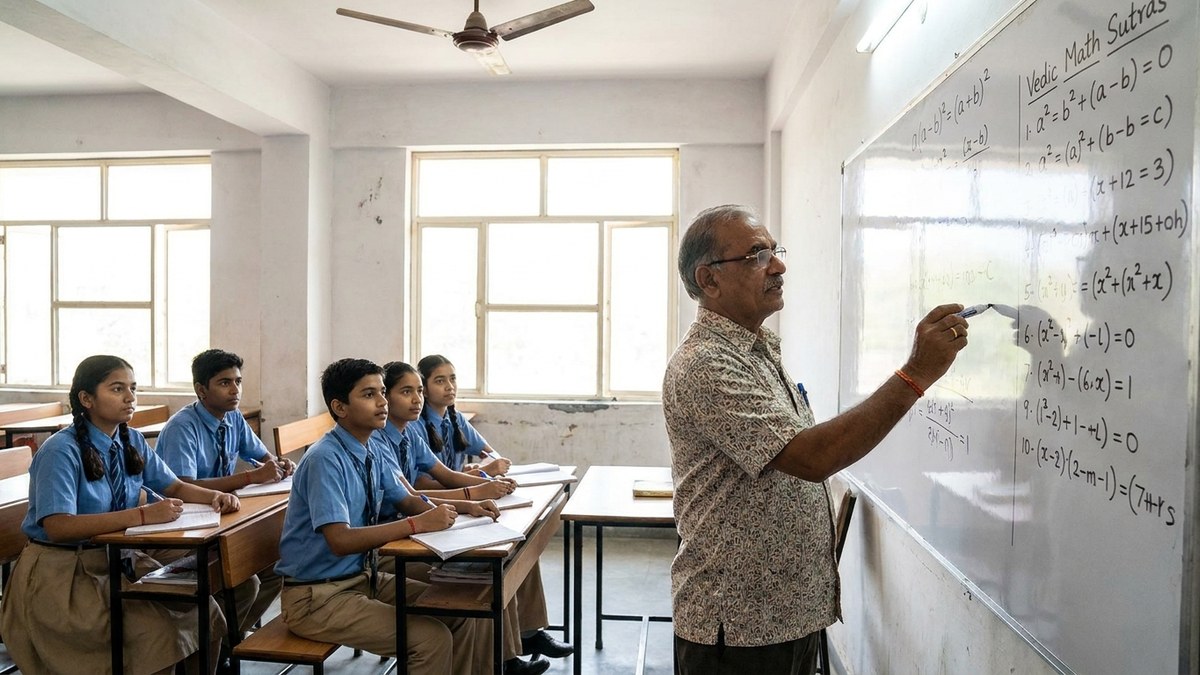
The 16 Sutras of Vedic Maths Explained Simply
These are the core formulas. Each one is a one-line rule that solves a whole family of problems.
- Ekadhikena Purvena: By one more than the previous one.
- Nikhilam Navatashcaramam Dashatah: All from nine and the last from ten.
- Urdhva Tiryagbhyam: Vertically and crosswise.
- Paraavartya Yojayet: Transpose and apply.
- Shunyam Saamyasamuccaye: When the sum is the same, that sum is zero.
- Anurupye Shunyamanyat: If one is in ratio, the other is zero.
- Sankalana Vyavakalanabhyam: By addition and by subtraction.
- Puranapuranabyham: By the completion or non-completion.
- Chalana Kalanabyham: Differences and similarities.
- Yaavadunam Tavadunikritya Varga Yojayet: Whatever the deficiency, lessen it further and square.
- Vyashtisamanstih: Part and whole.
- Shesanyankena Charamena: The remainders by the last digit.
- Sopantyadvayamantyam: The ultimate and twice the penultimate.
- Ekanyunena Purvena: By one less than the previous one.
- Gunitasamuchyah: The product of the sum is equal to the sum of the products.
- Gunakasamuchyah: The factors of the sum are equal to the sum of the factors.
5 Concrete Vedic Maths Tricks With Worked Examples
Read these with a pencil in hand, then close the page and repeat each step from memory.
1. Multiply any two-digit number by 11
Take 23 x 11. Write the first digit, add the two digits, then write the last digit. 2, then 2+3=5, then 3. Answer: 253. Now 47 x 11. Write 4, add 4+7=11 so carry the 1, then write 7. Answer: 517. Your child can do this in the head in five seconds, and the same trick handles three-digit numbers.
2. Subtract from a power of ten using Nikhilam
Subtract 287 from 1000. Take each digit of 287 and subtract from nine, except the last digit, which comes from ten. Nine minus 2 is 7. Nine minus 8 is 1. Ten minus 7 is 3. Answer: 713. No borrowing. No confusion. Just a rule applied three times.
3. Square any number ending in 5
Square 25. Take the digit before the 5, which is 2, and add one: 2+1=3. Multiply the two: 2 x 3 = 6. Then write 25 at the end. Answer: 625. Try 35 squared. Take 3, add one to get 4, multiply 3 x 4 = 12, then write 25. Answer: 1225. It works every single time.
4. Multiply two-digit numbers vertically and crosswise
Multiply 23 x 14. Vertically on the right: 3 x 4 = 12, write 2 and carry 1. Crosswise and add: (2 x 4) + (3 x 1) = 11, plus the carry gives 12, write 2 and carry 1. Vertically on the left: 2 x 1 = 2, plus the carry gives 3. Answer: 322. Check on paper: 23 x 14 = 322.
5. Check any answer with a digital root
Add the digits of a number until one digit remains. For 23: 2+3=5. For 14: 1+4=5. For the answer 322: 3+2+2=7. Since 5 x 5 = 25 and 2+5=7, the answer checks out. This single habit catches careless mistakes before the exam does.
Why Parents Enrol Kids in Vedic Maths Classes
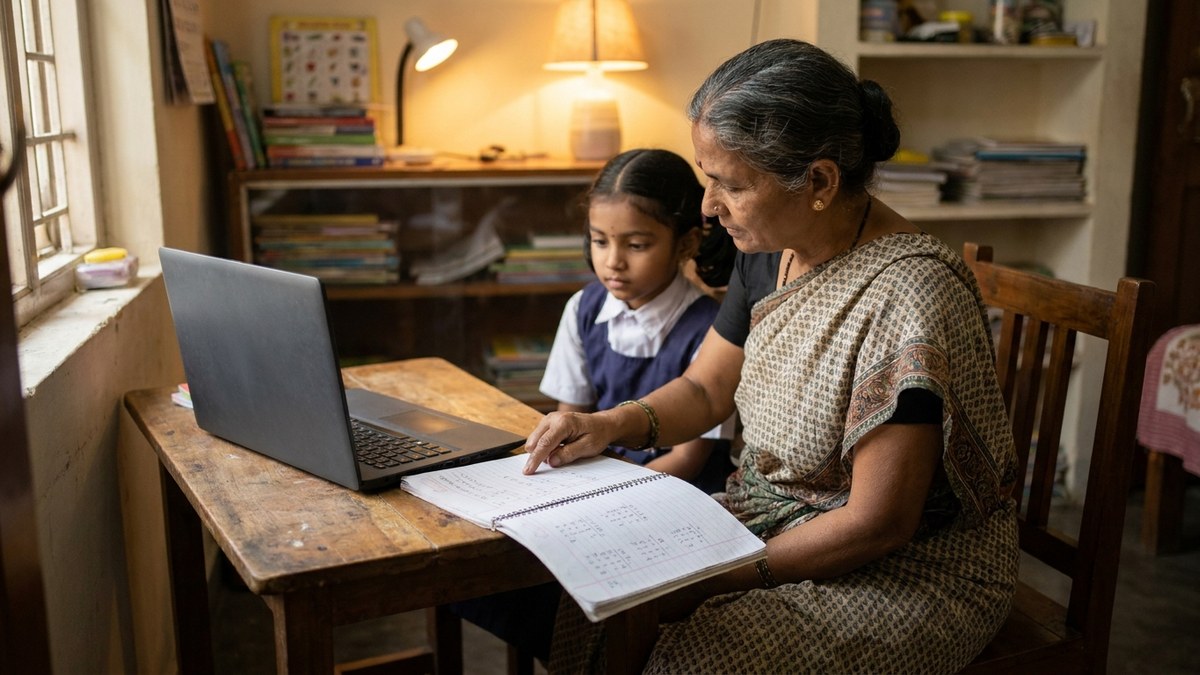
Let’s be honest: traditional maths teaching is slow. Kids memorise procedures without understanding why they work, then panic the moment a question changes shape. Vedic maths flips that order. The child sees the pattern first, owns the logic, and stops being afraid of numbers.
Parents want higher marks, more questions attempted, and a child who feels capable. These classes deliver all three, and most kids show visible improvement within a few months.
The Central Board of Secondary Education treats vedic maths as a legitimate supplementary approach, but no board mandates it in the curriculum. That gap is exactly why families search for vedic maths classes online or find a teacher nearby. Schools move at the speed of the syllabus. A good tutor moves at the speed of the child.
Running Vedic Maths Classes From Home: A Path for Homemakers and Tuition Teachers
You do not need an institute, a licence, or a building. You need a system, some training, and one working device.
Start a Point of Digital Learning (POD) from your home or a community room. Take 8 to 12 kids per batch. Teach the sutras two or three times a week. Charge Rs.1,500 to Rs.2,500 per child per month. One full batch can bring in Rs.1,20,000 to Rs.3,00,000 a year, and a second batch simply doubles it. Homemakers can run this. Senior citizens can run this. Working tuition teachers can add it to what they already offer.
The equipment matters more than people admit. APNA PC gives you the whole setup in one order: education software, a Mini PC (i3 7th Gen, 8GB RAM, 128GB SSD), monitor, keyboard, mouse, webcam and headset, plus installation and a three-year warranty for Rs.30,000. In many batches that one-time cost is recovered inside the first month. Teach in person or run live online sessions, record them, reuse them, and build a waiting list instead of chasing students.
Before you take a student, fix your own study habits, because kids copy what they see. Read this guide on how to take notes in class and turn it into a one-page handout for your batch. If you want the full model, start a Teach to Earn learning POD and follow a setup that already works.
The Biggest Mistake Parents Make
They push speed over understanding. They want 100 problems solved in 10 minutes, and they measure progress by the clock. Vedic maths classes should prioritise accuracy and logic first, because speed is the by-product, not the goal. A child who understands why 25 squared is 625 will still remember it in two years. A child who memorised the answer will not.
The Ministry of Education has pushed conceptual clarity in school maths for years, and vedic maths fits that goal neatly. It also complements school work instead of replacing it. Your child still has to understand the topics that decide their marks under the grading system in India. Treat vedic maths as the accelerator, not the engine.
The second mistake is passive learning. Kids must write each sutra and each step by hand. Listening feels like learning but leaves nothing behind.